Ch. 3 - Radian Measure and The Unit Circle
Lial - Trigonometry 12th Edition
Lial12th EditionTrigonometryISBN: 9780136552161Not the one you use?Change textbook
Chapter 4, Problem 77

Find each exact function value. See Example 3.
sin 5π/6

Verified step by step guidance
1
Identify the angle given: \(\frac{5\pi}{6}\). This angle is in radians and is located in the second quadrant of the unit circle because it is between \(\pi/2\) and \(\pi\).
Recall that the sine function in the second quadrant is positive, so \(\sin \theta\) will be positive for \(\theta = \frac{5\pi}{6}\).
Use the reference angle to find the sine value. The reference angle for \(\frac{5\pi}{6}\) is \(\pi - \frac{5\pi}{6} = \frac{\pi}{6}\).
Recall the exact value of \(\sin \frac{\pi}{6}\), which is a commonly known special angle: \(\sin \frac{\pi}{6} = \frac{1}{2}\).
Since sine is positive in the second quadrant, \(\sin \frac{5\pi}{6} = \sin \frac{\pi}{6} = \frac{1}{2}\).

Verified video answer for a similar problem:

This video solution was recommended by our tutors as helpful for the problem above.
Was this helpful?

Key Concepts

Here are the essential concepts you must grasp in order to answer the question correctly.

Unit Circle and Radian Measure

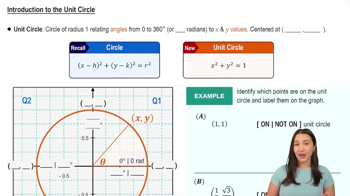
The unit circle is a circle with radius 1 centered at the origin of the coordinate plane. Angles measured in radians correspond to points on this circle, where the angle's measure represents the length of the arc subtended. Understanding how to locate angles like 5π/6 on the unit circle is essential for finding exact trigonometric values.
Recommended video:
06:11
Introduction to the Unit Circle

Sine Function on the Unit Circle

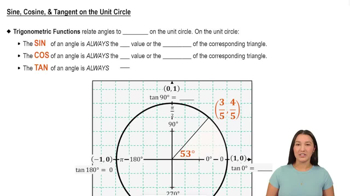
The sine of an angle in the unit circle is the y-coordinate of the corresponding point on the circle. For angles in different quadrants, sine values can be positive or negative. Knowing the sine values for common angles such as π/6, π/4, and π/3 helps in determining exact values for related angles like 5π/6.
Recommended video:
6:34
Sine, Cosine, & Tangent on the Unit Circle

Reference Angles and Symmetry

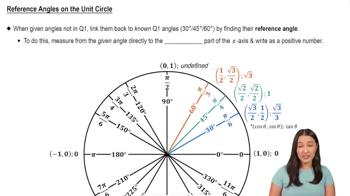
Reference angles are the acute angles formed between the terminal side of an angle and the x-axis. They help simplify finding trigonometric values by relating them to known angles in the first quadrant. For 5π/6, the reference angle is π/6, and using symmetry properties of the unit circle allows determination of the sine value's sign and magnitude.
Recommended video:
5:31
Reference Angles on the Unit Circle