Ch. R - Algebra Review
Lial - Trigonometry 12th Edition
Lial12th EditionTrigonometryISBN: 9780136552161Not the one you use?Change textbook
Chapter 1, Problem 89

Add or subtract, as indicated. See Example 6. √6 + √6

Verified step by step guidance
1
Identify the terms to be added: both are \( \sqrt{6} \). Since they are like terms (same radical part), you can combine them by adding their coefficients.
Rewrite each term with an explicit coefficient: \( 1 \times \sqrt{6} + 1 \times \sqrt{6} \).
Add the coefficients: \( 1 + 1 = 2 \).
Multiply the sum of the coefficients by the common radical: \( 2 \times \sqrt{6} \).
Write the final expression as \( 2\sqrt{6} \), which is the simplified form of the sum.

Verified video answer for a similar problem:

This video solution was recommended by our tutors as helpful for the problem above.
Video duration:
1m
Was this helpful?

Key Concepts

Here are the essential concepts you must grasp in order to answer the question correctly.

Like Terms in Radicals

Radical expressions can be added or subtracted only if they have the same radicand (the number inside the root). For example, √6 and √6 are like terms because both have the radicand 6, allowing their coefficients to be combined.
Recommended video:
3:42
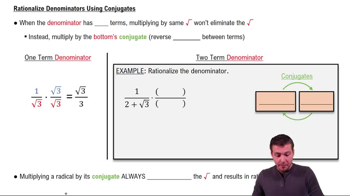
Rationalizing Denominators Using Conjugates

Simplifying Radicals

Before adding or subtracting radicals, it is important to simplify them if possible. Simplifying involves factoring the radicand to extract perfect squares, which can make combining terms easier or reveal like terms.
Recommended video:
6:36
Simplifying Trig Expressions

Combining Coefficients

When adding or subtracting like radicals, treat the radicals as variables and combine their coefficients. For example, √6 + √6 equals 2√6 because the coefficients 1 and 1 add up to 2.
Recommended video:
5:35
Introduction to Quadratic Equations