Solve each equation for exact solutions. sin⁻¹ x - tan⁻¹ 1 = -π/4
Verified step by step guidance
1
Recognize that the equation is given as \(\sin^{-1} x - \tan^{-1} 1 = -\frac{\pi}{4}\), where \(\sin^{-1} x\) and \(\tan^{-1} 1\) are inverse trigonometric functions (arcsine and arctangent respectively).
Recall the exact value of \(\tan^{-1} 1\). Since \(\tan \frac{\pi}{4} = 1\), it follows that \(\tan^{-1} 1 = \frac{\pi}{4}\).
Substitute \(\tan^{-1} 1 = \frac{\pi}{4}\) into the equation to get \(\sin^{-1} x - \frac{\pi}{4} = -\frac{\pi}{4}\).
Add \(\frac{\pi}{4}\) to both sides to isolate \(\sin^{-1} x\): \(\sin^{-1} x = -\frac{\pi}{4} + \frac{\pi}{4} = 0\).
Use the definition of the inverse sine function to solve for \(x\): since \(\sin^{-1} x = 0\), then \(x = \sin 0\). Recall that \(\sin 0 = 0\), so \(x = 0\).
Verified video answer for a similar problem:
This video solution was recommended by our tutors as helpful for the problem above
Play a video:
0 Comments
Key Concepts
Here are the essential concepts you must grasp in order to answer the question correctly.
Inverse Trigonometric Functions
Inverse trigonometric functions, such as sin⁻¹ (arcsin) and tan⁻¹ (arctan), return the angle whose sine or tangent is a given value. Understanding their domains and ranges is essential for solving equations involving these functions and finding exact angle measures.
The arctangent function, tan⁻¹(x), outputs angles in the interval (-π/2, π/2). Knowing specific values, like tan⁻¹(1) = π/4, helps simplify expressions and solve equations involving inverse tangent terms.
Solving trigonometric equations involves isolating the inverse trig functions and using known exact values or identities. This process often requires manipulating the equation to express one inverse function in terms of another and applying angle addition or subtraction formulas.

 Verified step by step guidance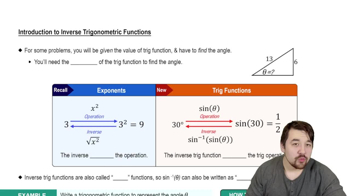
 4:28
4:28