Graph each function. See Examples 1 and 2.ƒ(x) = -3|x|
Verified step by step guidance
1
Identify the basic function: The function \( f(x) = |x| \) is the absolute value function, which is V-shaped and symmetric about the y-axis.
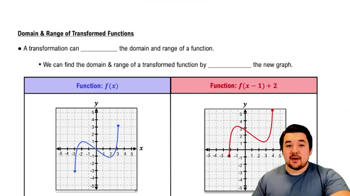
Understand the transformation: The function \( f(x) = -3|x| \) involves two transformations: a vertical stretch by a factor of 3 and a reflection across the x-axis.
Apply the vertical stretch: Multiply the output of the basic absolute value function by 3, which makes the V-shape steeper.
Apply the reflection: Reflect the graph across the x-axis, which inverts the V-shape, opening downwards.
Plot key points: Start by plotting the vertex at the origin (0,0) and additional points such as (1,-3) and (-1,-3) to guide the shape of the graph.
Verified video answer for a similar problem:
This video solution was recommended by our tutors as helpful for the problem above
Video duration:
6m
Play a video:
0 Comments
Key Concepts
Here are the essential concepts you must grasp in order to answer the question correctly.
Absolute Value Function
The absolute value function, denoted as |x|, outputs the non-negative value of x regardless of its sign. This means that for any real number x, |x| is equal to x if x is positive or zero, and -x if x is negative. Understanding this function is crucial for graphing, as it creates a V-shaped graph that opens upwards.
Evaluate Composite Functions - Values Not on Unit Circle
Transformation of Functions
Transformations involve altering the basic shape of a function through shifts, stretches, compressions, or reflections. In the case of ƒ(x) = -3|x|, the negative sign indicates a reflection over the x-axis, while the coefficient -3 indicates a vertical stretch by a factor of 3. Recognizing these transformations helps in accurately sketching the graph.
Graphing techniques involve plotting points and understanding the behavior of functions to create accurate visual representations. For ƒ(x) = -3|x|, one would start by plotting key points, such as (0,0), (1,-3), and (-1,-3), and then connect these points while considering the function's symmetry and transformations. Mastery of these techniques is essential for effectively visualizing functions.

 6:15 minutes
 Verified step by step guidance
 7:28
7:28