10. Parametric Equations
Graphing Parametric Equations

 4:25 minutes
Problem 39
Textbook Question
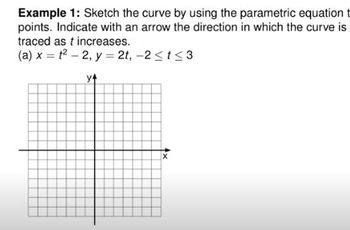
Textbook QuestionIn Exercises 21–40, eliminate the parameter t. Then use the rectangular equation to sketch the plane curve represented by the given parametric equations. Use arrows to show the orientation of the curve corresponding to increasing values of t. (If an interval for t is not specified, assume that −∞ < t < ∞. x = 2ᵗ, y = 2⁻ᵗ; t ≥ 0
 Verified Solution
This video solution was recommended by our tutors as helpful for the problem above

Video duration:
4mWas this helpful?
Key Concepts
Here are the essential concepts you must grasp in order to answer the question correctly.
Parametric Equations
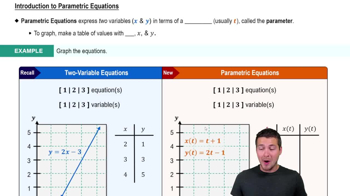
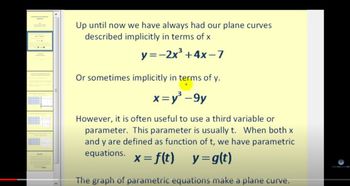
Parametric equations express the coordinates of points on a curve as functions of a variable, typically denoted as 't'. In this case, x and y are defined in terms of t, allowing for the representation of complex curves that may not be easily described by a single equation. Understanding how to manipulate these equations is essential for eliminating the parameter and finding a rectangular equation.
Recommended video:
 08:02
08:02
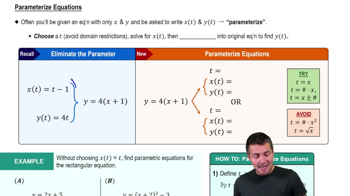
Parameterizing Equations
Eliminating the Parameter
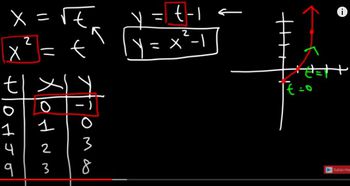
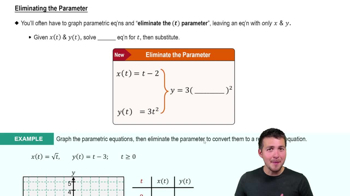
Eliminating the parameter involves finding a relationship between x and y that does not include the variable t. This is typically done by solving one of the parametric equations for t and substituting it into the other equation. This process transforms the parametric equations into a rectangular equation, which can then be analyzed and graphed more easily.
Recommended video:
 05:59
05:59Eliminating the Parameter
Graphing Rectangular Equations
Graphing rectangular equations involves plotting the relationship between x and y on a Cartesian plane. Understanding the shape and orientation of the curve is crucial, especially when indicating the direction of the curve as t increases. This requires knowledge of how to interpret the resulting equation and how to represent it visually, including the use of arrows to indicate the direction of increasing t.
Recommended video:
 6:50
6:50Convert Equations from Polar to Rectangular
4:47mWatch next
Master Introduction to Parametric Equations with a bite sized video explanation from Patrick Ford
Start learning