Skip to main content
Physics
My Course
Learn
Exam Prep
AI Tutor
Study Guides
Textbook Solutions
Flashcards
Explore
My Course
Learn
Exam Prep
AI Tutor
Study Guides
Textbook Solutions
Flashcards
Explore
Back
The Doppler Effect definitions
2 students found this helpful
You can tap to flip the card.
Doppler Effect
You can tap to
flip the card.
👆
Doppler Effect
Change in frequency of sound due to relative motion between source and listener.
Track progress
Control buttons has been changed to "navigation" mode.
1/15
Related practice
Recommended videos
Guided course
07:40
The Doppler Effect
Patrick
4308
views
78
rank
2
comments
Terms in this set (15)
Hide definitions
Doppler Effect
Change in frequency of sound due to relative motion between source and listener.
Frequency
Number of sound waves passing a point per second, measured in Hertz (Hz).
Sound Source
Object emitting sound waves, such as a siren or speaker.
Listener
Person or device receiving sound waves from a source.
Velocity
Speed of an object in a specific direction, crucial in Doppler calculations.
Speed of Sound
Constant speed at which sound waves travel, approximately 343 m/s in air.
Doppler Shift
Change in observed frequency due to motion of source or listener.
Relative Motion
Movement of source and listener towards or away from each other.
Hertz
Unit of frequency, representing one cycle per second.
Equation
Mathematical representation of the Doppler effect: FL = (v + vL) / (v + vS) * FS.
Positive Direction
Convention in Doppler problems, from listener to source.
Stationary
State of an object not in motion, affecting Doppler calculations.
Pitch
Perceived frequency of a sound, higher when source approaches.
Wave
Disturbance that transfers energy through a medium, like sound.
Vector
Quantity with both magnitude and direction, such as velocity.
 Back
Back
 Back
Back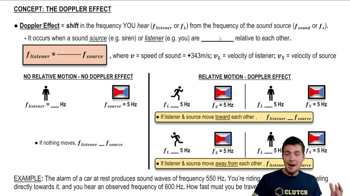
 07:40
07:40
