Join thousands of students who trust us to help them ace their exams!
Multiple Choice
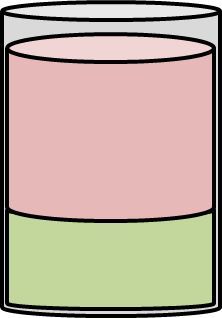
A tall cylindrical beaker 10 cm in radius is placed on a picnic table outside. You pour 5 L of an 8,000 kg/m3 liquid and 10 L of a 6,000 kg/m3 liquid into. Calculate the total pressure at the bottom of the beaker. (Use g=10 m/s2.)
A
3.20×10⁴
B
3.52×10⁴
C
1.33×10⁵
D
1.36×10⁵
2 Comments
Verified step by step guidance
1
First, calculate the volume of each liquid in cubic meters. Since 1 L = 0.001 m³, the volume of the first liquid is 5 L = 0.005 m³ and the volume of the second liquid is 10 L = 0.010 m³.
Next, calculate the mass of each liquid using the formula: mass = density × volume. For the first liquid, mass = 8000 kg/m³ × 0.005 m³. For the second liquid, mass = 6000 kg/m³ × 0.010 m³.
Determine the total height of the liquid column in the beaker. The beaker has a radius of 10 cm, which is 0.1 m. Use the formula for the volume of a cylinder: volume = π × radius² × height. Rearrange to find height: height = volume / (π × radius²). Calculate the height for each liquid separately and add them together.
Calculate the pressure at the bottom of the beaker using the formula: pressure = (density × g × height). Calculate the pressure contribution from each liquid separately and then add them together to find the total pressure at the bottom of the beaker.
Finally, add the atmospheric pressure to the calculated pressure at the bottom of the beaker, if required. In this problem, we assume the beaker is open to the atmosphere, so atmospheric pressure should be considered if not already included in the options.


 Verified step by step guidance

