Textbook QuestionThe position of a particle as a function of time is given by r→\(\overrightarrow{r}\) = ( 5.0î +4.0ĵ )t² m where t is in seconds. What is the particle's speed at t = 0, 2, and 5 s?1991views
Textbook QuestionThe position of a particle as a function of time is given by r→\(\overrightarrow{r}\) = ( 5.0î +4.0ĵ )t² m where t is in seconds. Find an expression for the particle's velocity v→\(\overrightarrow{v}\) as a function of time.2682views
Textbook QuestionThe position of a particle as a function of time is given by r→\(\overrightarrow{r}\) = ( 5.0î +4.0ĵ )t² m where t is in seconds. What is the particle's distance from the origin at t = 0, 2, and 5 s?1809views
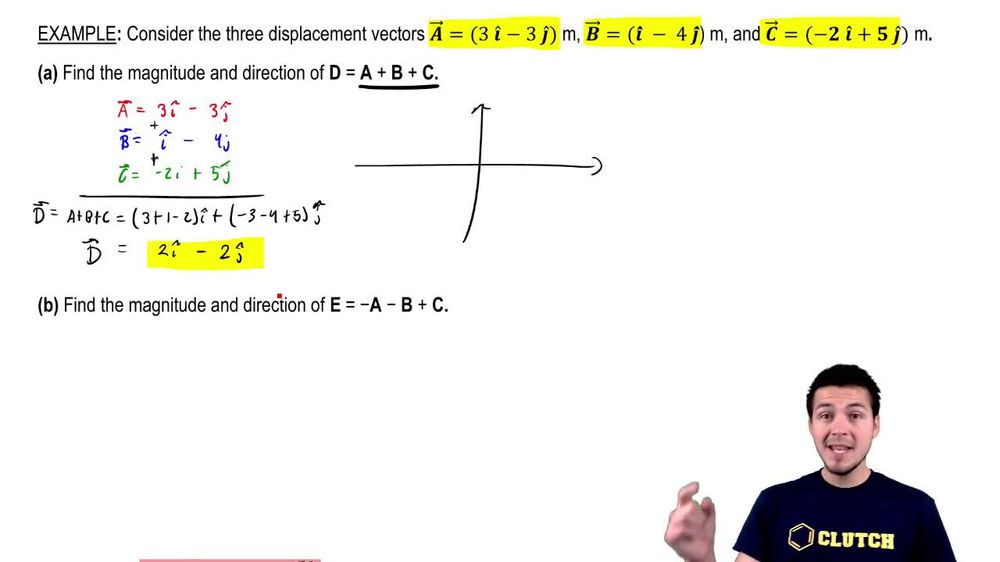
Open Question(II) Let V₁ (→ above V₁) = ― 6.0 î + 8.0 ĵ and V₂ (→ above V₂) = ― 4.5 î ― 5.0 ĵ. Determine the magnitude and direction of(c) V₁ (→ above V₁) + V₂ (→ above V₂), and1312views
Textbook QuestionFIGURE EX3.19 shows vectors A and B. What is C = A + B? Write your answer in component form using unit vectors.2004views1rank
Textbook QuestionLet V⃗1=−6.0i^+8.0j^\(\vec{V}\)_1 = -6.0\(\hat{i}\) + 8.0\(\hat{j}\) and V⃗2=−4.5i^−5.0j^\(\vec{V}\)_2 = -4.5\(\hat{i}\) - 5.0\(\hat{j}\). Determine the magnitude and direction of V⃗1+V⃗2\(\vec{V}\)_1 + \(\vec{V}\)_2.1390views
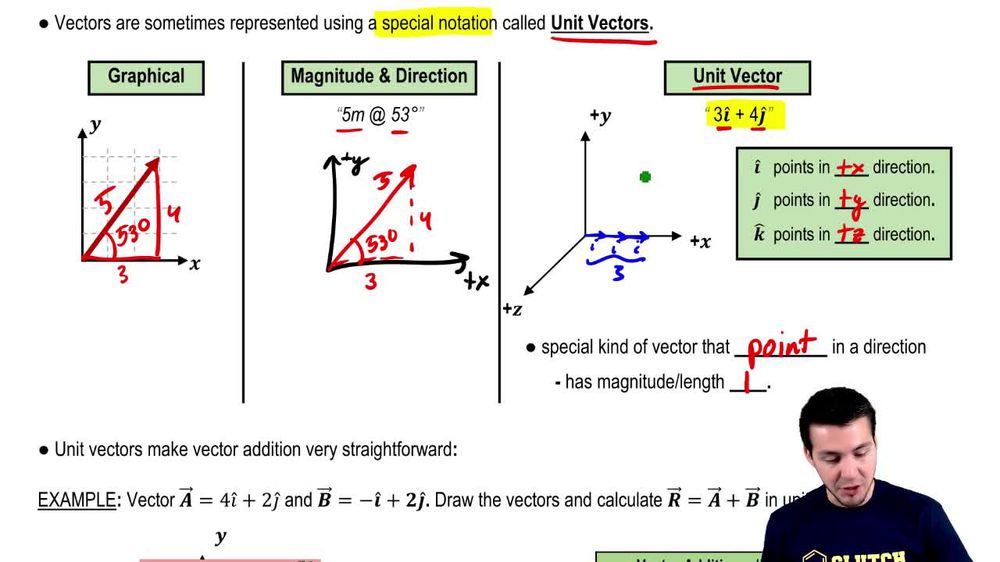
Multiple ChoiceWhich of the following correctly expresses the vector b using unit vectors in Cartesian coordinates?83views