Helmholtz coils are two identical circular coils having the same radius 𝑅 and the same number of turns N, separated by a distance equal to the radius 𝑅 and carrying the same dc current I in the same direction. (See Fig. 28–61.) They are used in scientific instruments to generate nearly uniform magnetic fields. (They can be seen in the photo, Fig. 27–19.) (a) Determine the magnetic field B at points 𝓍 along the line joining their centers. Let 𝓍 = 0 at the center of one coil, and 𝓍 = 𝑅 at the center of the other. (b) Show that the field midway between the coils is particularly uniform by showing that dB/d𝓍 = 0 and d²B/d𝓍² = 0 at the midpoint between the coils. (c) If 𝑅 = 10.0 cm, N = 85 turns and I = 3.0 A, what is the field at the midpoint between the coils, 𝓍 = 𝑅/2?
Verified step by step guidance
1
Step 1: Begin by understanding the setup of Helmholtz coils. These are two identical circular coils separated by a distance equal to their radius R, carrying the same current I in the same direction. The goal is to calculate the magnetic field B along the axis joining their centers, and analyze its uniformity at the midpoint.
Step 2: Use the Biot-Savart law to derive the magnetic field produced by a single coil at a point along its axis. The magnetic field at a distance x from the center of a single coil is given by: . Here, μ₀ is the permeability of free space, N is the number of turns, I is the current, R is the radius, and x is the distance from the coil center.
Step 3: For Helmholtz coils, the total magnetic field at a point x along the axis is the sum of the fields produced by both coils. Let the first coil be centered at x = 0 and the second coil at x = R. The total field is: , where B₁(x) and B₂(x) are the fields from the first and second coils respectively.
Step 4: To analyze the uniformity of the field at the midpoint (x = R/2), calculate the first derivative dB/dx and the second derivative d²B/dx² of the total field B with respect to x. Show that both derivatives are zero at x = R/2, indicating that the field is particularly uniform at this point.
Step 5: Finally, substitute the given values (R = 10.0 cm, N = 85 turns, I = 3.0 A) into the formula for B at x = R/2 to calculate the magnetic field at the midpoint. Use the derived expression for B and ensure all units are consistent (e.g., convert cm to meters for calculations).
Verified video answer for a similar problem:
This video solution was recommended by our tutors as helpful for the problem above
Video duration:
7m
Play a video:
0 Comments
Key Concepts
Here are the essential concepts you must grasp in order to answer the question correctly.
Magnetic Field of a Coil
The magnetic field generated by a circular coil of wire is determined by the current flowing through it and the number of turns in the coil. The magnetic field at the center of a single loop is given by the formula B = (μ₀ * I) / (2 * R), where μ₀ is the permeability of free space, I is the current, and R is the radius of the coil. For Helmholtz coils, the configuration allows for the superposition of the magnetic fields from both coils, leading to a more uniform field in the region between them.
Superposition Principle
The superposition principle states that when two or more magnetic fields overlap, the resultant field at any point is the vector sum of the individual fields. In the case of Helmholtz coils, the magnetic fields produced by each coil at a point along the axis can be added together to find the total magnetic field. This principle is crucial for analyzing the field strength and uniformity between the coils.
Uniform Magnetic Field
A uniform magnetic field is one where the magnetic field strength is constant in magnitude and direction throughout a specified region. For Helmholtz coils, the design aims to create a uniform field between the coils, particularly at the midpoint. This uniformity can be mathematically verified by showing that the first derivative of the magnetic field with respect to position is zero (dB/dx = 0) and that the second derivative is also zero (d²B/dx² = 0) at that point, indicating no change in field strength.


 7:27 minutes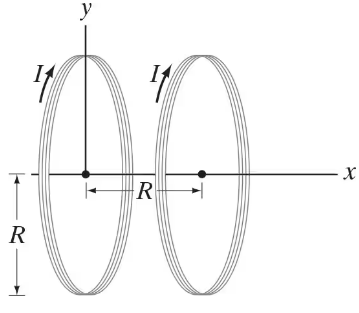
 Verified step by step guidance