What are the taxonomic challenges in classifying euglenids?
Verified step by step guidance
1
Understand that euglenids are a group of protists that exhibit characteristics of both plants and animals, which complicates their classification.
Recognize that traditional taxonomy relies heavily on morphological traits, but euglenids have a mix of features such as photosynthetic ability (like plants) and motility (like animals), making morphological classification difficult.
Consider the molecular and genetic data, which sometimes place euglenids in different groups depending on the genes analyzed, leading to conflicting phylogenetic trees.
Acknowledge that the presence of secondary endosymbiosis (where euglenids acquired chloroplasts from green algae) adds complexity to their evolutionary history and classification.
Note that these factors result in taxonomic challenges such as unclear evolutionary relationships, debates over their placement in kingdoms or domains, and difficulties in defining clear taxonomic boundaries.
Verified video answer for a similar problem:
This video solution was recommended by our tutors as helpful for the problem above
Video duration:
2m
Play a video:
0 Comments
Key Concepts
Here are the essential concepts you must grasp in order to answer the question correctly.
Taxonomy and Classification Systems
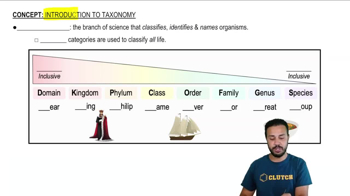
Taxonomy is the science of naming, describing, and classifying organisms based on shared characteristics. Classification systems organize organisms into hierarchical groups such as domain, kingdom, phylum, and so on. Understanding these systems is essential to grasp how euglenids fit into broader biological categories.
Euglenids exhibit a wide range of morphological traits and genetic variability, which complicates their classification. Their mix of plant-like (photosynthetic) and animal-like (motile) features challenges traditional taxonomy that separates organisms strictly as plants or animals.
Modern classification relies heavily on phylogenetic analysis using molecular data like DNA sequencing. For euglenids, molecular techniques help clarify evolutionary relationships but also reveal complex lineage patterns, making taxonomic placement difficult and sometimes controversial.