Element X reacts with element Y to give a product containing X3+ ions and Y2-ions. (b) Is element Y likely to be a metal or a nonmetal? Explain.
Ch.6 - Ionic Compounds: Periodic Trends and Bonding Theory
All textbooks
McMurry 8th Edition
Ch.6 - Ionic Compounds: Periodic Trends and Bonding Theory
Problem 77d
McMurry 8th Edition
Ch.6 - Ionic Compounds: Periodic Trends and Bonding Theory
Problem 77dChapter 6, Problem 77d
Each of the following pairs of elements will react to form a binary ionic compound. Write the formula of each compound formed, and give its name. (d) Barium and flourine
Verified step by step guidance1
Identify the charges of the ions formed by each element. Barium (Ba) typically forms a +2 cation (Ba^2+), and fluorine (F) forms a -1 anion (F^-).
Determine the simplest ratio of ions that will result in a neutral compound. Since barium has a +2 charge and fluorine has a -1 charge, two fluorine ions are needed to balance the charge of one barium ion.
Write the formula for the compound by placing the cation first followed by the anion. As determined, the ratio of barium to fluorine is 1:2, so the formula is BaF2.
Name the compound by first stating the name of the cation (barium) and then the name of the anion with an 'ide' suffix. Since the anion is fluorine, its name changes to fluoride in the compound name.
Combine the names to get the full name of the compound: barium fluoride.

Verified video answer for a similar problem:
This video solution was recommended by our tutors as helpful for the problem above.
Video duration:
49sWas this helpful?
Key Concepts
Here are the essential concepts you must grasp in order to answer the question correctly.
Ionic Compounds
Ionic compounds are formed when atoms transfer electrons, resulting in the formation of positively charged cations and negatively charged anions. These oppositely charged ions attract each other, creating a stable compound. The formula of an ionic compound reflects the ratio of the ions involved, ensuring that the overall charge is neutral.
Recommended video:
Guided course
Ionic Compounds Naming
Valence Electrons
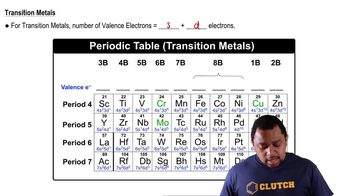
Valence electrons are the outermost electrons of an atom and play a crucial role in chemical bonding. The number of valence electrons determines how an element will react with others, particularly in forming ionic bonds. For example, barium has two valence electrons that it can lose to form a cation, while fluorine has seven valence electrons and can gain one to form an anion.
Recommended video:
Guided course
Transition Metals Valence Electrons
Naming Ionic Compounds
The naming of ionic compounds follows specific conventions. The cation (positive ion) is named first, followed by the anion (negative ion). For example, in the case of barium and fluorine, barium forms a cation (Ba²⁺) and fluorine forms an anion (F⁻), resulting in the compound name 'barium fluoride' with the formula BaF₂.
Recommended video:
Guided course
Ionic Compounds Naming
Related Practice
Textbook Question
740
views
Textbook Question
Each of the following pairs of elements will react to form a binary ionic compound. Write the formula of each compound formed, and give its name. (a) Sodium and iodine
701
views
Textbook Question
Element X reacts with element Y to give a product containing X3+ ions and Y2-ions. (d) In what groups of the periodic table are elements X and Y likely to be found?
469
views
Textbook Question
Each of the following pairs of elements will react to form a binary ionic compound. Write the formula of each compound formed, and give its name. (c) Lithium and nitrogen
607
views
Textbook Question
Each of the following pairs of elements will react to form a binary ionic compound. Write the formula of each compound formed, and give its name. (d) Aluminum and oxygen
1060
views
1
rank