Factor out the greatest common factor from each polynomial. See Example 1. 12m+60
Verified step by step guidance
1
Identify the greatest common factor (GCF) of the terms in the polynomial. For the terms \$12m\( and \)60\(, find the largest number that divides both coefficients (12 and 60) and any common variables. Here, the GCF of 12 and 60 is 12, and the variable \)m$ is only in the first term, so it is not part of the GCF.
Write the polynomial as a product of the GCF and another polynomial. This means expressing \$12m + 60$ as \(12(\ldots)\).
Divide each term of the original polynomial by the GCF. For the first term, divide \$12m\( by 12, which gives \)m$. For the second term, divide 60 by 12, which gives 5.
Rewrite the original polynomial as the product of the GCF and the simplified polynomial inside parentheses: \$12(m + 5)$.
Check your work by distributing the GCF back through the parentheses to ensure you get the original polynomial: \(12 \times m + 12 \times 5 = 12m + 60\).
Verified video answer for a similar problem:
This video solution was recommended by our tutors as helpful for the problem above
Video duration:
1m
Play a video:
0 Comments
Key Concepts
Here are the essential concepts you must grasp in order to answer the question correctly.
Greatest Common Factor (GCF)
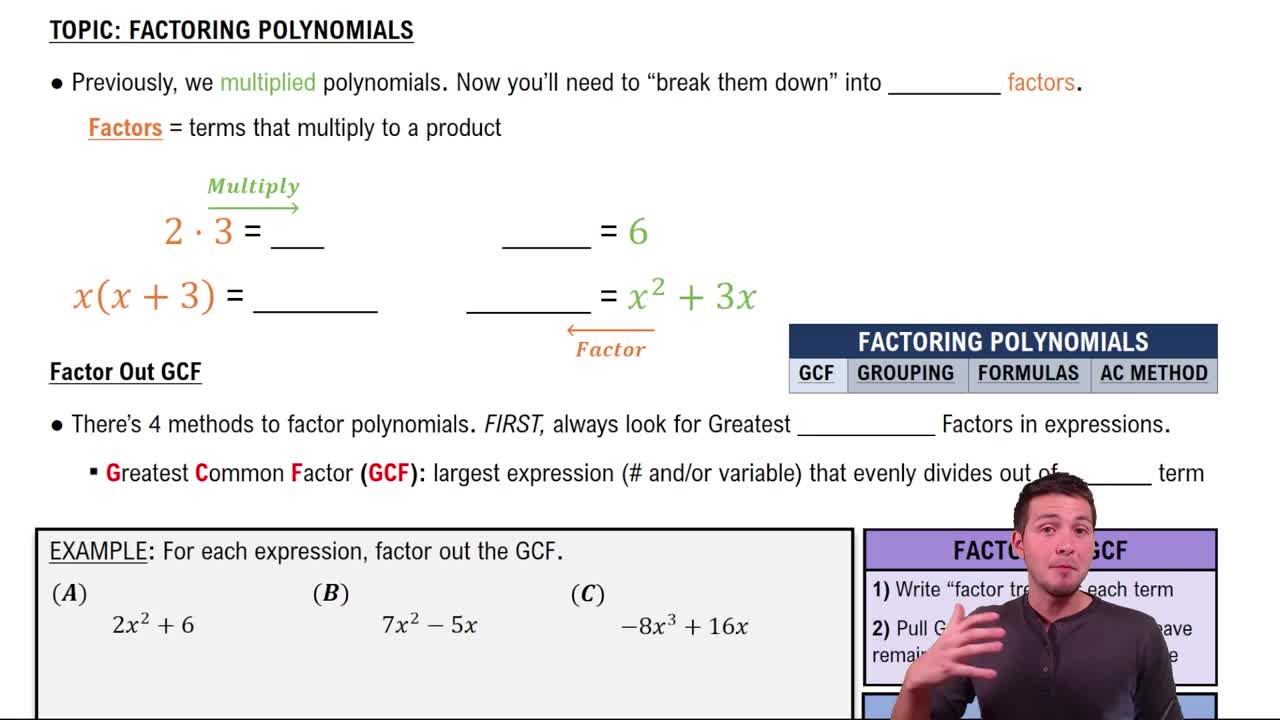
The Greatest Common Factor is the largest factor that divides two or more terms without leaving a remainder. Identifying the GCF helps simplify expressions by factoring out common elements, making the polynomial easier to work with.
Factoring polynomials involves rewriting the expression as a product of its factors. Factoring out the GCF is often the first step, which simplifies the polynomial and prepares it for further operations like solving or simplifying.
Prime factorization breaks down numbers into their prime number components. This process is essential for finding the GCF, as it allows you to identify the common prime factors shared by the terms in the polynomial.