Solve each problem. Find all values of b such that the straight line 3x - y = b touches the circle x2 + y2 = 25 at only one point.
Ch. 5 - Systems and Matrices

Chapter 6, Problem 61
Use the determinant theorems to evaluate each determinant. See Example 4.
Verified step by step guidance1
Identify the size and structure of the given determinant matrix to understand which determinant theorems can be applied effectively.
Recall key determinant theorems such as: the determinant of a matrix with two identical rows is zero, swapping two rows changes the sign of the determinant, and the determinant of a triangular matrix is the product of its diagonal entries.
Apply row operations that simplify the matrix to a form where the determinant is easier to calculate, keeping track of how each operation affects the determinant value according to the theorems.
Use the properties that multiplying a row by a scalar multiplies the determinant by that scalar, and adding a multiple of one row to another does not change the determinant, to further simplify the matrix if needed.
After simplifying the matrix using these theorems and operations, calculate the determinant by multiplying the diagonal entries if the matrix is triangular, or by expanding along a row or column if necessary.

Verified video answer for a similar problem:
This video solution was recommended by our tutors as helpful for the problem above.
Video duration:
5mWas this helpful?
Key Concepts
Here are the essential concepts you must grasp in order to answer the question correctly.
Determinant of a Matrix
The determinant is a scalar value computed from a square matrix that provides important properties such as invertibility. It can be calculated using various methods, including expansion by minors or row operations, and is essential for solving systems of linear equations and understanding matrix behavior.
Recommended video:
Guided course
Determinants of 2×2 Matrices
Determinant Theorems
Determinant theorems are rules that simplify the calculation of determinants, such as the effect of row swaps, scalar multiplication of rows, and adding multiples of one row to another. These theorems help reduce complex determinants to simpler forms without changing their value or by adjusting it predictably.
Recommended video:
Guided course
Determinants of 2×2 Matrices
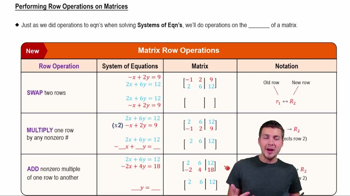
Row Operations and Their Impact on Determinants
Certain row operations affect the determinant in specific ways: swapping two rows multiplies the determinant by -1, multiplying a row by a scalar multiplies the determinant by that scalar, and adding a multiple of one row to another does not change the determinant. Understanding these effects is crucial for efficient determinant evaluation.
Recommended video:
Guided course
Performing Row Operations on Matrices
Related Practice
Textbook Question
435
views
Textbook Question
Find each product, if possible.
93
views
Textbook Question
Solve each problem using a system of equations in two variables. See Example 6. The longest side of a right triangle is 13 m in length. One of the other sides is 7 m longer than the shortest side. Find the lengths of the two shorter sides of the triangle.
527
views
Textbook Question
Solve each problem using a system of equations in two variables. See Example 6. Find two numbers whose ratio is 9 to 2 and whose product is 162.
545
views
Textbook Question
Solve each problem using a system of equations in two variables. See Example 6. Find two numbers whose ratio is 4 to 3 and are such that the sum of their squares is 100.
570
views
Textbook Question
Find each product, if possible.
131
views