Ch. 4 - Inverse, Exponential, and Logarithmic Functions
Lial - College Algebra 13th Edition
Lial13th EditionCollege AlgebraISBN: 9780136881063Not the one you use?Change textbook
Chapter 5, Problem 29

Determine whether each function graphed or defined is one-to-one. y = -(√x)+5

Verified step by step guidance
1
Recall that a function is one-to-one if each output corresponds to exactly one input. This means the function passes the Horizontal Line Test: no horizontal line should intersect the graph more than once.
Identify the given function: \(y = -\sqrt{x} + 5\). Note that the square root function \(\sqrt{x}\) is defined for \(x \geq 0\).
Analyze the behavior of \(y = -\sqrt{x} + 5\): as \(x\) increases, \(\sqrt{x}\) increases, so \(-\sqrt{x}\) decreases, and thus \(y\) decreases from 5 downward.
Since the function is strictly decreasing on its domain \([0, \infty)\), it means that for each \(y\) value, there is only one corresponding \(x\) value, satisfying the one-to-one condition.
Conclude that because the function is strictly decreasing and passes the Horizontal Line Test, it is one-to-one.

Verified video answer for a similar problem:

This video solution was recommended by our tutors as helpful for the problem above.
Video duration:
2m
Was this helpful?

Key Concepts

Here are the essential concepts you must grasp in order to answer the question correctly.

One-to-One Function

A function is one-to-one if each output corresponds to exactly one input, meaning no two different inputs produce the same output. This property ensures the function has an inverse that is also a function.
Recommended video:
4:07
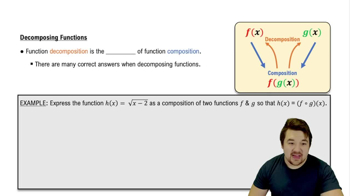
Decomposition of Functions

Square Root Function

The square root function, √x, is defined only for x ≥ 0 and produces non-negative outputs. Understanding its domain and range is essential when analyzing transformations like y = -√x + 5.
Recommended video:
02:20
Imaginary Roots with the Square Root Property

Function Transformations

Transformations such as reflections, shifts, and stretches modify the graph of a function. For y = -√x + 5, the negative sign reflects the graph over the x-axis, and adding 5 shifts it upward, affecting its shape and one-to-one nature.
Recommended video:
4:22
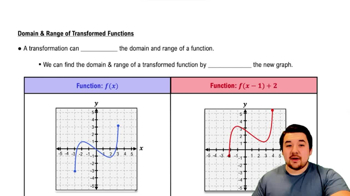
Domain & Range of Transformed Functions