Ch. R - Review of Basic Concepts
Lial - College Algebra 13th Edition
Lial13th EditionCollege AlgebraISBN: 9780136881063Not the one you use?Change textbook
Chapter 1, Problem 99

Simplify each expression. Write answers without negative exponents. Assume all variables represent positive real numbers. (x1/4y2/5)20/x2

Verified step by step guidance
1
Start by applying the power of a power rule to the numerator: \( (x^{\frac{1}{4}} y^{\frac{2}{5}})^{20} \). This means you multiply each exponent inside the parentheses by 20.
Calculate the new exponents for each variable in the numerator: \( x^{\frac{1}{4} \times 20} \) and \( y^{\frac{2}{5} \times 20} \).
Rewrite the expression with the simplified exponents in the numerator: \( x^{5} y^{8} \) (after multiplying the exponents).
Now, write the entire expression as \( \frac{x^{5} y^{8}}{x^{2}} \).
Use the quotient rule for exponents to simplify the \( x \) terms: subtract the exponent in the denominator from the exponent in the numerator, resulting in \( x^{5 - 2} y^{8} \).

Verified video answer for a similar problem:

This video solution was recommended by our tutors as helpful for the problem above.
Video duration:
2m
Was this helpful?

Key Concepts

Here are the essential concepts you must grasp in order to answer the question correctly.

Exponentiation of Powers

When raising a power to another power, multiply the exponents. For example, (x^(a))^b = x^(a*b). This rule helps simplify expressions like (x^(1/4))^20 by multiplying 1/4 and 20 to get the new exponent.
Recommended video:
04:10
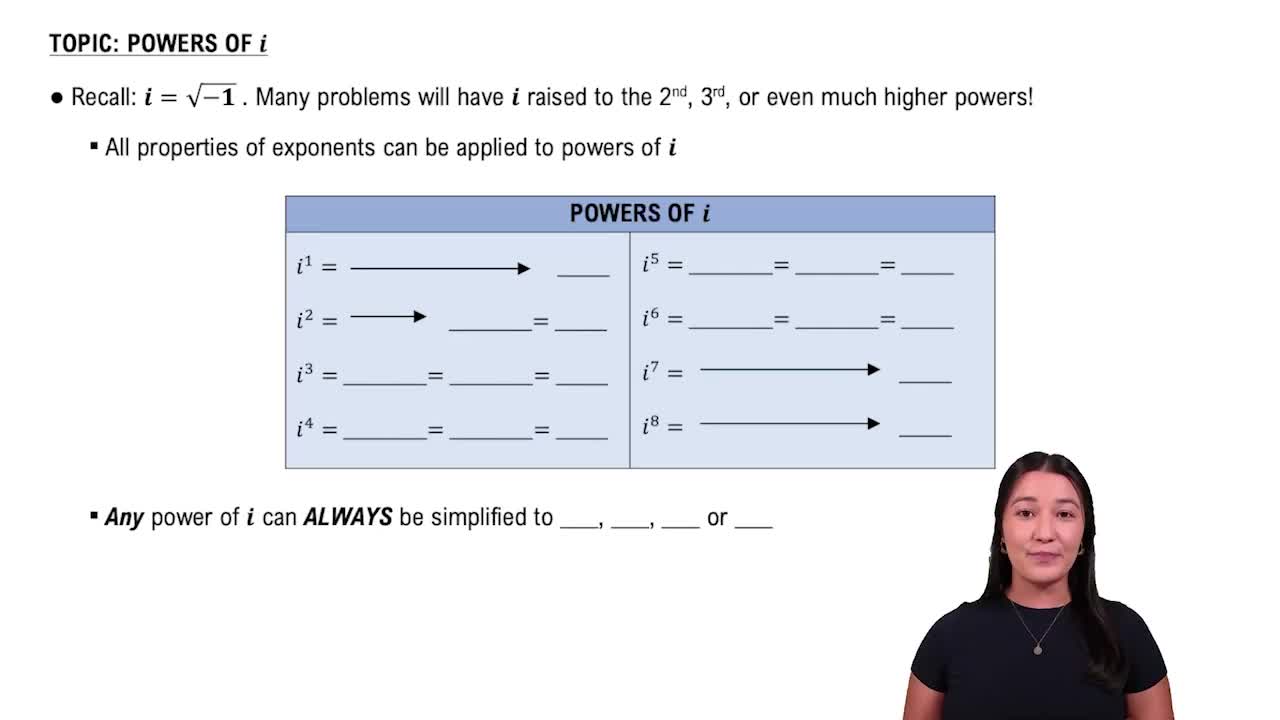
Powers of i

Division of Exponents with the Same Base

When dividing expressions with the same base, subtract the exponents: x^m / x^n = x^(m-n). This is essential for simplifying the given expression after applying the power rule.
Recommended video:
Guided course
7:39
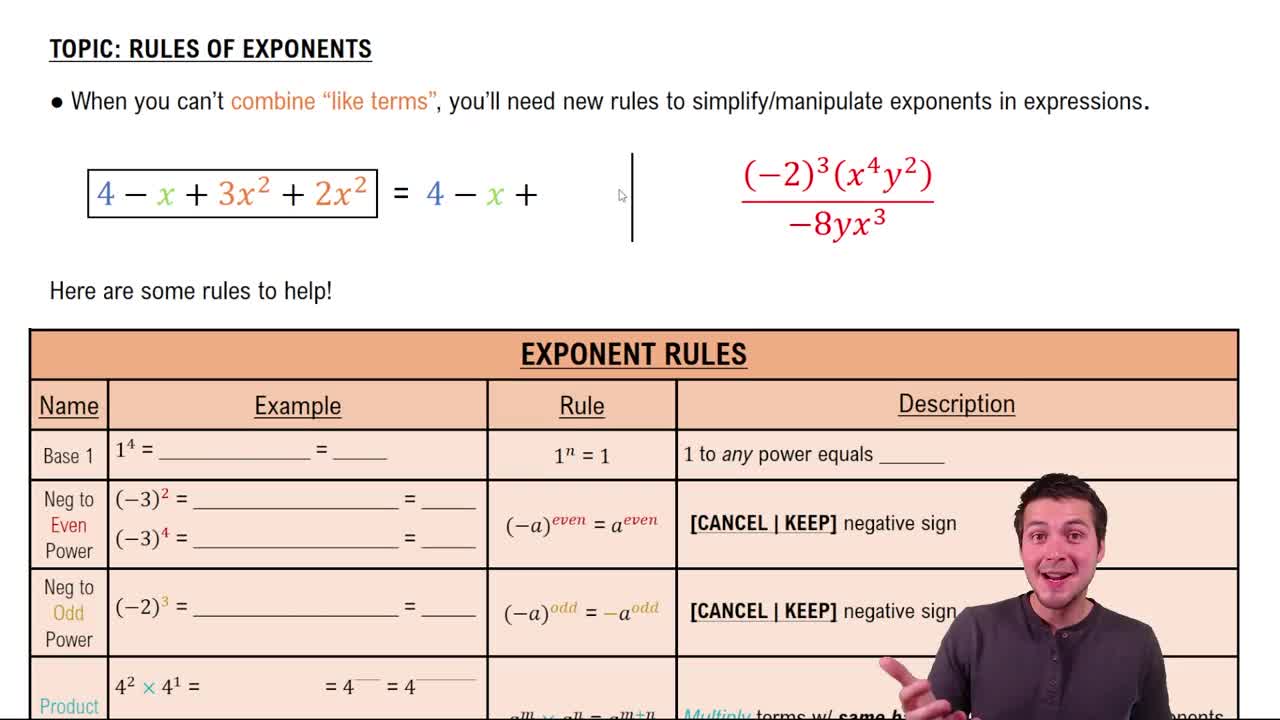
Introduction to Exponent Rules

Negative Exponents and Positive Exponent Form

Negative exponents indicate reciprocals, e.g., x^(-a) = 1/x^a. The problem requires answers without negative exponents, so rewrite any negative exponents as positive by moving factors between numerator and denominator.
Recommended video:
Guided course
04:06
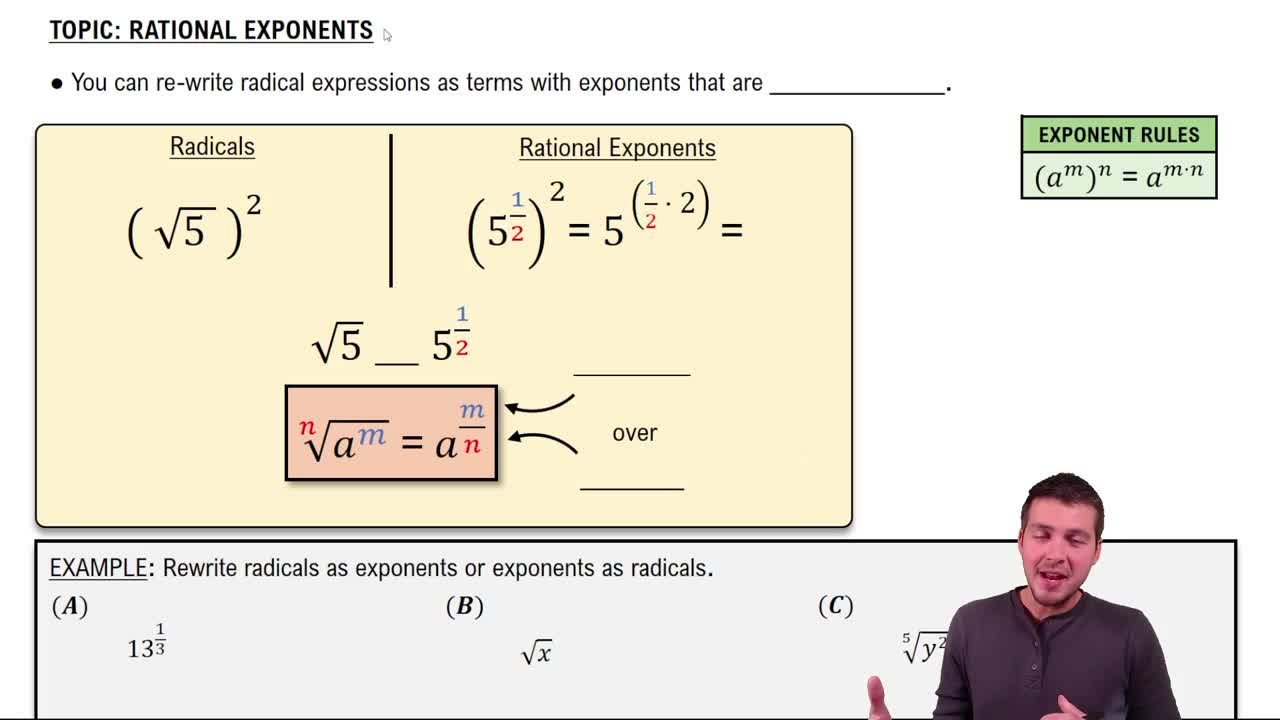
Rational Exponents