Ch. 2 - Graphs and Functions
Lial - College Algebra 13th Edition
Lial13th EditionCollege AlgebraISBN: 9780136881063Not the one you use?Change textbook
Chapter 3, Problem 29

Graph each line. Give the domain and range. -x + 5 = 0

Verified step by step guidance
1
Rewrite the given equation \(-x + 5 = 0\) to isolate \(x\). Add \(x\) to both sides to get \(5 = x\), or equivalently \(x = 5\).
Recognize that the equation \(x = 5\) represents a vertical line on the coordinate plane where \(x\) is always 5 regardless of \(y\).
To graph this line, draw a straight vertical line passing through all points where the \(x\)-coordinate is 5.
Determine the domain of the line: since \(x\) is fixed at 5, the domain is the single value \(\{5\}\).
Determine the range of the line: because \(y\) can be any real number, the range is all real numbers, expressed as \(( -\infty, \infty )\).

Verified video answer for a similar problem:

This video solution was recommended by our tutors as helpful for the problem above.
Video duration:
3m
Was this helpful?

Key Concepts

Here are the essential concepts you must grasp in order to answer the question correctly.

Graphing Linear Equations

Graphing a linear equation involves plotting all points (x, y) that satisfy the equation. For equations like -x + 5 = 0, which can be rewritten as x = 5, the graph is a vertical line crossing the x-axis at 5. Understanding how to interpret and plot such lines is essential for visualizing solutions.
Recommended video:
06:00
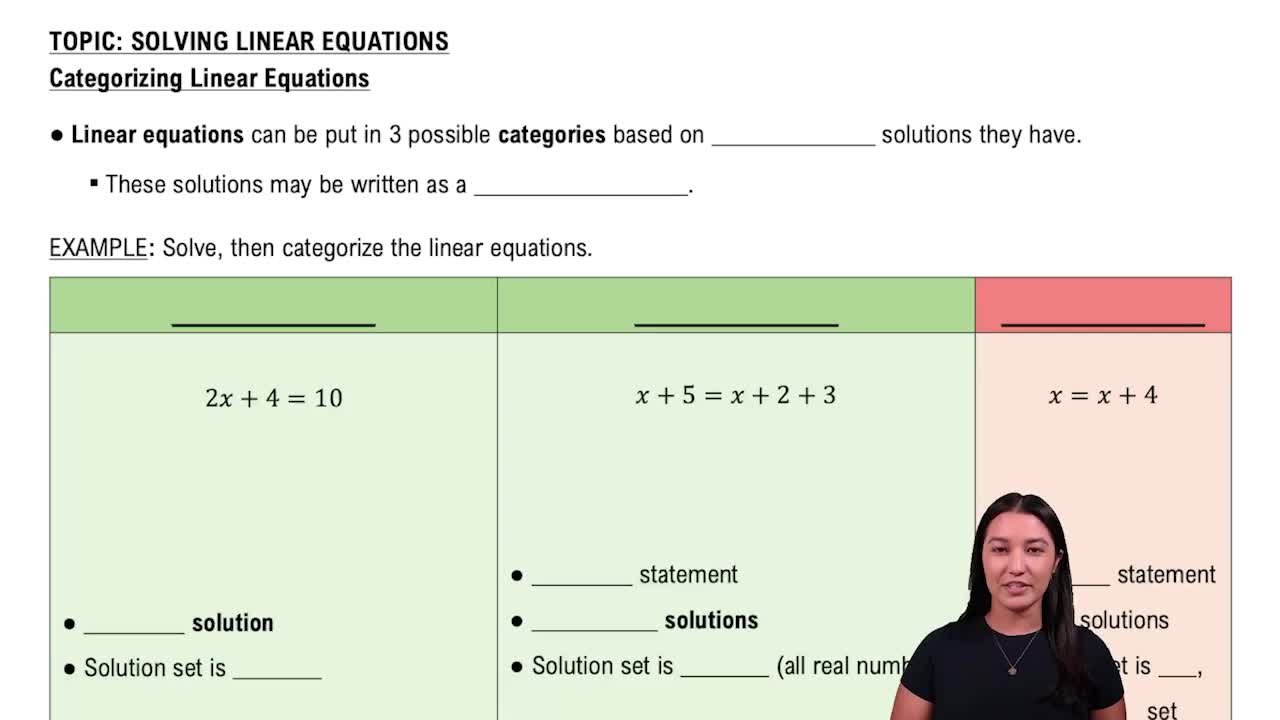
Categorizing Linear Equations

Domain of a Function or Relation

The domain is the set of all possible input values (x-values) for which the equation or function is defined. For a vertical line like x = 5, the domain is a single value, x = 5, since the line exists only at that x-coordinate.
Recommended video:
5:20
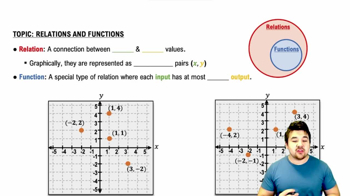
Relations and Functions

Range of a Function or Relation

The range is the set of all possible output values (y-values) that the equation or function can take. For the vertical line x = 5, the range includes all real numbers because y can be any value along that vertical line.
Recommended video:
5:20
Relations and Functions