Determine whether each function is even, odd, or neither. ƒ(x)=-x3+2x
Verified step by step guidance
1
Recall the definitions: A function \( f(x) \) is even if \( f(-x) = f(x) \) for all \( x \), and it is odd if \( f(-x) = -f(x) \) for all \( x \). If neither condition holds, the function is neither even nor odd.
Given the function \( f(x) = -x^{3} + 2x \), find \( f(-x) \) by substituting \( -x \) into the function:
\[ f(-x) = -(-x)^{3} + 2(-x) \]
Simplify the expression for \( f(-x) \) by evaluating the powers and multiplying:
\[ f(-x) = -(-x^{3}) - 2x = x^{3} - 2x \]
Compare \( f(-x) \) with \( f(x) \) and \( -f(x) \) to determine if the function is even, odd, or neither:
Verified video answer for a similar problem:
This video solution was recommended by our tutors as helpful for the problem above
Video duration:
1m
Play a video:
0 Comments
Key Concepts
Here are the essential concepts you must grasp in order to answer the question correctly.
Even and Odd Functions
An even function satisfies f(-x) = f(x) for all x in its domain, meaning its graph is symmetric about the y-axis. An odd function satisfies f(-x) = -f(x), indicating symmetry about the origin. Functions that do not meet either condition are neither even nor odd.
To determine if a function is even or odd, substitute -x into the function in place of x and simplify. Comparing the result to the original function f(x) helps identify symmetry properties. This process is essential for analyzing the function's behavior.
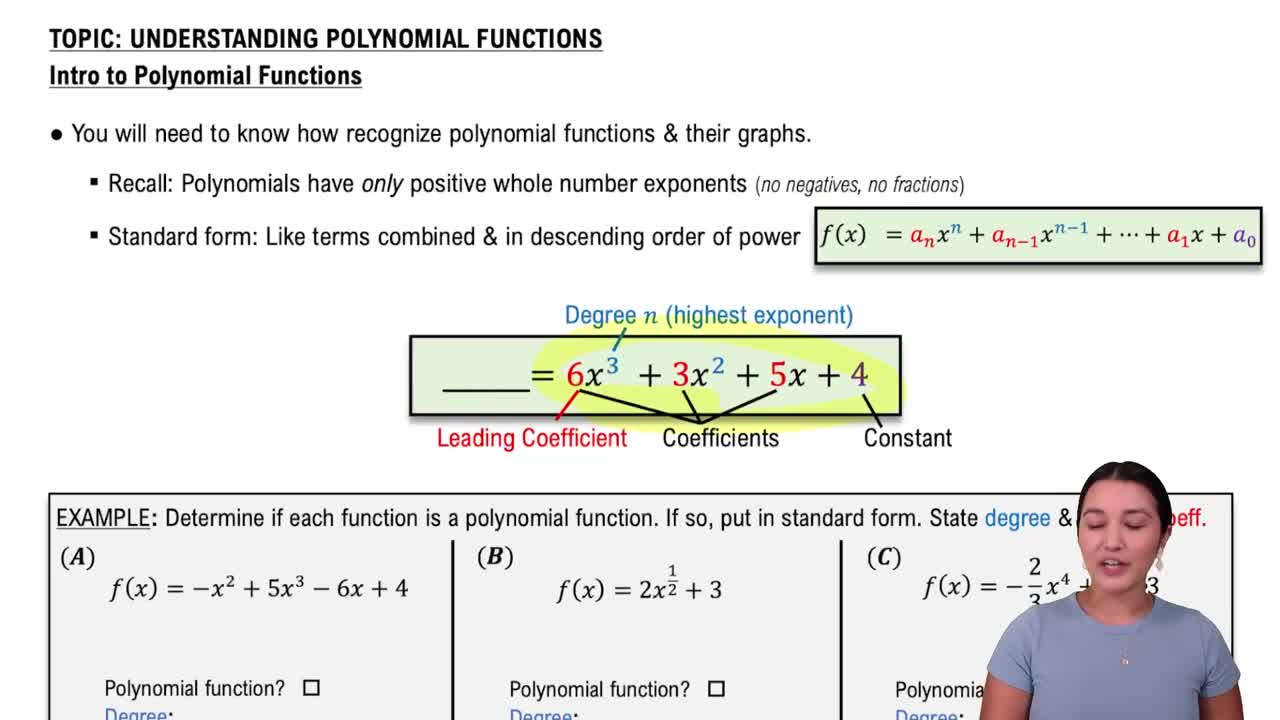
Polynomial functions can be classified by the parity of their terms: even powers contribute to even symmetry, odd powers to odd symmetry. For example, x³ is an odd function term, while x² is even. Understanding this helps predict the overall function's symmetry.

 1:23 minutes
 Verified step by step guidance
 06:08
06:08