Determine whether each function is even, odd, or neither. ƒ(x)=x5-2x3
Verified step by step guidance
1
Recall the definitions: A function \( f(x) \) is even if \( f(-x) = f(x) \) for all \( x \), and it is odd if \( f(-x) = -f(x) \) for all \( x \). If neither condition holds, the function is neither even nor odd.
Start by finding \( f(-x) \) for the given function \( f(x) = x^{5} - 2x^{3} \). Substitute \( -x \) into the function:
\[ f(-x) = (-x)^{5} - 2(-x)^{3} \]
Simplify each term using the properties of exponents: \( (-x)^{5} = -x^{5} \) because 5 is odd, and \( (-x)^{3} = -x^{3} \) because 3 is odd. So, \( f(-x) = -x^{5} - 2(-x^{3}) = -x^{5} + 2x^{3} \).
Compare \( f(-x) \) with \( f(x) \) and \( -f(x) \): \( f(x) = x^{5} - 2x^{3} \) and \( -f(x) = -x^{5} + 2x^{3} \). Since \( f(-x) = -f(x) \), the function \( f(x) \) is an odd function.
Verified video answer for a similar problem:
This video solution was recommended by our tutors as helpful for the problem above
Video duration:
1m
Play a video:
0 Comments
Key Concepts
Here are the essential concepts you must grasp in order to answer the question correctly.
Even and Odd Functions
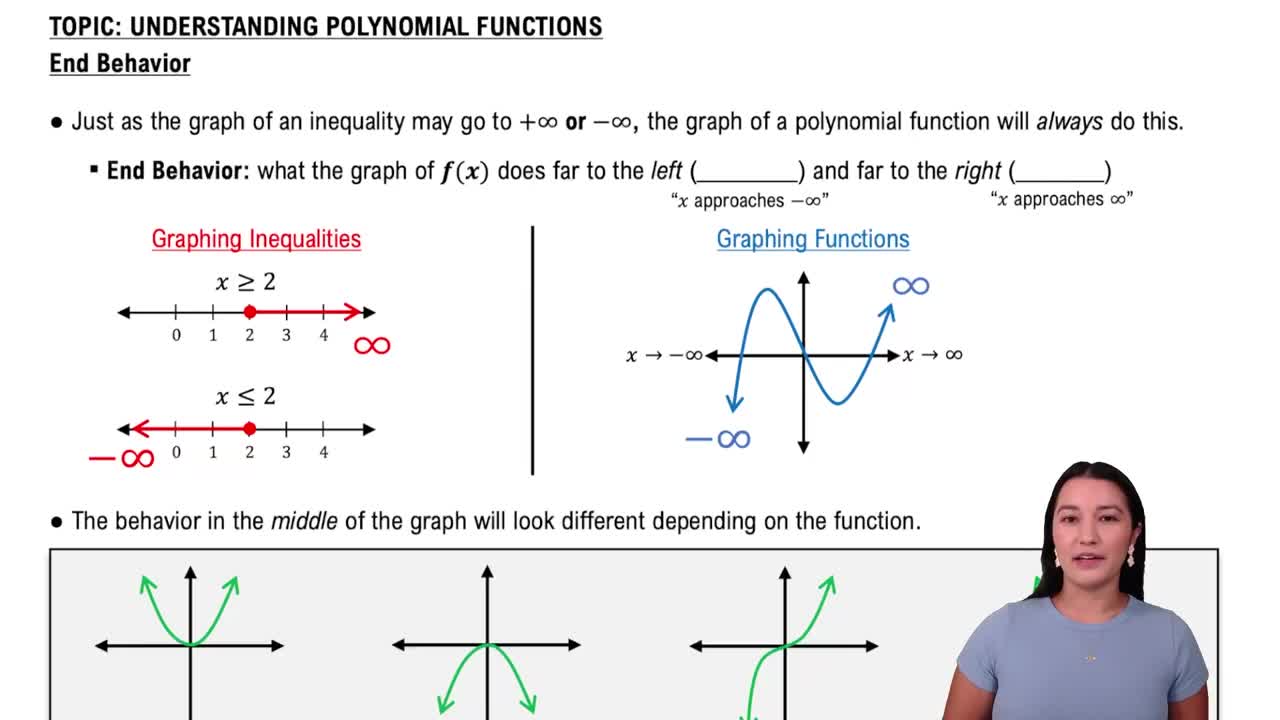
An even function satisfies f(-x) = f(x) for all x in its domain, meaning its graph is symmetric about the y-axis. An odd function satisfies f(-x) = -f(x), showing symmetry about the origin. Functions that do not meet either condition are neither even nor odd.
To determine if a function is even or odd, substitute -x into the function and simplify. Comparing the result to the original function f(x) and its negative -f(x) helps identify the function's symmetry properties.
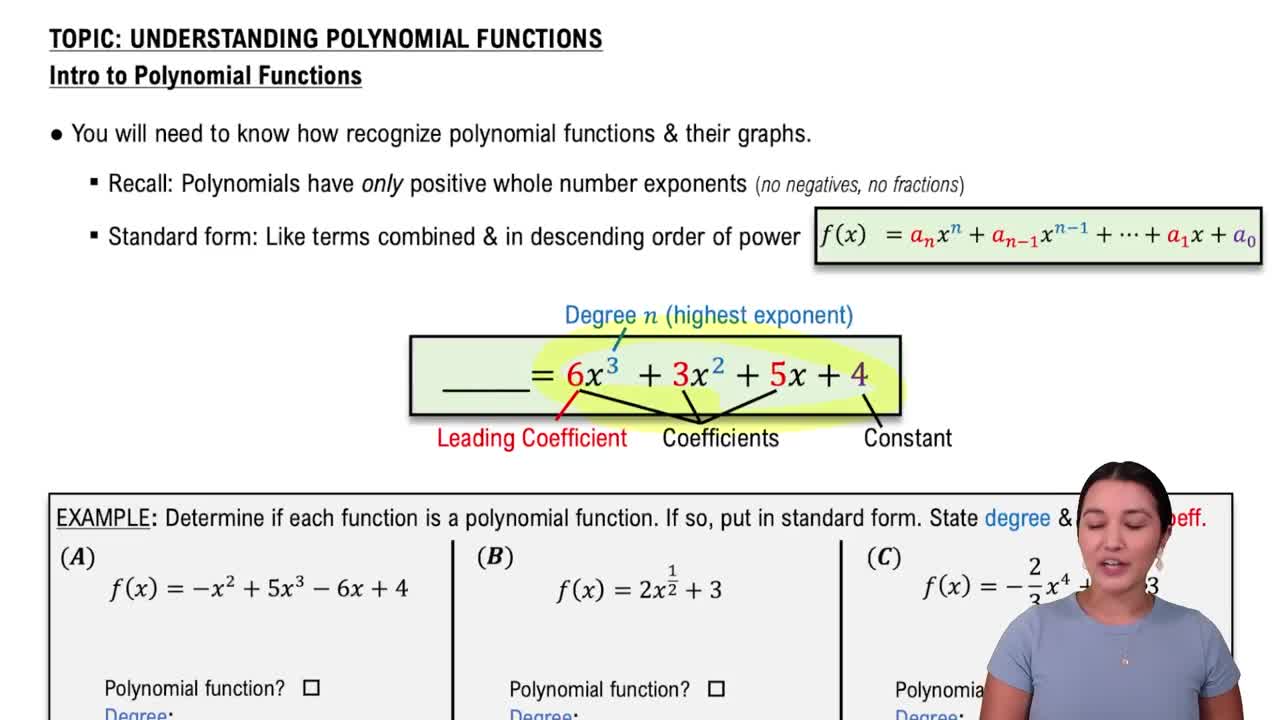
Polynomial functions with only even powers of x are typically even functions, while those with only odd powers are odd functions. Mixed powers usually result in functions that are neither even nor odd, unless terms cancel out in a specific way.

 1:39 minutes
 Verified step by step guidance
 06:08
06:08