Ch. 3 - Polynomial and Rational Functions
Lial - College Algebra 13th Edition
Lial13th EditionCollege AlgebraISBN: 9780136881063Not the one you use?Change textbook
Chapter 4, Problem 28

Graph each quadratic function. Give the (a) vertex, (b) axis, (c) domain, and (d) range. ƒ(x) = -3 (x - 2)2 +1

Verified step by step guidance
1
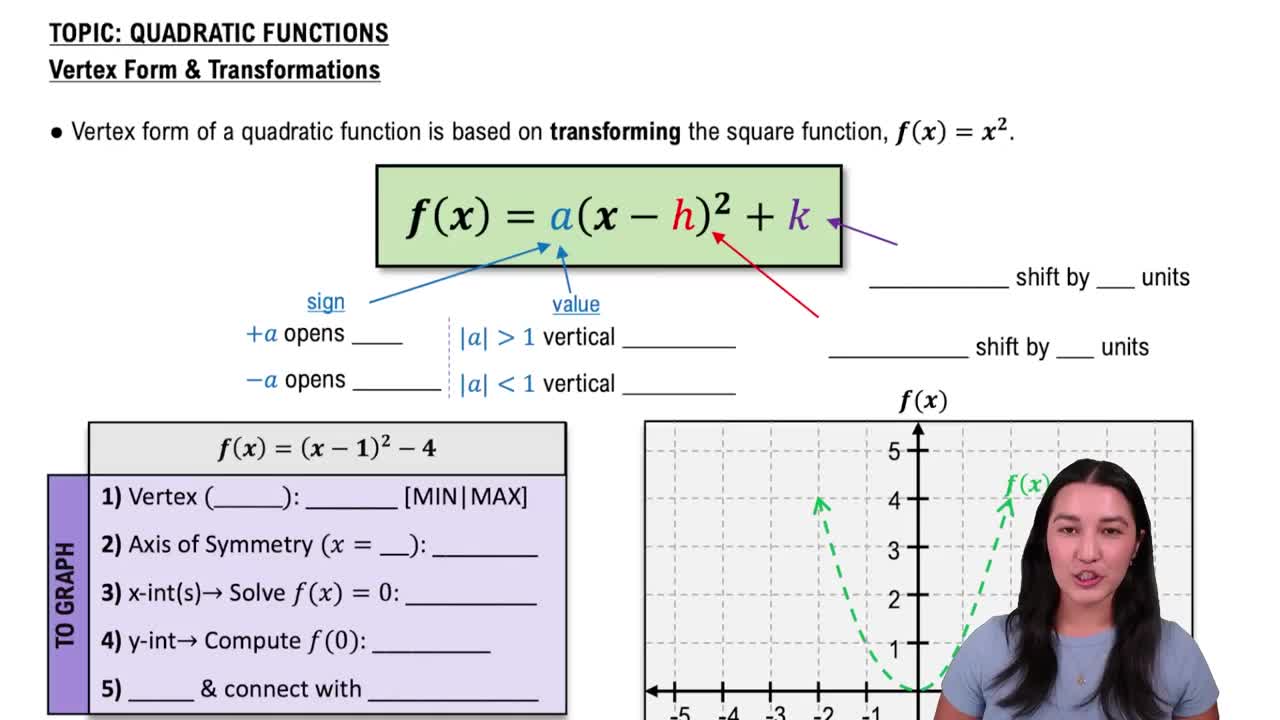
Identify the given quadratic function: \(f(x) = -3 (x - 2)^2 + 1\). Notice it is in vertex form, which is \(f(x) = a(x - h)^2 + k\), where \((h, k)\) is the vertex.
Find the vertex by comparing: Here, \(h = 2\) and \(k = 1\), so the vertex is at the point \((2, 1)\).
Determine the axis of symmetry: The axis is the vertical line that passes through the vertex, so it is \(x = 2\).
State the domain of the function: Since this is a quadratic function, the domain is all real numbers, which can be written as \((-\infty, \infty)\).
Find the range by analyzing the vertex and the leading coefficient \(a = -3\): Because \(a\) is negative, the parabola opens downward, so the range includes all \(y\) values less than or equal to the vertex's \(y\)-coordinate, expressed as \((-\infty, 1]\).

Verified video answer for a similar problem:

This video solution was recommended by our tutors as helpful for the problem above.
Video duration:
5m
Was this helpful?

Key Concepts

Here are the essential concepts you must grasp in order to answer the question correctly.

Vertex Form of a Quadratic Function

The vertex form of a quadratic function is f(x) = a(x - h)^2 + k, where (h, k) is the vertex of the parabola. This form makes it easy to identify the vertex directly, which is the highest or lowest point depending on the sign of 'a'. In the given function, the vertex is (2, 1).
Recommended video:
08:07
Vertex Form

Axis of Symmetry

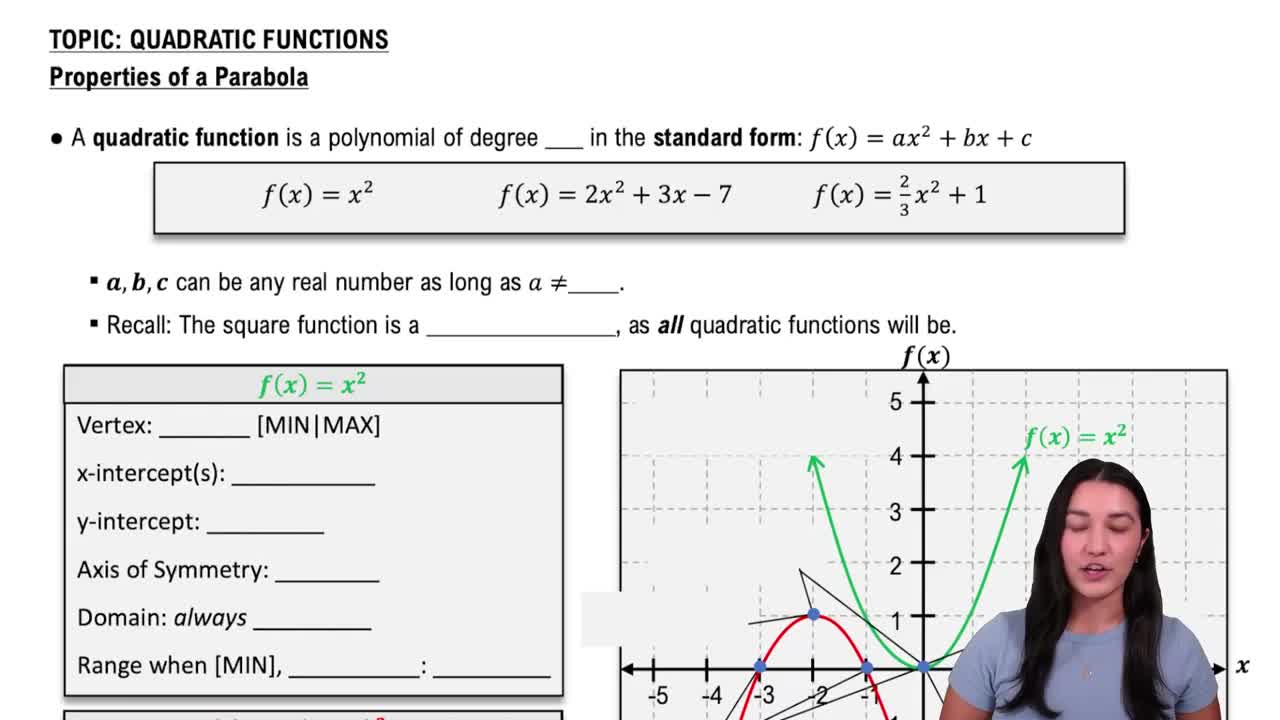
The axis of symmetry is a vertical line that passes through the vertex and divides the parabola into two mirror images. Its equation is x = h, where h is the x-coordinate of the vertex. For the function f(x) = -3(x - 2)^2 + 1, the axis of symmetry is x = 2.
Recommended video:
07:42
Properties of Parabolas

Domain and Range of Quadratic Functions

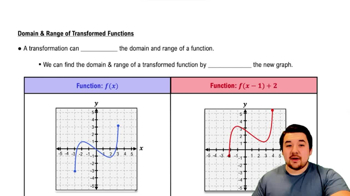
The domain of any quadratic function is all real numbers since you can input any x-value. The range depends on the vertex and the direction the parabola opens. If 'a' is negative, the parabola opens downward, so the range is all y-values less than or equal to the vertex's y-coordinate.
Recommended video:
4:22
Domain & Range of Transformed Functions