Ch. R - Review of Basic Concepts
Lial - College Algebra 13th Edition
Lial13th EditionCollege AlgebraISBN: 9780136881063Not the one you use?Change textbook
Chapter 1, Problem 30

Multiply or divide as indicated. Write answers in lowest terms as needed. (1/8)∙(10/7)

Verified step by step guidance
1
Identify the operation: You are asked to multiply two fractions, \( \frac{1}{8} \) and \( \frac{10}{7} \).
Multiply the numerators together: \( 1 \times 10 = 10 \).
Multiply the denominators together: \( 8 \times 7 = 56 \).
Write the product as a single fraction: \( \frac{10}{56} \).
Simplify the fraction by finding the greatest common divisor (GCD) of 10 and 56, then divide both numerator and denominator by the GCD to write the fraction in lowest terms.

Verified video answer for a similar problem:

This video solution was recommended by our tutors as helpful for the problem above.
Video duration:
2m
Was this helpful?

Key Concepts

Here are the essential concepts you must grasp in order to answer the question correctly.

Multiplication of Fractions

To multiply fractions, multiply the numerators together to get the new numerator, and multiply the denominators together to get the new denominator. For example, (a/b) * (c/d) = (a*c) / (b*d). This process combines the two fractions into a single fraction.
Recommended video:
Guided course
05:45
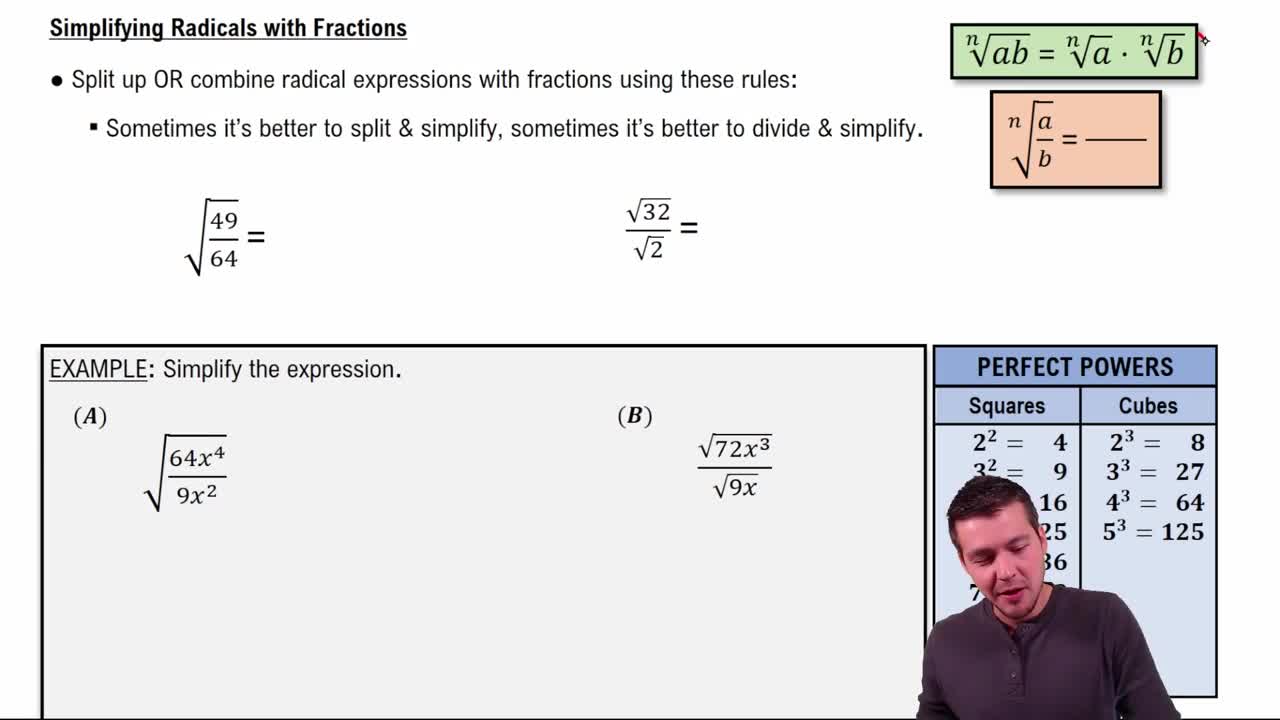
Radical Expressions with Fractions

Simplifying Fractions

After performing operations on fractions, simplify the result by dividing the numerator and denominator by their greatest common divisor (GCD). This reduces the fraction to its lowest terms, making it easier to interpret and compare.
Recommended video:
Guided course
05:45
Radical Expressions with Fractions

Understanding Numerators and Denominators

A fraction consists of a numerator (top number) and a denominator (bottom number). The numerator represents how many parts are considered, while the denominator indicates the total number of equal parts. Proper manipulation of these parts is essential for fraction operations.
Recommended video:
Guided course
02:58
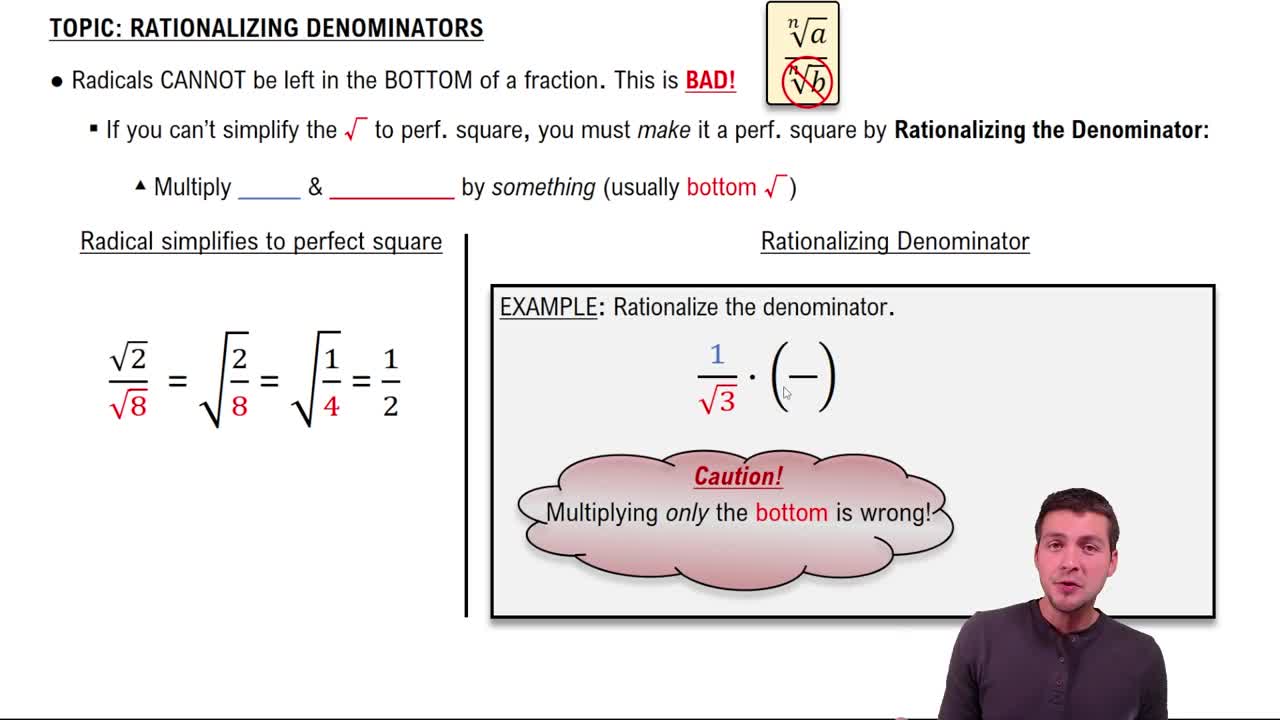
Rationalizing Denominators