Ch. 4 - Inverse, Exponential, and Logarithmic Functions
Lial - College Algebra 13th Edition
Lial13th EditionCollege AlgebraISBN: 9780136881063Not the one you use?Change textbook
Chapter 5, Problem 11

Solve each equation. In Exercises 11–34, give irrational solutions as decimals correct to the nearest thousandth. In Exercises 35-40, give solutions in exact form. 3x = 7

Verified step by step guidance
1
Identify the equation to solve: \(3^x = 7\).
Since the variable \(x\) is in the exponent, apply the logarithm to both sides to bring the exponent down. You can use the natural logarithm (ln) or common logarithm (log). For example, take the natural logarithm: \(\ln(3^x) = \ln(7)\).
Use the logarithmic property that allows you to move the exponent in front: \(x \cdot \ln(3) = \ln(7)\).
Isolate \(x\) by dividing both sides of the equation by \(\ln(3)\): \(x = \frac{\ln(7)}{\ln(3)}\).
To find the decimal approximation, use a calculator to evaluate \(\ln(7)\) and \(\ln(3)\), then divide and round the result to the nearest thousandth.

Verified video answer for a similar problem:

This video solution was recommended by our tutors as helpful for the problem above.
Video duration:
2m
Was this helpful?

Key Concepts

Here are the essential concepts you must grasp in order to answer the question correctly.

Exponential Equations

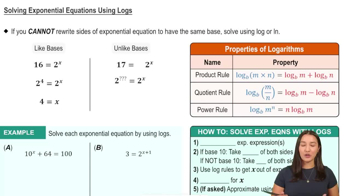
An exponential equation is one in which the variable appears in the exponent, such as 3^x = 7. Solving these requires methods that can handle variables in exponents, often involving logarithms to isolate the variable.
Recommended video:
5:47
Solving Exponential Equations Using Logs

Logarithms and Their Properties

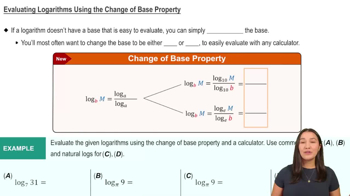
Logarithms are the inverse operations of exponentials and are used to solve equations where the variable is an exponent. Applying the logarithm to both sides of an equation like 3^x = 7 allows you to rewrite it as x = log base 3 of 7, facilitating the solution.
Recommended video:
5:36
Change of Base Property

Decimal Approximation of Irrational Numbers

When solutions involve irrational numbers, such as logarithms that do not simplify to rational numbers, it is common to approximate them as decimals. Rounding to the nearest thousandth means expressing the solution with three digits after the decimal point for practical use.
Recommended video:
4:47
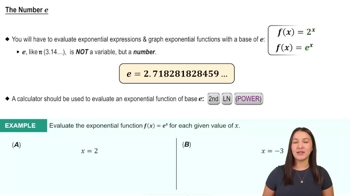
The Number e