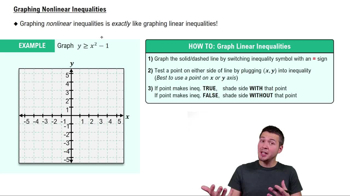
Solve each rational inequality. Give the solution set in interval notation. 1 /(x - 1) < 1 /(x + 1)
Ch. 3 - Polynomial and Rational Functions

Chapter 4, Problem 65
Solve each rational inequality. Give the solution set in interval notation. 2 /(x - 2) ≥ 1 / x
Verified step by step guidance1
Start by writing the inequality clearly: \(\frac{2}{x - 2} \geq \frac{1}{x}\).
Bring all terms to one side to have a single rational expression: \(\frac{2}{x - 2} - \frac{1}{x} \geq 0\).
Find a common denominator, which is \(x(x - 2)\), and combine the fractions: \(\frac{2x - (x - 2)}{x(x - 2)} \geq 0\).
Simplify the numerator: \$2x - (x - 2) = 2x - x + 2 = x + 2$, so the inequality becomes \(\frac{x + 2}{x(x - 2)} \geq 0\).
Determine the critical points by setting numerator and denominator equal to zero: \(x + 2 = 0\), \(x = 0\), and \(x - 2 = 0\). These points divide the number line into intervals to test the sign of the expression and find where it is greater than or equal to zero.

Verified video answer for a similar problem:
This video solution was recommended by our tutors as helpful for the problem above.
Video duration:
4mWas this helpful?
Key Concepts
Here are the essential concepts you must grasp in order to answer the question correctly.
Rational Inequalities
Rational inequalities involve expressions where variables appear in the denominator. Solving them requires finding values that satisfy the inequality while ensuring denominators are not zero, as division by zero is undefined.
Recommended video:
Guided course
Nonlinear Inequalities
Finding a Common Denominator and Combining Terms
To solve rational inequalities, rewrite both sides with a common denominator to combine terms into a single rational expression. This allows comparison to zero and simplifies the inequality into a form suitable for analysis.
Recommended video:
Guided course
Rationalizing Denominators Using Conjugates
Sign Analysis and Interval Notation
After simplifying, determine where the rational expression is positive, negative, or zero by analyzing critical points (zeros and undefined points). Use this to identify solution intervals and express the solution set clearly in interval notation.
Recommended video:
Interval Notation
Related Practice
Textbook Question
493
views
Textbook Question
Show that the real zeros of each polynomial function satisfy the given conditions. See Example 6.
; no real zero less than -3
566
views
Textbook Question
The remainder theorem indicates that when a polynomial ƒ(x) is divided by x-k, the remainder is equal to ƒ(k). Consider the polynomial function ƒ(x) = x3 - 2x2 - x+2. Use the remainder theorem to find each of the following. Then determine the coordinates of the corresponding point on the graph of ƒ(x). ƒ (-2)
506
views
Textbook Question
Graph each rational function. ƒ(x)=4/(x-1)
663
views
Textbook Question
Solve each rational inequality. Give the solution set in interval notation. See Examples 4 and 5.
451
views
Textbook Question
Find a polynomial function f of least degree having the graph shown. (Hint: See the NOTE following Example 4.)
1159
views