Ch. 1 - Equations and Inequalities
Lial - College Algebra 13th Edition
Lial13th EditionCollege AlgebraISBN: 9780136881063Not the one you use?Change textbook
Chapter 2, Problem 87

Solve each inequality. Give the solution set using interval notation. 5 ≤ 2x -3 ≤ 7

Verified step by step guidance
1
Start by understanding that the compound inequality \(5 \leq 2x - 3 \leq 7\) means that \$2x - 3$ is simultaneously greater than or equal to 5 and less than or equal to 7.
To isolate \(x\), first add 3 to all three parts of the inequality to eliminate the \(-3\): \(5 + 3 \leq 2x - 3 + 3 \leq 7 + 3\), which simplifies to \(8 \leq 2x \leq 10\).
Next, divide all parts of the inequality by 2 to solve for \(x\): \(\frac{8}{2} \leq \frac{2x}{2} \leq \frac{10}{2}\), which simplifies to \(4 \leq x \leq 5\).
Interpret the solution: \(x\) is greater than or equal to 4 and less than or equal to 5.
Express the solution set in interval notation as \([4, 5]\), which includes both endpoints since the inequalities are inclusive.

Verified video answer for a similar problem:

This video solution was recommended by our tutors as helpful for the problem above.
Video duration:
1m
Was this helpful?

Key Concepts

Here are the essential concepts you must grasp in order to answer the question correctly.

Compound Inequalities

A compound inequality involves two inequalities joined together, often with 'and' or 'or'. In this problem, the inequality 5 ≤ 2x - 3 ≤ 7 means both 5 ≤ 2x - 3 and 2x - 3 ≤ 7 must be true simultaneously. Solving compound inequalities requires handling both parts to find the values of x that satisfy both conditions.
Recommended video:
06:07
Linear Inequalities

Solving Linear Inequalities

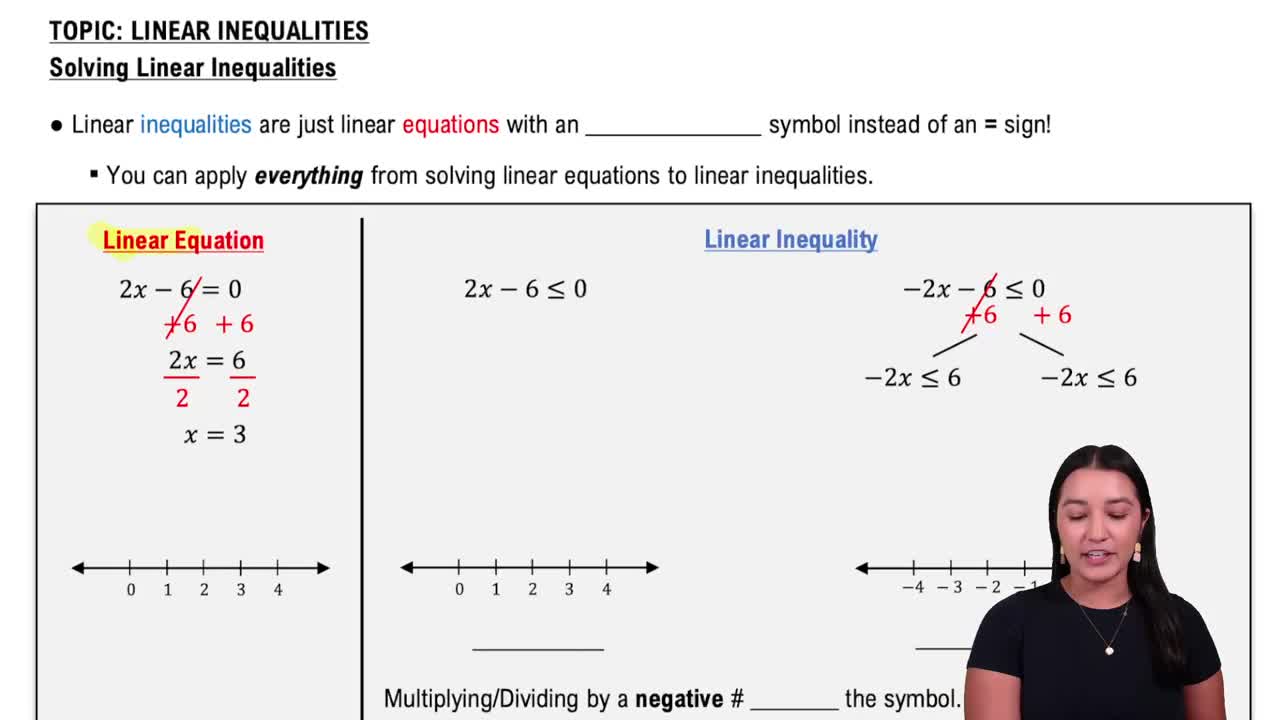
Solving linear inequalities involves isolating the variable on one side by performing inverse operations, similar to solving equations. When multiplying or dividing by a negative number, the inequality sign reverses. The goal is to find all values of x that make the inequality true.
Recommended video:
06:07
Linear Inequalities

Interval Notation

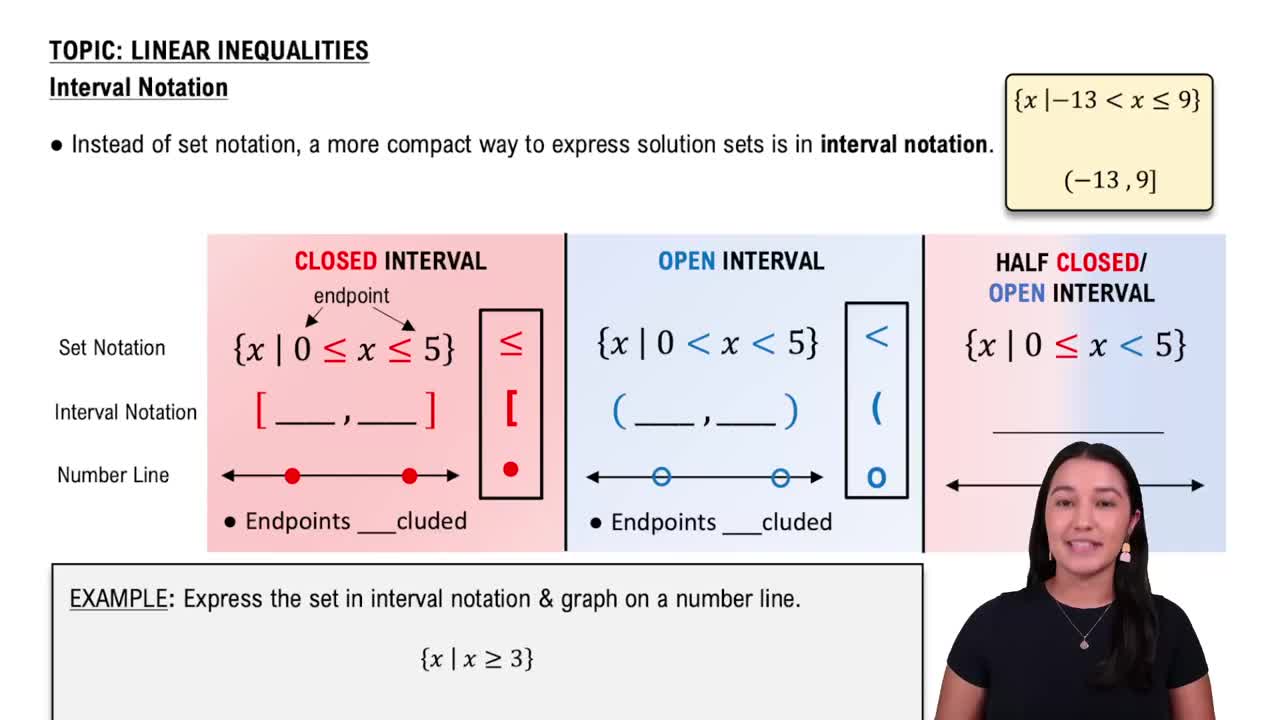
Interval notation is a concise way to represent solution sets of inequalities using parentheses and brackets. Brackets [ ] indicate that an endpoint is included (closed interval), while parentheses ( ) mean it is excluded (open interval). For example, [a, b] includes all numbers from a to b, including a and b.
Recommended video:
05:18
Interval Notation