Find a polynomial function ƒ(x) of least degree having only real coefficients and zeros as given. Assume multiplicity 1 unless otherwise stated. 5+i and 5-i
Ch. 3 - Polynomial and Rational Functions

Chapter 4, Problem 61
Solve each rational inequality. Give the solution set in interval notation.
Verified step by step guidance1
First, identify the rational inequality: \(\frac{x^2 - 3x - 4}{x^2 + 6x + 9} \leq 0\).
Factor both the numerator and the denominator: numerator \(x^2 - 3x - 4\) factors as \((x - 4)(x + 1)\), and denominator \(x^2 + 6x + 9\) factors as \((x + 3)^2\).
Determine the critical points by setting numerator and denominator equal to zero: numerator zeros at \(x = 4\) and \(x = -1\), denominator zero at \(x = -3\) (note this makes the denominator zero, so \(x = -3\) is excluded from the domain).
Create a number line and mark the critical points \(-3\), \(-1\), and \(4\). Test values from each interval formed by these points in the inequality to determine where the expression is less than or equal to zero.
Write the solution set by including intervals where the inequality holds true, remembering to exclude points where the denominator is zero, and express the solution in interval notation.

Verified video answer for a similar problem:
This video solution was recommended by our tutors as helpful for the problem above.
Video duration:
10mWas this helpful?
Key Concepts
Here are the essential concepts you must grasp in order to answer the question correctly.
Rational Inequalities
Rational inequalities involve expressions where one polynomial is divided by another, and the inequality compares this ratio to zero or another value. Solving them requires finding where the expression is positive, negative, or zero, considering the domain restrictions from the denominator.
Recommended video:
Guided course
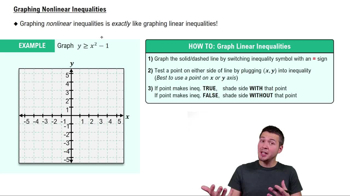
Nonlinear Inequalities
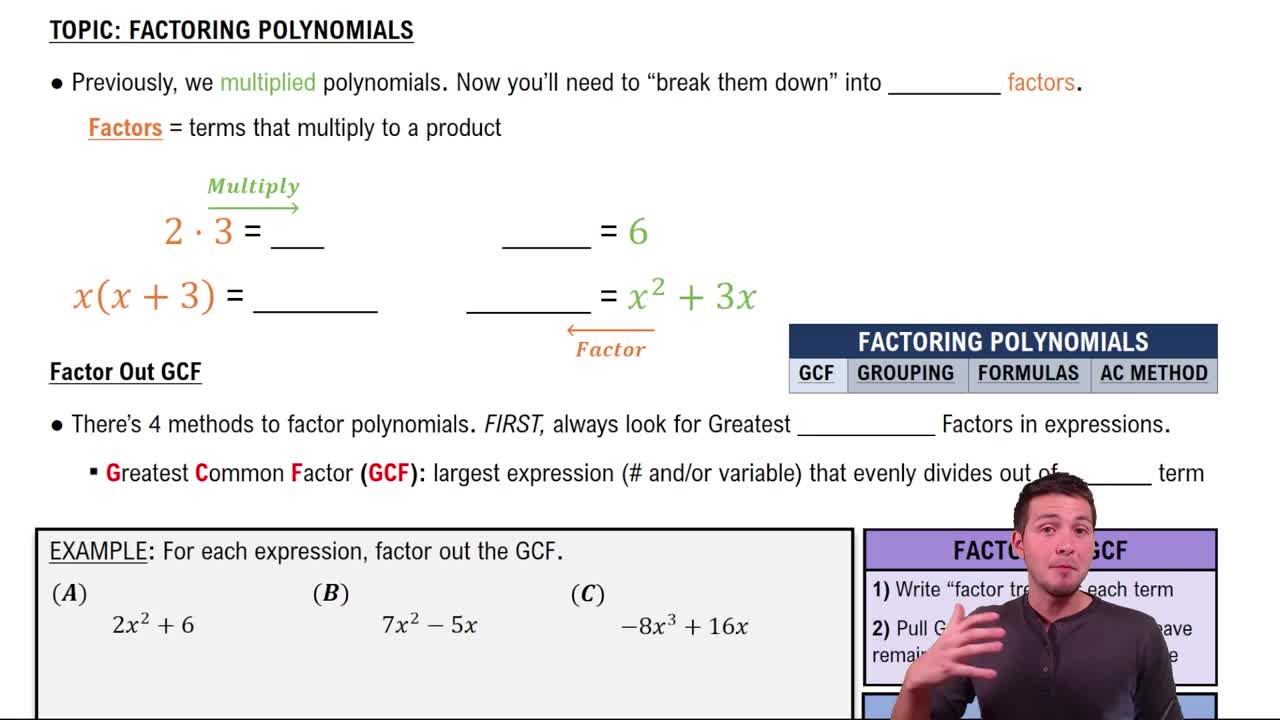
Factoring Polynomials
Factoring is the process of breaking down polynomials into products of simpler polynomials. It helps identify zeros of the numerator and denominator, which are critical points for determining intervals to test in the inequality.
Recommended video:
Guided course
Introduction to Factoring Polynomials
Interval Testing and Domain Restrictions
After finding critical points, the number line is divided into intervals. Each interval is tested to see if the inequality holds. Additionally, values that make the denominator zero are excluded from the solution set because they are undefined.
Recommended video:
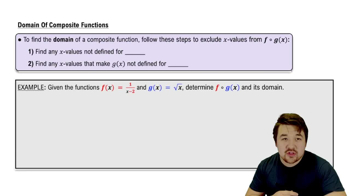
Domain Restrictions of Composed Functions
Related Practice
Textbook Question
900
views
Textbook Question
Show that the real zeros of each polynomial function satisfy the given conditions. See Example 6.
; no real zero less than -2
648
views
Textbook Question
Use synthetic division to determine whether the given number k is a zero of the polynomial function. If it is not, give the value of ƒ(k). ƒ(x) = 4x4 + x2 + 17x + 3; k= -3/2
424
views
Textbook Question
Show that the real zeros of each polynomial function satisfy the given conditions. ƒ(x)=3x4+2x3-4x2+x-1; no real zero greater than 1
565
views
Textbook Question
Graph each rational function. ƒ(x)=(x+2)/(x-3)
706
views
Textbook Question
Use synthetic division to determine whether the given number k is a zero of the polynomial function. If it is not, give the value of ƒ(k). ƒ(x) = x3 + 3x2 -x + 1; k = 1+i
563
views