Ch. 3 - Polynomial and Rational Functions
Lial - College Algebra 13th Edition
Lial13th EditionCollege AlgebraISBN: 9780136881063Not the one you use?Change textbook
Chapter 4, Problem 15

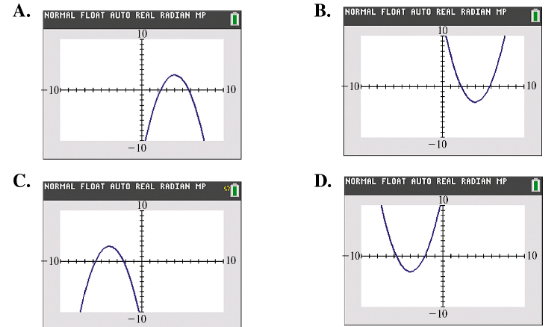
Match each function with its graph without actually entering it into a calculator. Then, after completing the exercises, check the answers with a calculator. Use the standard viewing window. ƒ(x) = (x - 4)2 - 3

Verified step by step guidance
1
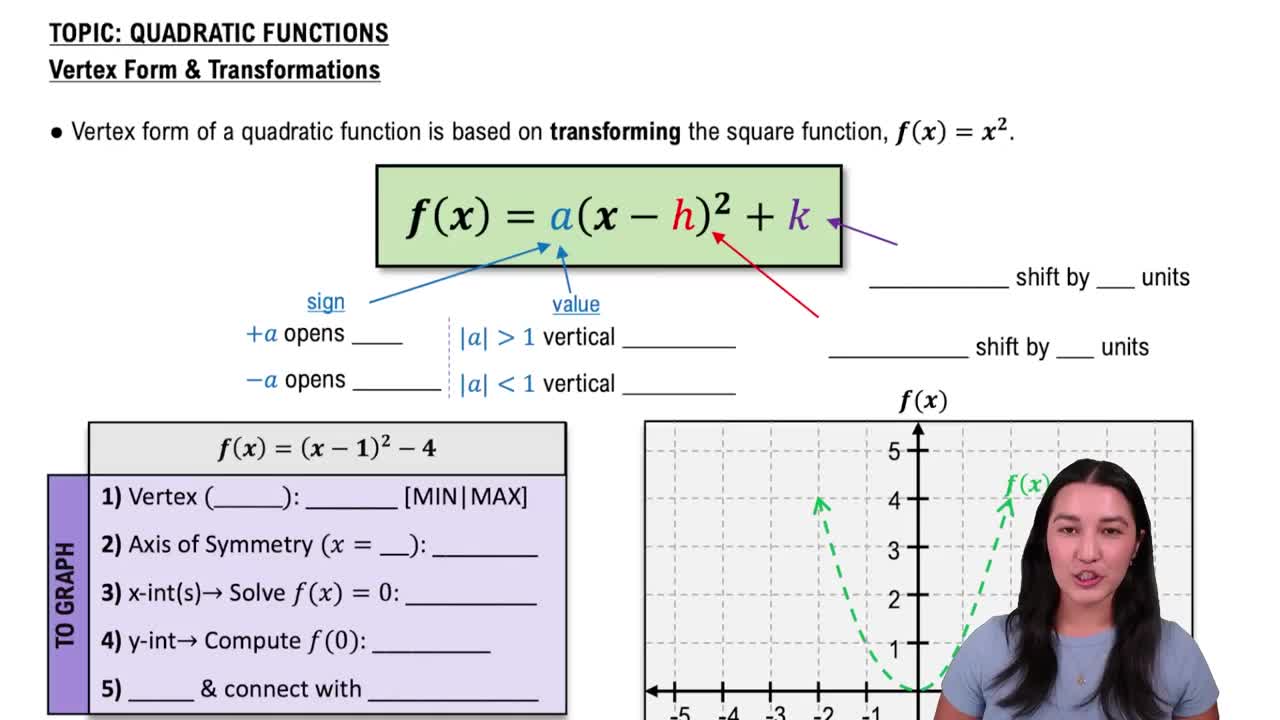
Identify the base function: recognize that the given function is a quadratic function in vertex form, which is \(f(x) = (x - h)^2 + k\), where \((h, k)\) is the vertex of the parabola.
Determine the vertex of the parabola from the function \(f(x) = (x - 4)^2 - 3\). Here, \(h = 4\) and \(k = -3\), so the vertex is at the point \((4, -3)\).
Analyze the direction of the parabola: since the coefficient of the squared term is positive (1), the parabola opens upwards.
Consider the axis of symmetry, which is the vertical line passing through the vertex, given by \(x = 4\).
Use this information to match the function to its graph by looking for a parabola with vertex at \((4, -3)\), opening upwards, and symmetric about the line \(x = 4\).

Verified video answer for a similar problem:

This video solution was recommended by our tutors as helpful for the problem above.
Video duration:
4m
Was this helpful?

Key Concepts

Here are the essential concepts you must grasp in order to answer the question correctly.

Vertex Form of a Quadratic Function

The vertex form of a quadratic function is f(x) = a(x - h)^2 + k, where (h, k) is the vertex of the parabola. This form makes it easy to identify the vertex and understand the graph's shifts from the origin. In the given function, (4, -3) is the vertex, indicating a horizontal shift right by 4 and a vertical shift down by 3.
Recommended video:
08:07
Vertex Form

Graphing Parabolas

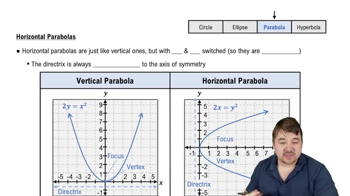
Parabolas are U-shaped graphs of quadratic functions. The sign of 'a' determines if the parabola opens upward (a > 0) or downward (a < 0). The vertex is the minimum or maximum point, and the axis of symmetry passes through the vertex. Understanding these features helps match the function to its graph without a calculator.
Recommended video:
5:28
Horizontal Parabolas

Effect of Transformations on Graphs

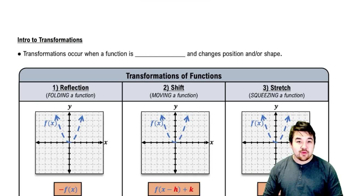
Transformations such as translations shift the graph horizontally or vertically without changing its shape. For f(x) = (x - 4)^2 - 3, subtracting 4 inside the squared term shifts the graph right by 4 units, and subtracting 3 outside shifts it down by 3 units. Recognizing these shifts aids in visualizing the graph accurately.
Recommended video:
5:25
Intro to Transformations