Solve each inequality. Give the solution set in interval notation. 4/(x+6)>2/(x-1)
Ch. 3 - Polynomial and Rational Functions

Chapter 4, Problem 86
A quadratic equation ƒ(x) = 0 has a solution x = 2. Its graph has vertex (5, 3). What is the other solution of the equation?
Verified step by step guidance1
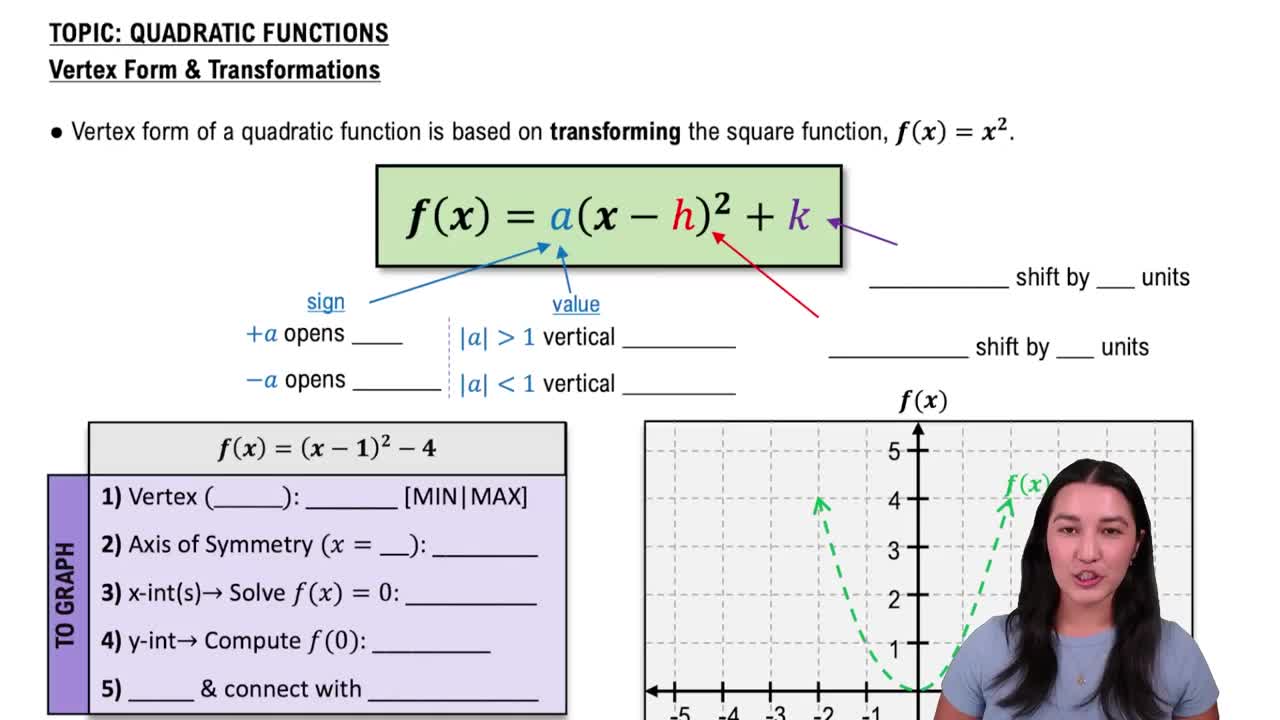
Recall that the quadratic function can be written in vertex form as \(f(x) = a(x - h)^2 + k\), where \((h, k)\) is the vertex. Here, the vertex is given as \((5, 3)\), so the function can be expressed as \(f(x) = a(x - 5)^2 + 3\).
Since \(x = 2\) is a solution to the equation \(f(x) = 0\), substitute \(x = 2\) and \(f(x) = 0\) into the vertex form to find the value of \(a\): \(0 = a(2 - 5)^2 + 3\).
Simplify the equation to solve for \(a\): calculate \((2 - 5)^2\) and then isolate \(a\) on one side of the equation.
Once \(a\) is found, write the quadratic function explicitly as \(f(x) = a(x - 5)^2 + 3\).
To find the other solution, set \(f(x) = 0\) and solve the equation \(a(x - 5)^2 + 3 = 0\) for \(x\). This will give two solutions, one of which is \(x = 2\), and the other will be the other solution you are asked to find.

Verified video answer for a similar problem:
This video solution was recommended by our tutors as helpful for the problem above.
Video duration:
6mWas this helpful?
Key Concepts
Here are the essential concepts you must grasp in order to answer the question correctly.
Quadratic Equation and Its Roots
A quadratic equation is a second-degree polynomial of the form ax² + bx + c = 0. It has two solutions or roots, which can be real or complex. These roots correspond to the x-values where the graph of the quadratic function intersects the x-axis.
Recommended video:
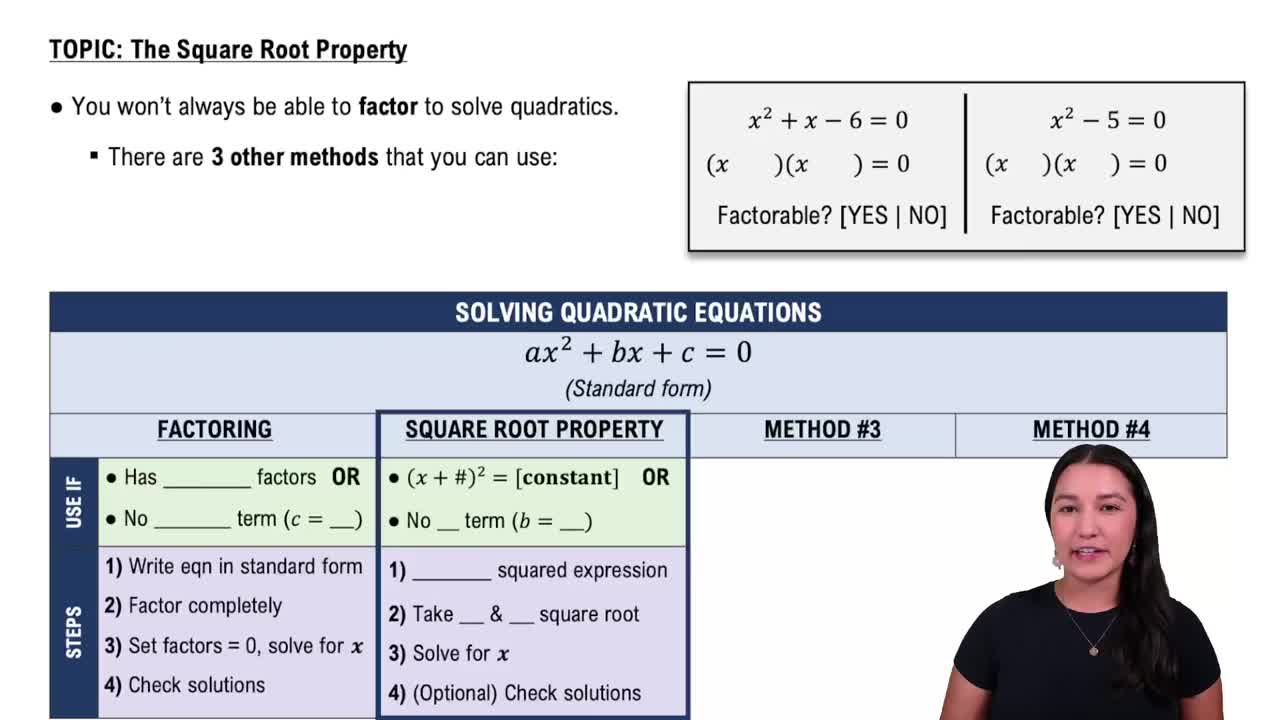
Solving Quadratic Equations by the Square Root Property
Vertex Form of a Quadratic Function
The vertex form of a quadratic function is f(x) = a(x - h)² + k, where (h, k) is the vertex of the parabola. Knowing the vertex helps in understanding the shape and position of the parabola, and it can be used to find the quadratic equation when combined with other points.
Recommended video:
Vertex Form
Symmetry of a Parabola
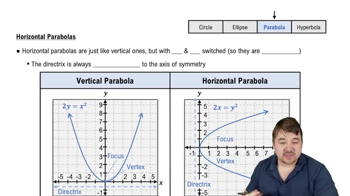
A parabola is symmetric about a vertical line called the axis of symmetry, which passes through the vertex. If one root is known, the other root can be found by reflecting it across the axis of symmetry, using the vertex's x-coordinate as the midpoint between the roots.
Recommended video:
Horizontal Parabolas
Related Practice
Textbook Question
515
views
Textbook Question
Graph each rational function. ƒ(x)=(20+6x-2x2)/(8+6x-2x2)
412
views
Textbook Question
Graph each rational function. ƒ(x)=(18+6x-4x2)/(4+6x+2x2)
427
views
Textbook Question
Use a graphing calculator to find the coordinates of the turning points of the graph of each polynomial function in the given domain interval. Give answers to the nearest hundredth. ƒ(x)=2x3-5x2-x+1; [1.4, 2]
733
views
Textbook Question
Determine the different possibilities for the numbers of positive, negative, and nonreal complex zeros of each function.
457
views
Textbook Question
The distance between the two points and is . Distance formula. Find the closest point on the line to the point . (Hint: Every point on has the form , and the closest point has the minimum distance.)
1012
views