
Textbook Question
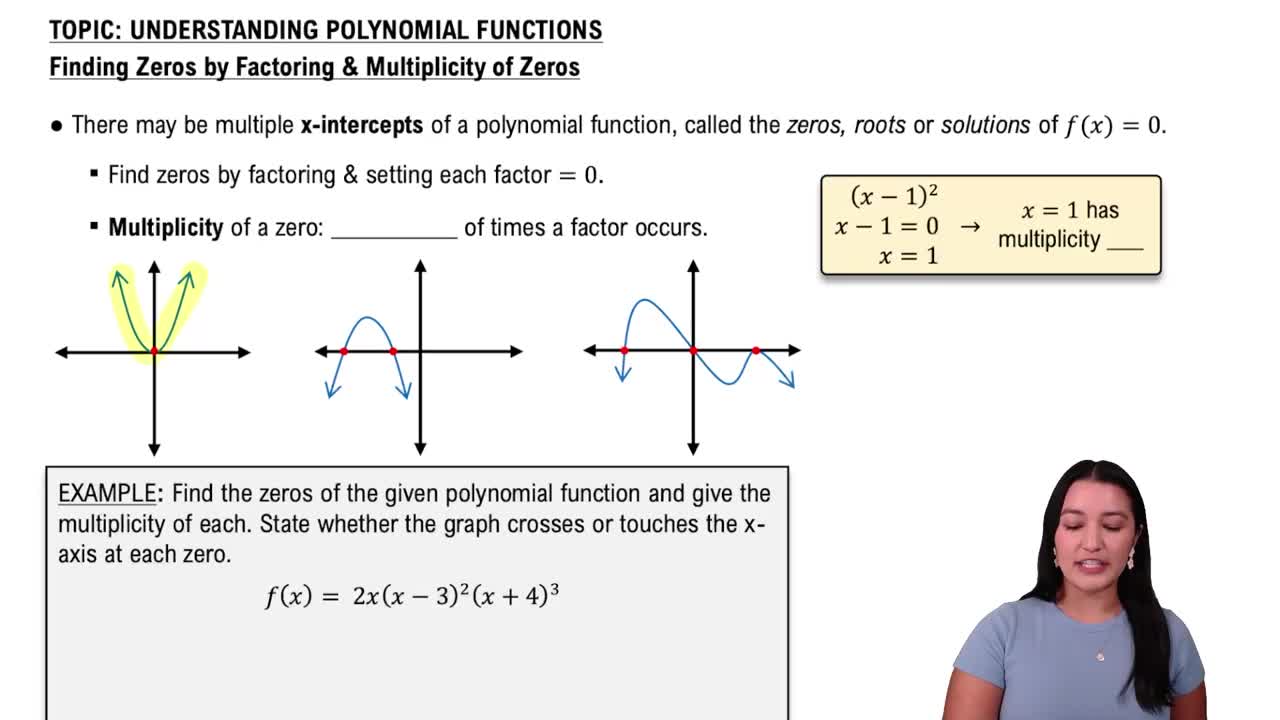
Determine whether each statement is true or false. If false, explain why. A polynomial function having degree 6 and only real coefficients may have no real zeros.
704
views

 Verified step by step guidance
 03:42
03:42 03:42
03:42 07:30
07:30Determine whether each statement is true or false. If false, explain why. A polynomial function having degree 6 and only real coefficients may have no real zeros.
Fill in the blank(s) to correctly complete each sentence, or answer the question as appropriate. In the equation y = 6x, y varies directly as x. When x=5, y=30. What is the value of y when x=10?
Graph each quadratic function. Give the vertex, axis, x-intercepts, y-intercept, domain, range, and largest open intervals of the domain over which each function is increasing or decreasing. ƒ(x)=-3x2-12x-1
Fill in the blank(s) to correctly complete each sentence. The highest point on the graph of a parabola that opens down is the ____ of the parabola.
Use the graph to solve each equation or inequality. Use interval notation where appropriate. 7x(x - 1)(x - 2) = 0
Use the graph to solve each equation or inequality. Use interval notation where appropriate. 7x(x - 1)(x - 2) < 0