Provide a short answer to each question. What is the domain of the function ? What is its range?
Ch. 3 - Polynomial and Rational Functions

Chapter 4, Problem 3
Determine whether each statement is true or false. If false, explain why. For ƒ(x)=(x+2)4(x-3), the number 2 is a zero of multiplicity 4.
Verified step by step guidance1
Recall that the zeros of a function are the values of \( x \) that make \( f(x) = 0 \).
Given \( f(x) = (x+2)^4 (x-3) \), the zeros come from setting each factor equal to zero: \( x+2=0 \) and \( x-3=0 \).
Solving these, we find the zeros are \( x = -2 \) and \( x = 3 \).
The multiplicity of a zero is the exponent on the factor corresponding to that zero. For \( x = -2 \), the multiplicity is 4 because of the \( (x+2)^4 \) term.
Since the problem states the number 2 is a zero of multiplicity 4, but the zero with multiplicity 4 is actually \( -2 \), the statement is false.

Verified video answer for a similar problem:
This video solution was recommended by our tutors as helpful for the problem above.
Video duration:
2mWas this helpful?
Key Concepts
Here are the essential concepts you must grasp in order to answer the question correctly.
Zeros of a Function
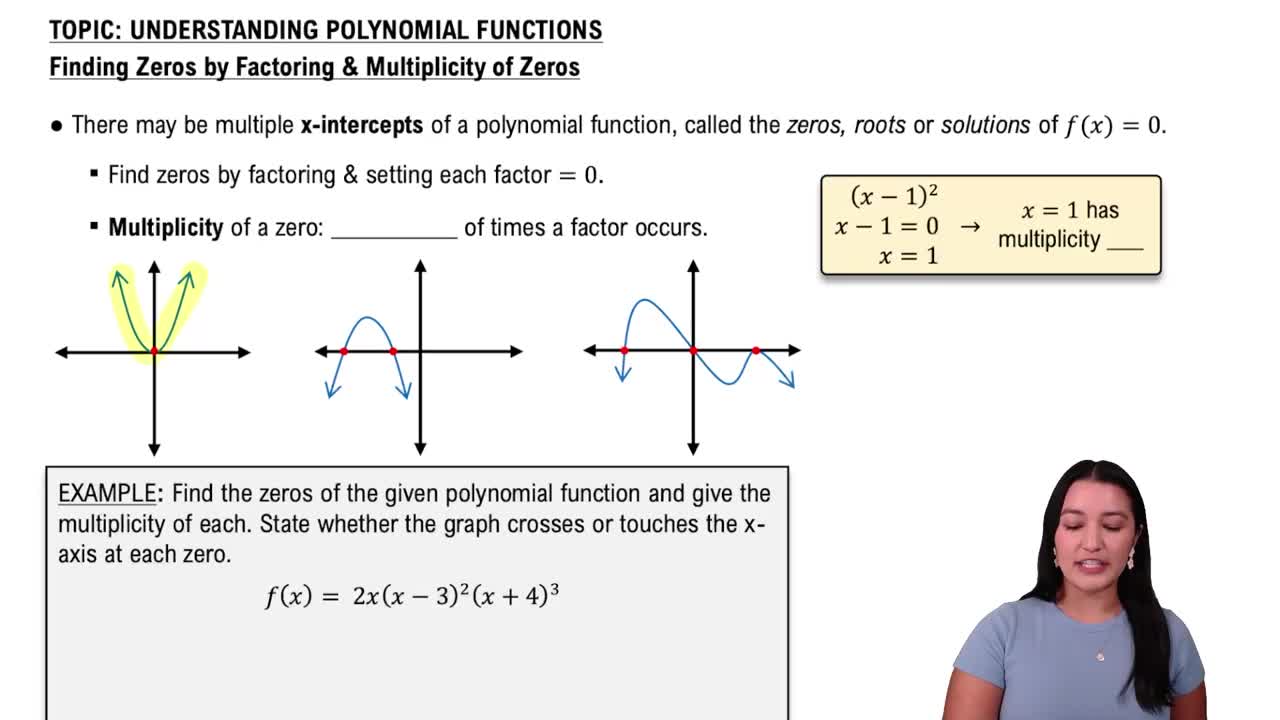
A zero of a function is a value of x for which the function equals zero. To find zeros, set the function equal to zero and solve for x. Each zero corresponds to a root of the equation, indicating where the graph crosses or touches the x-axis.
Recommended video:
Finding Zeros & Their Multiplicity
Multiplicity of a Zero
Multiplicity refers to how many times a particular zero appears as a factor in the function. For example, if (x - a)^n is a factor, then x = a is a zero of multiplicity n. The multiplicity affects the graph's behavior at that zero, such as whether it crosses or just touches the x-axis.
Recommended video:
Finding Zeros & Their Multiplicity
Factoring and Identifying Zeros from Polynomial Expressions
To identify zeros and their multiplicities, express the polynomial in factored form. Each factor of the form (x - c)^k indicates a zero at x = c with multiplicity k. Understanding how to read and interpret these factors is essential for analyzing the function's roots.
Recommended video:
Guided course
Introduction to Factoring Polynomials
Related Practice
Textbook Question
599
views
Textbook Question
Graph each quadratic function. Give the vertex, axis, x-intercepts, y-intercept, domain, range, and largest open intervals of the domain over which each function is increasing or decreasing. ƒ(x)=-3x2-12x-1
1571
views
Textbook Question
Fill in the blank(s) to correctly complete each sentence. The highest point on the graph of a parabola that opens down is the ____ of the parabola.
897
views
Textbook Question
Determine whether each statement is true or false. If false, explain why. Because x-1 is a factor of ƒ(x)=x6-x4+2x2-2, we can also conclude that ƒ(1) = 0.
447
views
Textbook Question
Provide a short answer to each question. What is the domain of the function ƒ(x)=1/x? What is its range?
1161
views
Textbook Question
Use the graph to solve each equation or inequality. Use interval notation where appropriate. 7x(x - 1)(x - 2) = 0
540
views