Ch. 4 - Inverse, Exponential, and Logarithmic Functions
Lial - College Algebra 13th Edition
Lial13th EditionCollege AlgebraISBN: 9780136881063Not the one you use?Change textbook
Chapter 5, Problem 57

Find each value. If applicable, give an approximation to four decimal places. ln 98/13

Verified step by step guidance
1
Recognize that the expression involves the natural logarithm function: \(\ln \left( \frac{98}{13} \right)\).
Use the logarithm property that allows you to rewrite the logarithm of a quotient as the difference of logarithms: \(\ln \left( \frac{a}{b} \right) = \ln a - \ln b\).
Apply this property to rewrite the expression as \(\ln 98 - \ln 13\).
Find or use a calculator to determine the approximate values of \(\ln 98\) and \(\ln 13\) separately.
Subtract the value of \(\ln 13\) from \(\ln 98\) to get the result, and if needed, round the answer to four decimal places.

Verified video answer for a similar problem:

This video solution was recommended by our tutors as helpful for the problem above.
Video duration:
1m
Was this helpful?

Key Concepts

Here are the essential concepts you must grasp in order to answer the question correctly.

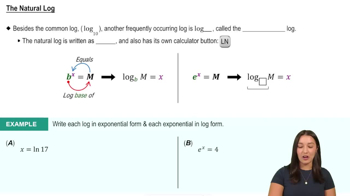
Natural Logarithm (ln)

The natural logarithm, denoted as ln, is the logarithm to the base e, where e ≈ 2.71828. It answers the question: to what power must e be raised to get a given number? For example, ln(1) = 0 because e^0 = 1.
Recommended video:
2:51
The Natural Log

Properties of Logarithms

Logarithms have key properties that simplify calculations, such as ln(a/b) = ln(a) - ln(b). This property allows the logarithm of a quotient to be expressed as the difference of two logarithms, making complex expressions easier to evaluate.
Recommended video:
5:36
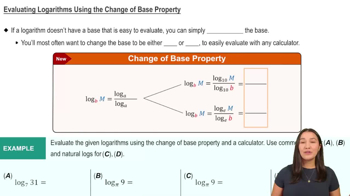
Change of Base Property

Approximation of Logarithmic Values

When exact values of logarithms are not easily found, approximations are used, often rounded to a certain number of decimal places. Calculators or tables provide these approximations, and rounding to four decimal places means keeping four digits after the decimal point.
Recommended video:
7:30
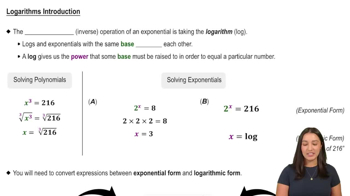
Logarithms Introduction