Ch. 2 - Graphs and Functions
Lial - College Algebra 13th Edition
Lial13th EditionCollege AlgebraISBN: 9780136881063Not the one you use?Change textbook
Chapter 3, Problem 71

Graph each function. See Examples 6–8 and the Summary of Graphing Techniques box following Example 9. g(x)=(x+2)2

Verified step by step guidance
1
Identify the base function. Here, the base function is the quadratic function \(f(x) = x^2\), which is a parabola opening upwards with its vertex at the origin \((0,0)\).
Recognize the transformation applied to the base function. The function \(g(x) = (x + 2)^2\) represents a horizontal shift of the base function. Specifically, the graph shifts left by 2 units because of the \(+2\) inside the parentheses with \(x\).
Determine the new vertex of the parabola after the shift. Since the original vertex is at \((0,0)\), shifting left by 2 units moves the vertex to \((-2, 0)\).
Plot the vertex at \((-2, 0)\) on the coordinate plane. Then, use the shape of the parabola \(y = x^2\) to plot additional points by choosing \(x\)-values around \(-2\), calculating \(g(x)\), and plotting those points.
Draw a smooth curve through the plotted points to complete the graph of \(g(x) = (x + 2)^2\), ensuring the parabola opens upwards and is symmetric about the vertical line \(x = -2\).

Verified video answer for a similar problem:

This video solution was recommended by our tutors as helpful for the problem above.
Video duration:
1m
Was this helpful?

Key Concepts

Here are the essential concepts you must grasp in order to answer the question correctly.

Function Notation and Evaluation

Function notation, such as g(x), represents a rule that assigns each input x to an output value. Understanding how to evaluate g(x) for various x-values is essential for plotting points and graphing the function accurately.
Recommended video:
4:26
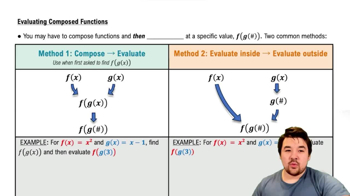
Evaluating Composed Functions

Graphing Quadratic Functions

Quadratic functions have the form f(x) = ax^2 + bx + c and produce parabolas when graphed. Recognizing that g(x) = (x+2)^2 is a quadratic shifted horizontally helps in sketching its shape and position on the coordinate plane.
Recommended video:
5:26
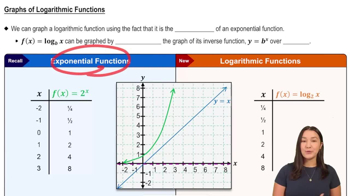
Graphs of Logarithmic Functions

Transformations of Functions

Transformations modify the graph of a base function. For g(x) = (x+2)^2, the '+2' inside the parentheses indicates a horizontal shift of the parent function x^2 two units to the left, which is crucial for accurate graphing.
Recommended video:
4:22
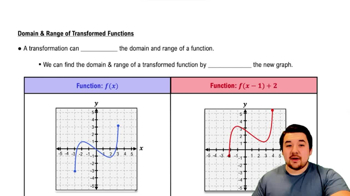
Domain & Range of Transformed Functions