Give the equations of any vertical, horizontal, or oblique asymptotes for the graph of each rational function. ƒ(x)=(x2-2x-3)/(2x2-x-10)
Ch. 3 - Polynomial and Rational Functions

Chapter 4, Problem 43
Determine the largest open interval of the domain (a) over which the function is increasing and (b) over which it is decreasing. ƒ(x) = -2x2 - 8x - 7
Verified step by step guidance1
Identify the function given: \(f(x) = -2x^2 - 8x - 7\). Since this is a quadratic function, its graph is a parabola.
Find the first derivative \(f'(x)\) to determine where the function is increasing or decreasing. Use the power rule: \(f'(x) = \frac{d}{dx}(-2x^2) + \frac{d}{dx}(-8x) + \frac{d}{dx}(-7)\).
Simplify the derivative: \(f'(x) = -4x - 8\). This derivative tells us the slope of the tangent line at any point \(x\).
Set the derivative equal to zero to find critical points: \(-4x - 8 = 0\). Solve for \(x\) to find where the slope changes from positive to negative or vice versa.
Use the critical point to divide the domain into intervals. Test values from each interval in \(f'(x)\) to determine if the function is increasing (where \(f'(x) > 0\)) or decreasing (where \(f'(x) < 0\)) on those intervals.

Verified video answer for a similar problem:
This video solution was recommended by our tutors as helpful for the problem above.
Video duration:
4mWas this helpful?
Key Concepts
Here are the essential concepts you must grasp in order to answer the question correctly.
Domain of a Function
The domain of a function is the set of all possible input values (x-values) for which the function is defined. For polynomial functions like ƒ(x) = -2x² - 8x - 7, the domain is all real numbers since polynomials are defined everywhere on the real line.
Recommended video:
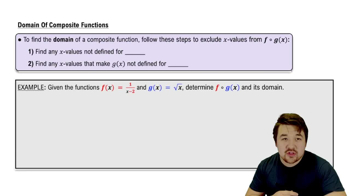
Domain Restrictions of Composed Functions
Increasing and Decreasing Intervals
A function is increasing on an interval if its output values rise as x increases, and decreasing if its output values fall as x increases. Identifying these intervals involves analyzing the behavior of the function’s slope or derivative over different parts of the domain.
Recommended video:
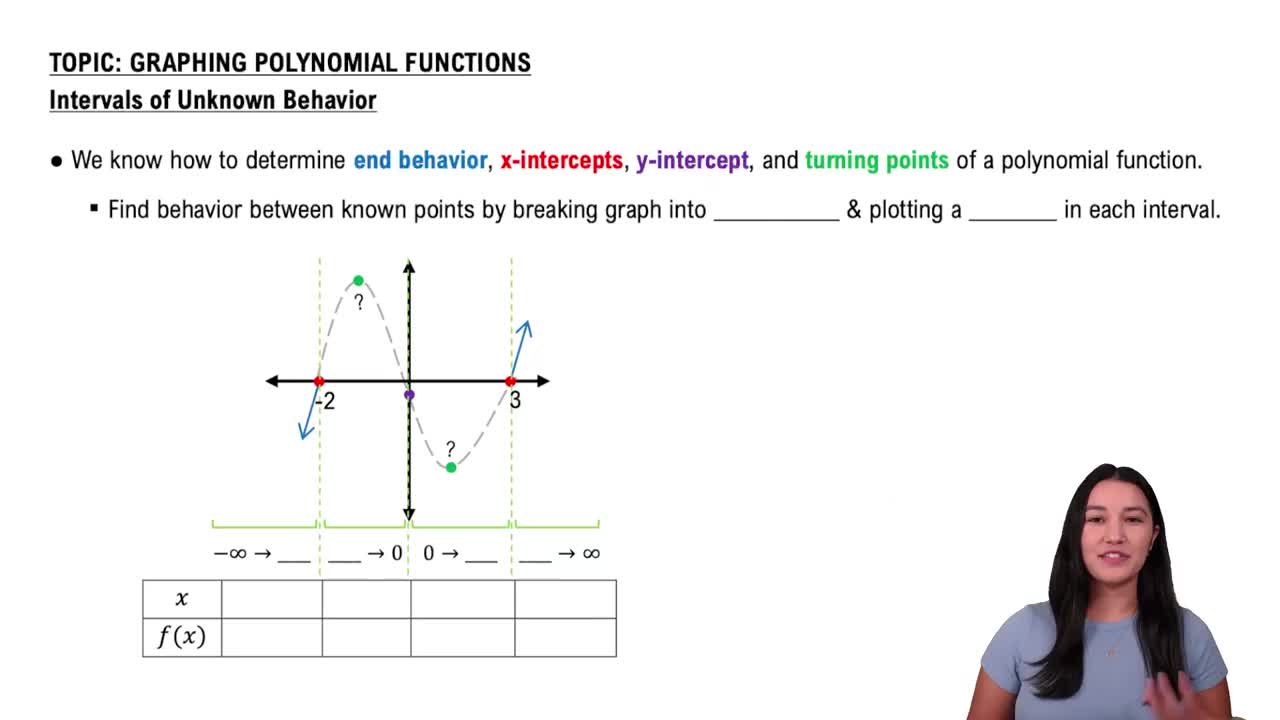
Identifying Intervals of Unknown Behavior
Using the Derivative to Determine Monotonicity
The derivative of a function gives the slope of the tangent line at any point. If the derivative is positive on an interval, the function is increasing there; if negative, the function is decreasing. For ƒ(x) = -2x² - 8x - 7, finding ƒ'(x) and solving inequalities helps find these intervals.
Recommended video:
Guided course
Determinants of 2×2 Matrices
Related Practice
Textbook Question
814
views
Textbook Question
Solve each polynomial inequality. Give the solution set in interval notation. x4 + 2x3 + 36 < 11x2 + 12x
491
views
Textbook Question
Graph each polynomial function. Factor first if the polynomial is not in factored form. ƒ(x)=2x4+x3-6x2-7x-2
554
views
Textbook Question
Determine the largest open interval of the domain (a) over which the function is increasing and (b) over which it is decreasing. ƒ(x) = -3x2 + 18x + 1
803
views
Textbook Question
Several graphs of the quadratic function ƒ(x) = ax2 + bx + c are shown below. For the given restrictions on a, b, and c, select the corresponding graph from choices A–F. (Hint: Use the discriminant.) a < 0; b2 - 4ac = 0
1072
views
Textbook Question
For each polynomial function, use the remainder theorem to find ƒ(k). ƒ(x) = 2x5 - 10x3 - 19x2 - 50; k=3
404
views