Height of a Projected Ball An astronaut on the moon throws a baseball upward. The astronaut is 6 ft, 6 in. tall, and the initial velocity of the ball is 30 ft per sec. The height s of the ball in feet is given by the equations=-2.7t2+30t+6.5,where t is the number of seconds after the ball was thrown. (a) After how many seconds is the ball 12 ft above the moon's surface? Round to the nearest hundredth. (b) How many seconds will it take for the ball to hit the moon's surface? Round to the nearest hundredth.
Ch. 1 - Equations and Inequalities

Chapter 2, Problem 47a
Find each sum or difference. Write answers in standard form. (3+2i) + (9+3i)
Verified step by step guidance1
Identify the problem as adding two complex numbers: \((3 + 2i)\) and \((9 + 3i)\).
Recall that to add complex numbers, you add their real parts together and their imaginary parts together separately.
Add the real parts: \$3 + 9$.
Add the imaginary parts: \$2i + 3i$.
Write the result in standard form as the sum of the real part and the imaginary part: \((\text{real part}) + (\text{imaginary part})i\).

Verified video answer for a similar problem:
This video solution was recommended by our tutors as helpful for the problem above.
Video duration:
1mWas this helpful?
Key Concepts
Here are the essential concepts you must grasp in order to answer the question correctly.
Complex Numbers
Complex numbers are numbers in the form a + bi, where a and b are real numbers and i is the imaginary unit with the property i² = -1. They combine a real part and an imaginary part, allowing for operations beyond the real number line.
Recommended video:
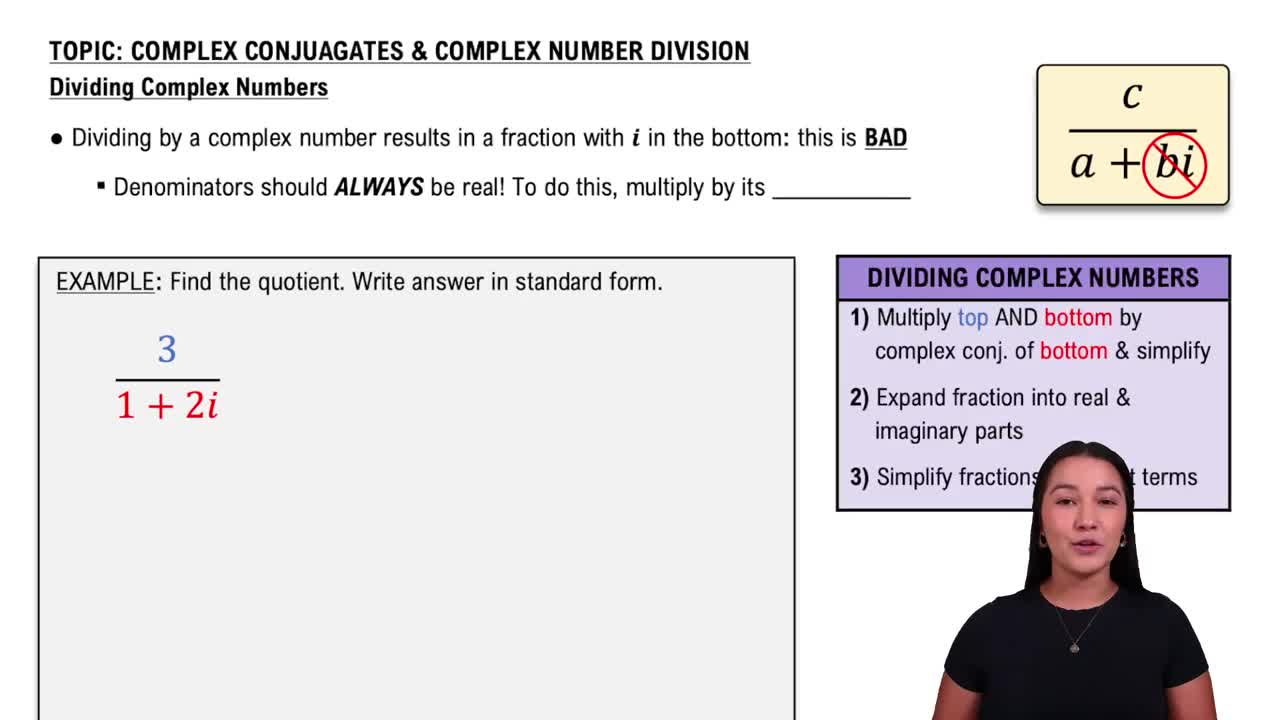
Dividing Complex Numbers
Addition of Complex Numbers
To add complex numbers, add their real parts together and their imaginary parts together separately. For example, (a + bi) + (c + di) = (a + c) + (b + d)i, combining like terms to form a new complex number.
Recommended video:
Dividing Complex Numbers
Standard Form of Complex Numbers
The standard form of a complex number is written as a + bi, where a is the real part and b is the coefficient of the imaginary part. Writing answers in this form clearly separates the real and imaginary components.
Recommended video:
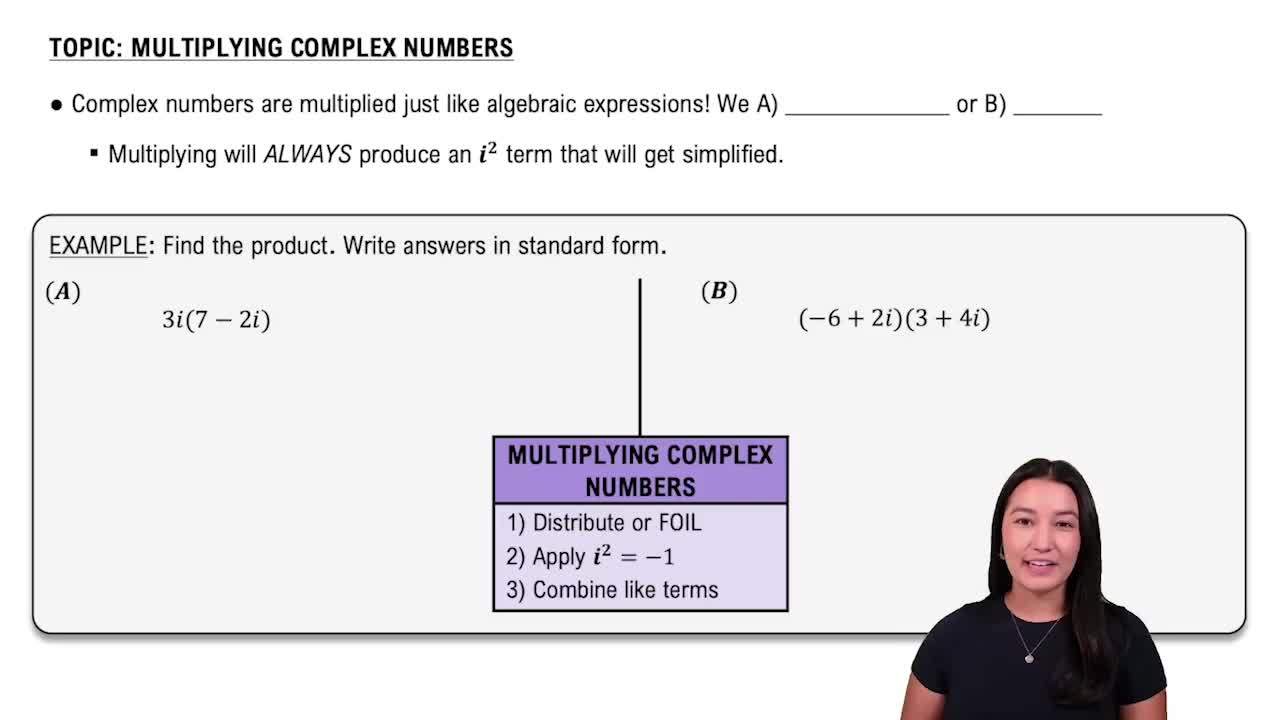
Multiplying Complex Numbers
Related Practice
Textbook Question
76
views
Textbook Question
Solve each quadratic inequality. Give the solution set in interval notation. x(x-1)≤6
466
views
Textbook Question
Solve each quadratic inequality. Give the solution set in interval notation. x(x+1)<12
501
views
Textbook Question
Solve each equation or inequality. | 5x + 2 | - 2 < 3
733
views
Textbook Question
Solve each equation using completing the square. 3x2 - 9x + 7 = 0
1049
views
Textbook Question
Solve each equation. √(3x+7) = 3x+5
537
views
