Identify the operation: The problem asks to find the sum or difference of -15 and 6, which means we are adding a negative number and a positive number.
Rewrite the expression clearly: \(-15 + 6\).
Understand that adding a positive number to a negative number is equivalent to subtracting the smaller absolute value from the larger absolute value and keeping the sign of the number with the larger absolute value.
Compare the absolute values: \(| -15 | = 15\) and \(| 6 | = 6\). Since 15 is greater, the result will have the sign of -15, which is negative.
Subtract the smaller absolute value from the larger absolute value: \$15 - 6$ and then apply the negative sign to get the final expression.
Verified video answer for a similar problem:
This video solution was recommended by our tutors as helpful for the problem above
Video duration:
1m
Play a video:
0 Comments
Key Concepts
Here are the essential concepts you must grasp in order to answer the question correctly.
Integer Addition and Subtraction
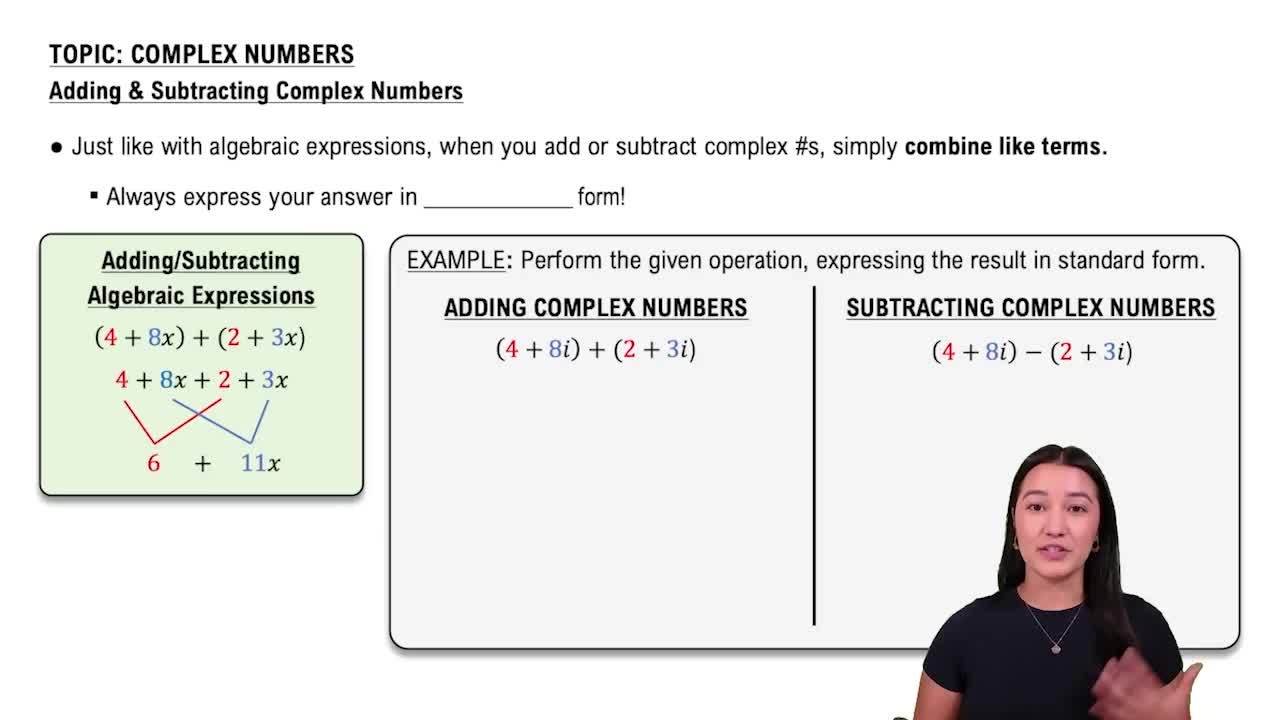
This concept involves combining positive and negative whole numbers. Adding a positive number increases the value, while adding a negative number decreases it. Understanding how to handle signs is essential for correctly computing sums and differences.
Using a number line helps visualize addition and subtraction of integers. Moving right represents adding positive numbers, and moving left represents adding negative numbers or subtracting. This aids in understanding the direction and magnitude of changes.
Simplifying involves performing arithmetic operations to reduce an expression to a single value. For sums and differences, this means combining like terms and calculating the final result accurately.

 1:29 minutes
 Verified step by step guidance
 03:18
03:18