Ch. 1 - Equations and Inequalities
Lial - College Algebra 13th Edition
Lial13th EditionCollege AlgebraISBN: 9780136881063Not the one you use?Change textbook
Chapter 2, Problem 83

Solve each equation. (2x-1)2/3 = x1/3

Verified step by step guidance
1
Start by rewriting the equation to clearly see the terms: \( (2x - 1)^{\frac{2}{3}} = x^{\frac{1}{3}} \).
To eliminate the fractional exponents, consider raising both sides of the equation to a power that will clear the denominators. Since the denominators are 3, raise both sides to the power of 3 to get rid of the cube roots.
After raising both sides to the power of 3, simplify the expressions carefully. Remember that \(\left(a^{\frac{m}{n}}\right)^n = a^m\). This will transform the equation into a polynomial form.
Once you have a polynomial equation, expand and simplify all terms to bring the equation into standard polynomial form (e.g., quadratic or cubic).
Solve the resulting polynomial equation using appropriate methods such as factoring, the quadratic formula, or synthetic division. Finally, check your solutions in the original equation to ensure they do not produce extraneous results due to the fractional exponents.

Verified video answer for a similar problem:

This video solution was recommended by our tutors as helpful for the problem above.
Video duration:
6m
Was this helpful?

Key Concepts

Here are the essential concepts you must grasp in order to answer the question correctly.

Rational Exponents

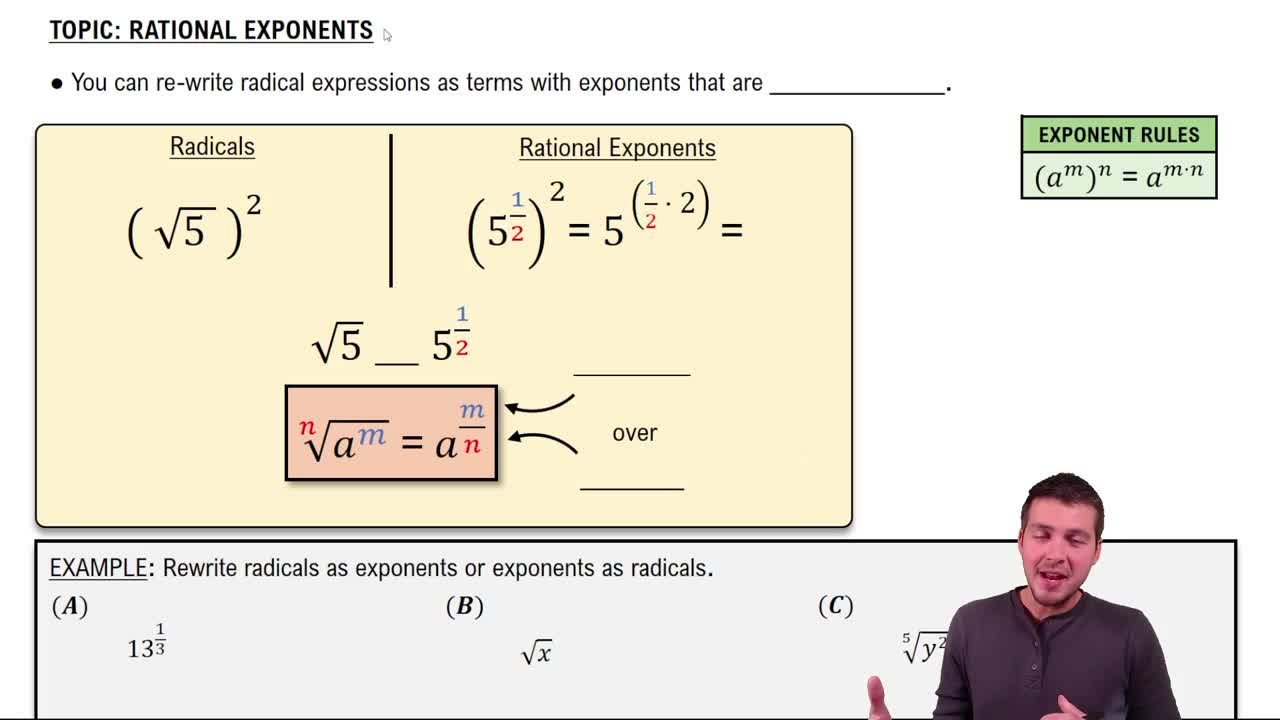
Rational exponents represent roots and powers simultaneously, where the numerator is the power and the denominator is the root. For example, x^(2/3) means the cube root of x squared. Understanding how to manipulate and simplify expressions with rational exponents is essential for solving equations like the given one.
Recommended video:
Guided course
04:06
Rational Exponents

Equation Solving with Exponents

Solving equations involving exponents often requires isolating the variable term and applying inverse operations such as raising both sides to a power that eliminates the fractional exponent. Recognizing equivalent expressions and carefully handling domain restrictions is important to find all valid solutions.
Recommended video:
5:02
Solving Logarithmic Equations

Domain and Extraneous Solutions

When dealing with fractional exponents, especially with even roots, the domain of the variable is restricted to values that keep the expression defined (e.g., no negative values under even roots). Checking for extraneous solutions after solving is crucial because some algebraic manipulations can introduce invalid answers.
Recommended video:
3:43
Finding the Domain of an Equation