Solve each problem. See Examples 5 and 6. Formaldehyde is an indoor air pollutant formerly found in plywood, foam insulation, and carpeting. When concentrations in the air reach 33 micrograms per cubic foot (μg/ft3), eye irritation can occur. One square foot of new plywood could emit 140 μg per hr. (Data from A. Hines, Indoor Air Quality & Control.) A room has 100 ft2 of new plywood flooring. Find a linear equation F that computes the amount of formaldehyde, in micrograms, emitted in x hours.
Ch. 1 - Equations and Inequalities

Chapter 2, Problem 43
Solve each equation. (2x+1)(x-4) = x
Verified step by step guidance1
Start by expanding the left-hand side of the equation using the distributive property (FOIL method): multiply each term in the first binomial by each term in the second binomial. So, expand \((2x+1)(x-4)\) to get \(2x \cdot x + 2x \cdot (-4) + 1 \cdot x + 1 \cdot (-4)\).
Simplify the expression from the expansion: combine like terms to write the left side as a quadratic expression in standard form.
Rewrite the equation by setting it equal to the right-hand side, which is \(x\). Then, move all terms to one side of the equation to set the equation equal to zero. This will give you a quadratic equation in the form \(ax^2 + bx + c = 0\).
Use the quadratic formula to solve for \(x\). Recall the quadratic formula is \(x = \frac{-b \pm \sqrt{b^2 - 4ac}}{2a}\), where \(a\), \(b\), and \(c\) are the coefficients from your quadratic equation.
Calculate the discriminant \(b^2 - 4ac\) to determine the nature of the roots, then substitute the values into the quadratic formula to find the solutions for \(x\).

Verified video answer for a similar problem:
This video solution was recommended by our tutors as helpful for the problem above.
Video duration:
5mWas this helpful?
Key Concepts
Here are the essential concepts you must grasp in order to answer the question correctly.
Expanding Algebraic Expressions
Expanding involves multiplying terms within parentheses to remove them, using the distributive property. For example, (2x+1)(x-4) expands to 2x·x + 2x·(-4) + 1·x + 1·(-4). This step simplifies the equation into a polynomial form that is easier to solve.
Recommended video:
Guided course
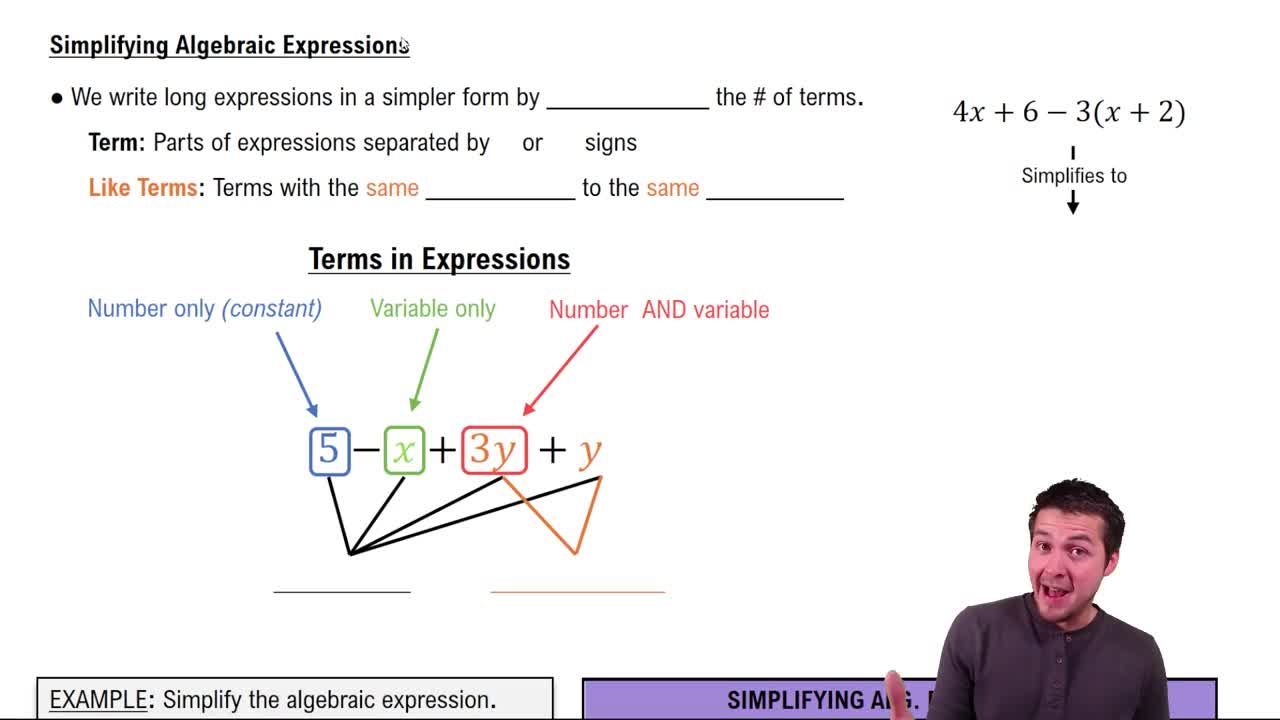
Simplifying Algebraic Expressions
Forming and Solving Quadratic Equations
After expansion, the equation typically becomes quadratic (ax² + bx + c = 0). Solving quadratic equations involves rearranging all terms to one side to set the equation equal to zero, then applying methods like factoring, completing the square, or the quadratic formula to find the values of x.
Recommended video:
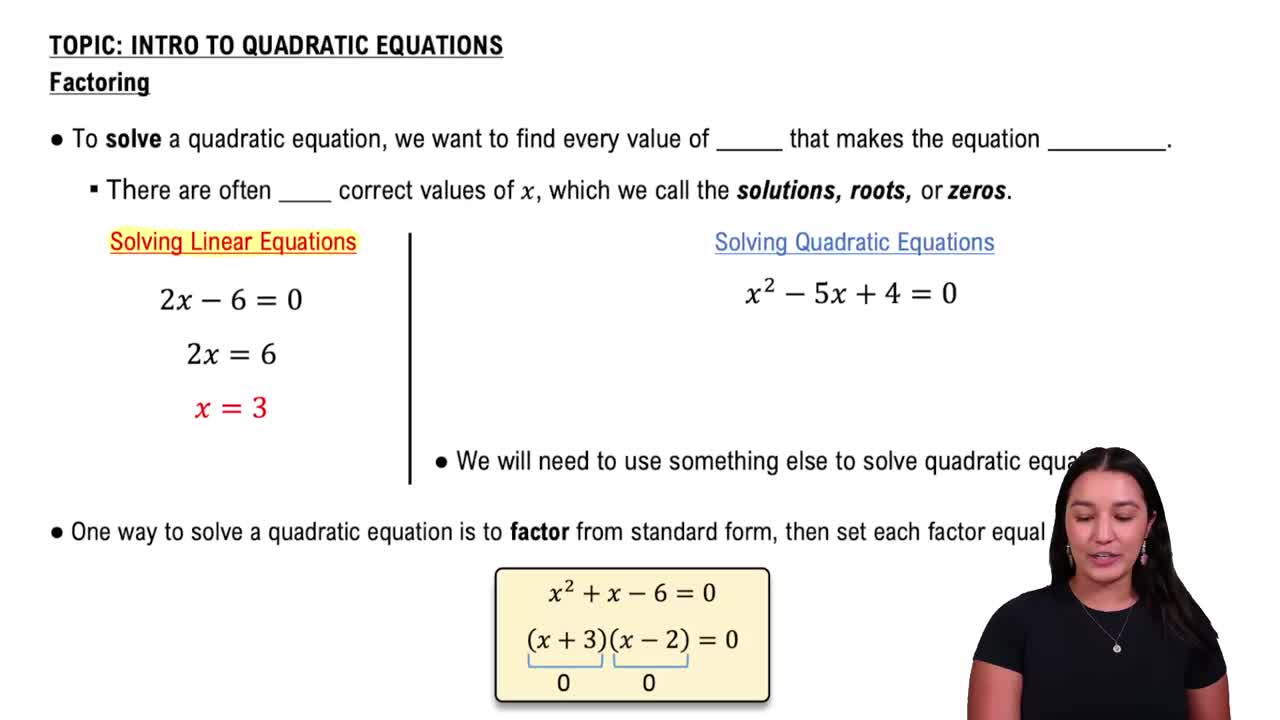
Solving Quadratic Equations by Factoring
Isolating Variables and Simplifying Equations
Isolating variables means manipulating the equation to get x alone on one side. This includes combining like terms and moving all terms to one side to simplify the equation. Simplification is crucial before applying solution methods to ensure accuracy and clarity.
Recommended video:
Guided course
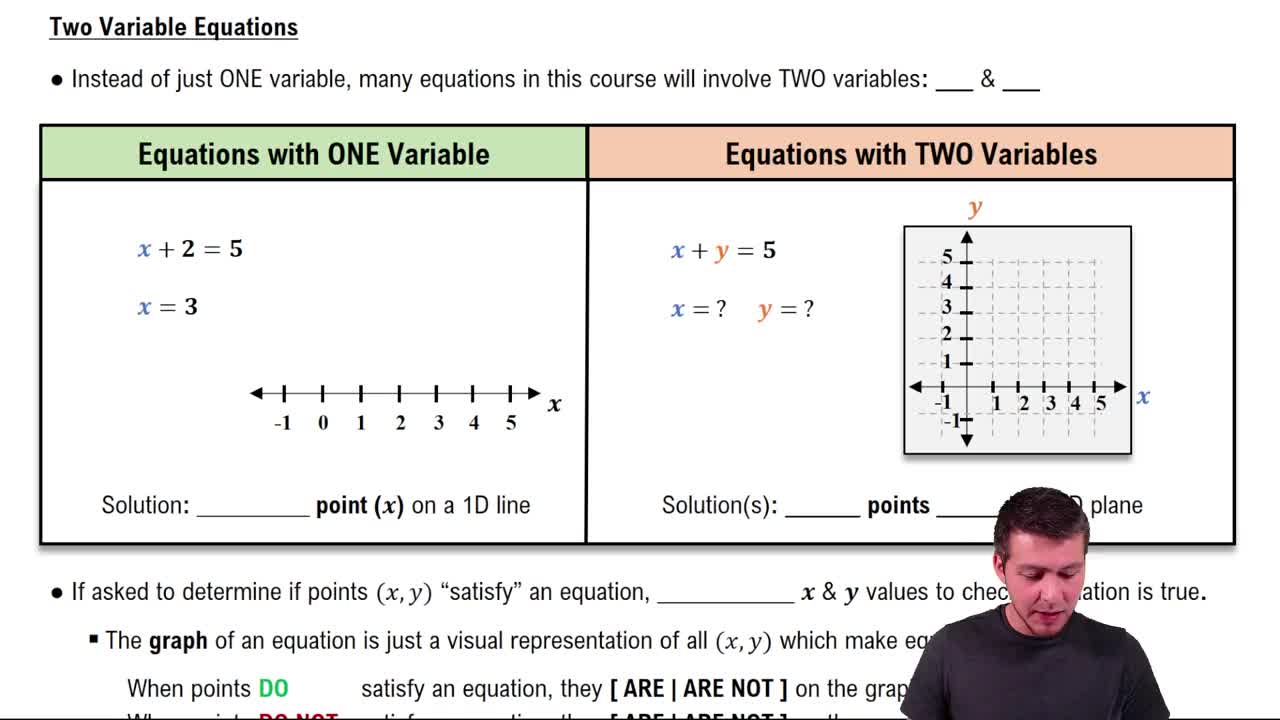
Equations with Two Variables
Related Practice
Textbook Question
636
views
Textbook Question
Solve each quadratic inequality. Give the solution set in interval notation. x2-7x+10>0
504
views
Textbook Question
Solve each quadratic inequality. Give the solution set in interval notation. 2x2-9x≤18
597
views
Textbook Question
Height of a Projectile A projectile is launched from ground level with an initial velocity of v0 feet per second. Neglecting air resistance, its height in feet t seconds after launch is given by s=-16t2+v0t. In each exercise, find the time(s) that the projectile will (a) reach a height of 80 ft and (b) return to the ground for the given value of v0. Round answers to the nearest hundredth if necessary. v0=96
1070
views
Textbook Question
Solve each equation or inequality. |4x + 3| - 2 = -1
726
views
Textbook Question
Solve each equation using completing the square. 2x2 + x = 10
1071
views
