Multiply or divide as indicated. 12.8 × 9.1
Ch. R - Review of Basic Concepts

Chapter 1, Problem 105
Perform the indicated operations. Assume all variables represent positive real numbers.
Verified step by step guidance1
Identify the terms to be operated on: \(3x\sqrt[3]{xy^{2}}\) and \(2\sqrt[3]{8x^{4}y^{2}}\).
Rewrite the cube roots as fractional exponents: \(\sqrt[3]{xy^{2}} = (xy^{2})^{\frac{1}{3}}\) and \(\sqrt[3]{8x^{4}y^{2}} = (8x^{4}y^{2})^{\frac{1}{3}}\).
Simplify the second cube root by factoring inside the root: \$8 = 2^{3}$, so \(\sqrt[3]{8x^{4}y^{2}} = \sqrt[3]{2^{3} \cdot x^{4} \cdot y^{2}}\).
Apply the cube root to each factor separately: \(\sqrt[3]{2^{3}} = 2\), \(\sqrt[3]{x^{4}} = x^{\frac{4}{3}}\), and \(\sqrt[3]{y^{2}} = y^{\frac{2}{3}}\).
Rewrite the original expression using these simplifications and then combine like terms by expressing all parts with fractional exponents to facilitate addition or subtraction.

Verified video answer for a similar problem:
This video solution was recommended by our tutors as helpful for the problem above.
Video duration:
6mWas this helpful?
Key Concepts
Here are the essential concepts you must grasp in order to answer the question correctly.
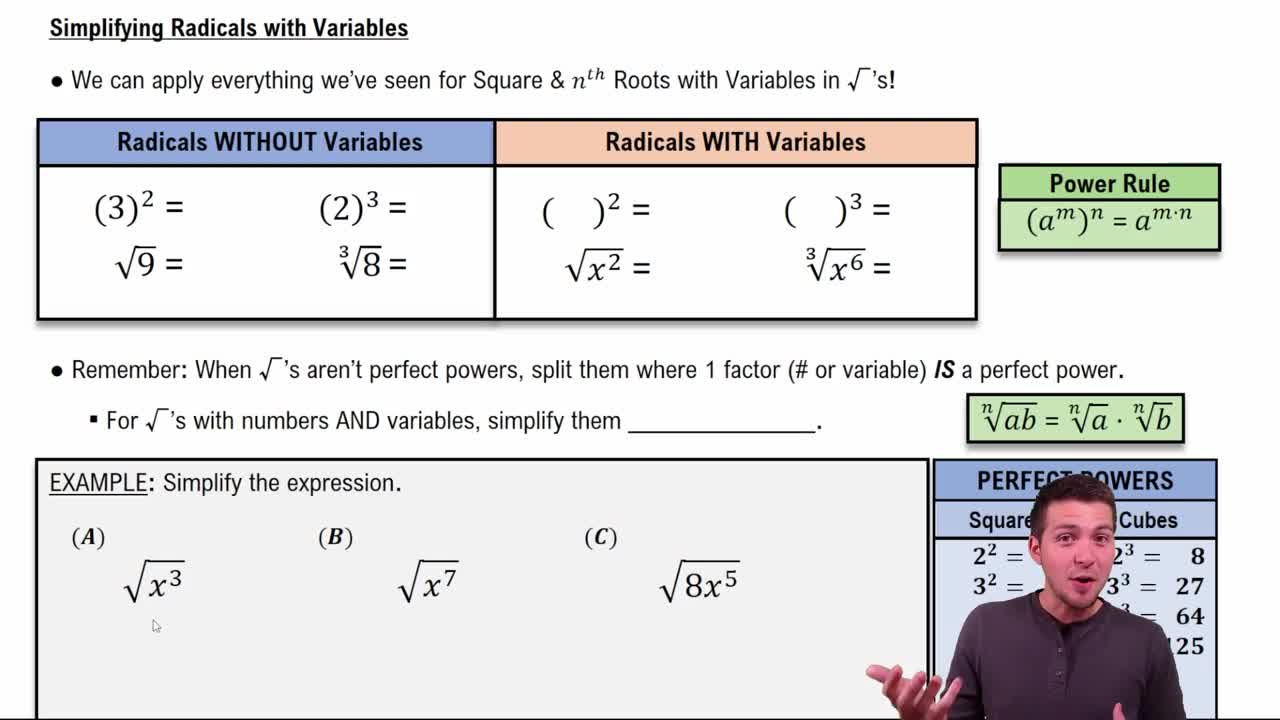
Radical Expressions and Cube Roots
Radical expressions involve roots such as square roots or cube roots. The cube root of a number x, denoted ∛x, is a value that when cubed gives x. Understanding how to simplify and manipulate cube roots is essential for combining terms involving radicals.
Recommended video:
Guided course
Radical Expressions with Variables
Properties of Exponents
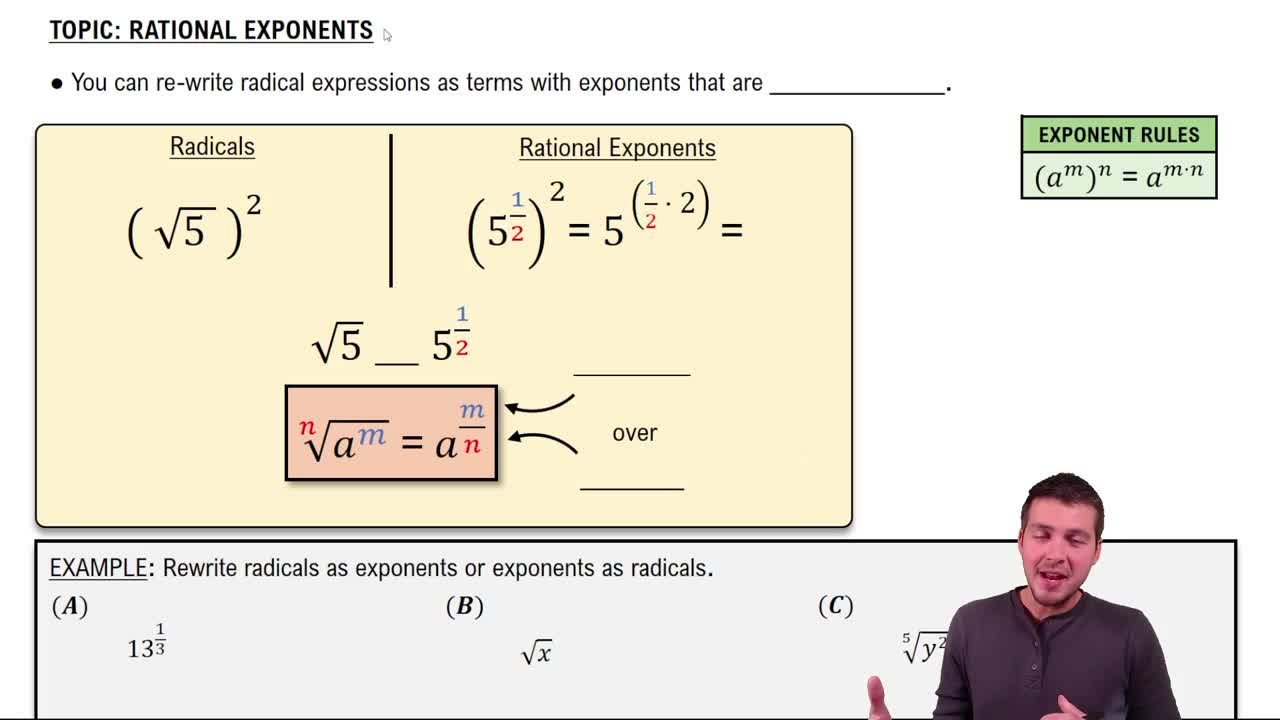
Exponents indicate repeated multiplication. When working with radicals, exponents can be manipulated using rules like multiplying powers, dividing powers, and converting between radicals and fractional exponents, which helps simplify expressions under the root.
Recommended video:
Guided course
Rational Exponents
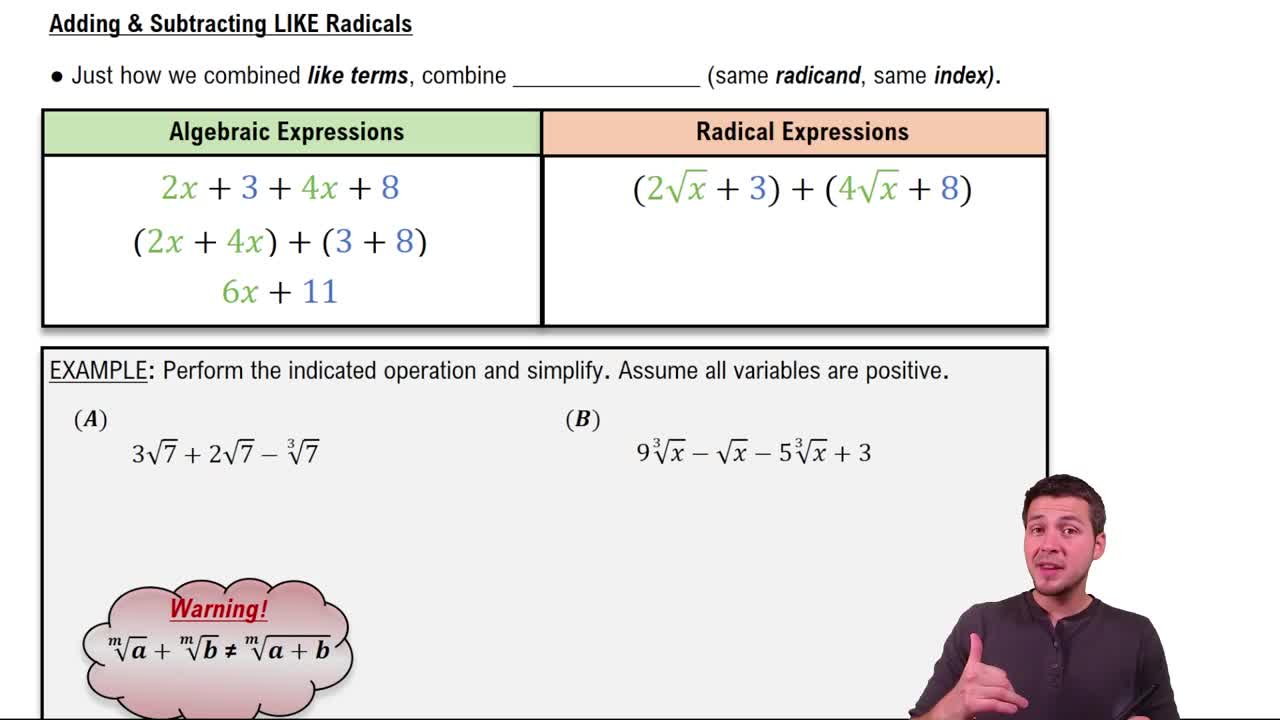
Combining Like Terms with Radicals
To perform operations like addition or subtraction on radical expressions, the terms must have the same radicand and root degree. Simplifying each radical to its simplest form allows identification of like terms, enabling proper combination of coefficients.
Recommended video:
Guided course
Adding & Subtracting Like Radicals
Related Practice
Textbook Question
1006
views
Textbook Question
Factor by any method. See Examples 1–7.
1076
views
Textbook Question
Multiply or divide as indicated. 34.04 × 0.56
1001
views
Textbook Question
Let U = {0, 1, 2, 3, 4, 5, 6, 7, 8, 9, 10, 11, 12, 13}, M = {0, 2, 4, 6, 8}, N = {1, 3, 5, 7, 9, 11, 13}, Q = {0, 2, 4, 6, 8, 10, 12}, and R = {0, 1, 2, 3, 4}.Use these sets to find each of the following. Identify any disjoint sets. {x | x ∈ U, x ∉ R}
991
views
Textbook Question
Simplify each expression. Write answers without negative exponents. Assume all variables represent positive real numbers. (p1/5p7/10p1/2)/(p3)-1/5
763
views
Textbook Question
Let U = {0, 1, 2, 3, 4, 5, 6, 7, 8, 9, 10, 11, 12, 13}, M = {0, 2, 4, 6, 8}, N = {1, 3, 5, 7, 9, 11, 13}, Q = {0, 2, 4, 6, 8, 10, 12}, and R = {0, 1, 2, 3, 4}.Use these sets to find each of the following. Identify any disjoint sets. {x | x ∈ U, x ∉ M}
1014
views