In Exercises 5–9, graph f and g in the same rectangular coordinate system. Use transformations of the graph of f to obtain the graph of g. Graph and give equations of all asymptotes. Use the graphs to determine each function's domain and range. f(x) = ex and g(x) = 2ex/2
Ch. 4 - Exponential and Logarithmic Functions

Chapter 5, Problem 9
In Exercises 1–10, approximate each number using a calculator. Round your answer to three decimal places. e-0.95
Verified step by step guidance1
Identify the expression to evaluate: \(e^{-0.95}\), where \(e\) is the base of the natural logarithm, approximately equal to 2.71828.
Recall that \(e^x\) represents the exponential function, which can be calculated using a scientific calculator or a calculator app with an exponential function key.
Enter the exponent value \(-0.95\) into the calculator, then use the \(e^x\) function to compute \(e^{-0.95}\).
After obtaining the decimal value from the calculator, round the result to three decimal places as instructed.
Write down the rounded value as the final approximation of \(e^{-0.95}\).

Verified video answer for a similar problem:
This video solution was recommended by our tutors as helpful for the problem above.
Video duration:
47sWas this helpful?
Key Concepts
Here are the essential concepts you must grasp in order to answer the question correctly.
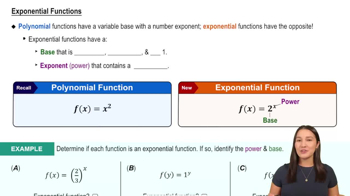
Exponential Functions
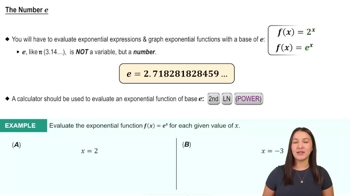
Exponential functions involve expressions where a constant base is raised to a variable exponent, such as e^x. The number e (approximately 2.718) is a fundamental constant in mathematics, often used in growth and decay models. Understanding how to evaluate e raised to a negative exponent is essential for this problem.
Recommended video:
Exponential Functions
Using a Calculator for Exponentials
Calculators can compute values of exponential expressions like e^x directly, often through a dedicated 'e^x' button. Knowing how to input negative exponents correctly ensures accurate results. This skill is crucial for approximating values that cannot be simplified easily by hand.
Recommended video:
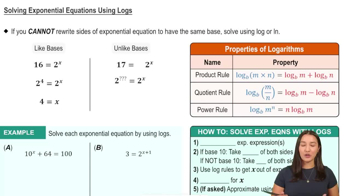
Solving Exponential Equations Using Logs
Rounding to a Specific Decimal Place
Rounding involves adjusting a number to a specified number of decimal places to simplify or standardize results. For this question, answers must be rounded to three decimal places, meaning the value is truncated or increased based on the fourth decimal digit. Proper rounding ensures clarity and consistency in numerical answers.
Recommended video:
The Number e
Related Practice
Textbook Question
761
views
Textbook Question
Solve each exponential equation in Exercises 1–22 by expressing each side as a power of the same base and then equating exponents. 9x=27
666
views
Textbook Question
Use properties of logarithms to expand each logarithmic expression as much as possible. Where possible, evaluate logarithmic expressions without using a calculator. log(x/100)
1085
views
Textbook Question
Solve each exponential equation in Exercises 1–22 by expressing each side as a power of the same base and then equating exponents. 32x=8
697
views
Textbook Question
Use the compound interest formulas to solve Exercises 10–11. Suppose that you have \$5000 to invest. Which investment yields the greater return over 5 years: 1.5% compounded semiannually or 1.45% compounded monthly?
1319
views
Textbook Question
Write each equation in its equivalent logarithmic form. 54 = 625
801
views
