Ch. 2 - Graphs and Functions
Lial - College Algebra 13th Edition
Lial13th EditionCollege AlgebraISBN: 9780136881063Not the one you use?Change textbook
Chapter 3, Problem 80

Graph each function. See Examples 6–8 and the Summary of Graphing Techniques box following Example 9. ƒ(x)=-3(x-2)2+1

Verified step by step guidance
1
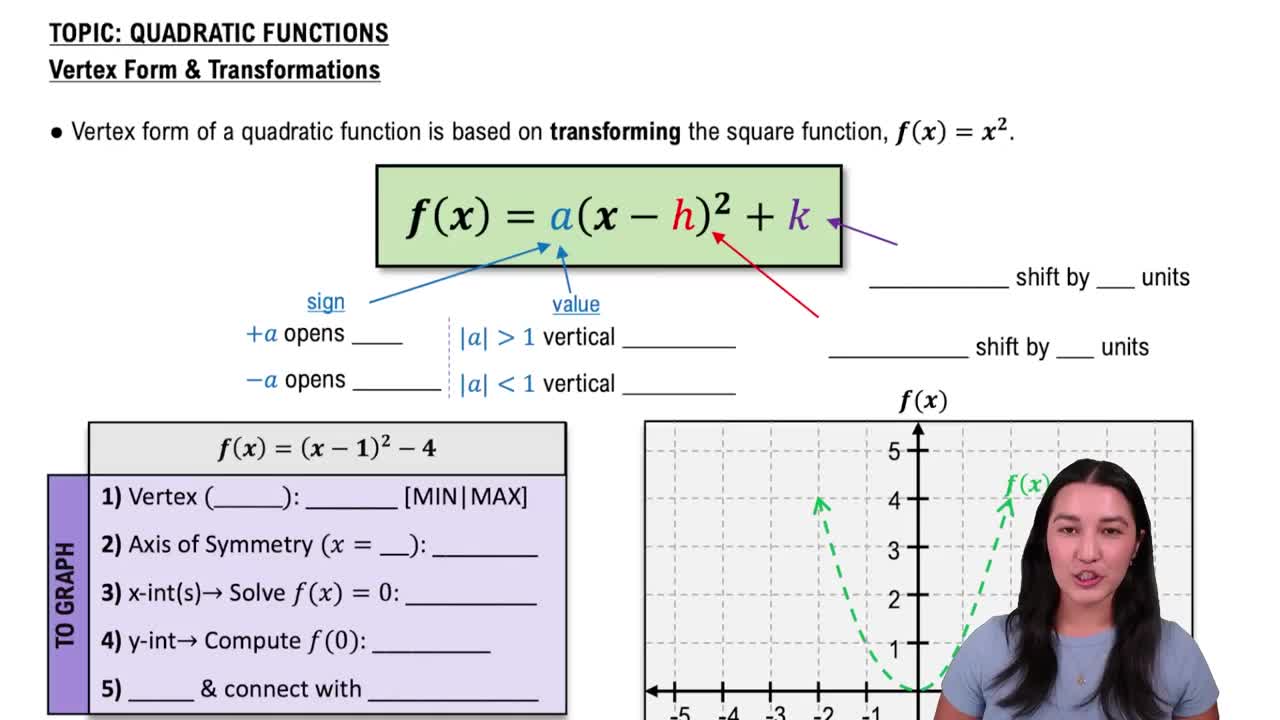
Identify the given function: \(f(x) = -3(x-2)^2 + 1\). This is a quadratic function in vertex form, \(f(x) = a(x-h)^2 + k\), where \((h, k)\) is the vertex.
Determine the vertex of the parabola. From the function, \(h = 2\) and \(k = 1\), so the vertex is at the point \((2, 1)\).
Analyze the coefficient \(a = -3\). Since \(a\) is negative, the parabola opens downward. The value \(3\) indicates the parabola is vertically stretched by a factor of 3 compared to the parent function \(y = x^2\).
Find additional points by choosing \(x\)-values around the vertex, substituting them into the function, and calculating the corresponding \(y\)-values. For example, try \(x = 1\) and \(x = 3\) to find symmetric points on either side of the vertex.
Plot the vertex and the additional points on the coordinate plane, then draw a smooth curve through these points to complete the graph of the parabola.

Verified video answer for a similar problem:

This video solution was recommended by our tutors as helpful for the problem above.
Video duration:
1m
Was this helpful?

Key Concepts

Here are the essential concepts you must grasp in order to answer the question correctly.

Vertex Form of a Quadratic Function

The vertex form of a quadratic function is expressed as f(x) = a(x - h)^2 + k, where (h, k) is the vertex of the parabola. This form makes it easy to identify the vertex and understand the graph's shape and position. In the given function, f(x) = -3(x - 2)^2 + 1, the vertex is at (2, 1).
Recommended video:
08:07
Vertex Form

Effect of the Coefficient 'a' on the Graph

The coefficient 'a' in the quadratic function affects the parabola's direction and width. If 'a' is negative, the parabola opens downward; if positive, it opens upward. The absolute value of 'a' determines the steepness: larger values make the graph narrower, while smaller values make it wider. Here, a = -3 means the parabola opens downward and is narrower than the standard parabola.
Recommended video:
05:25
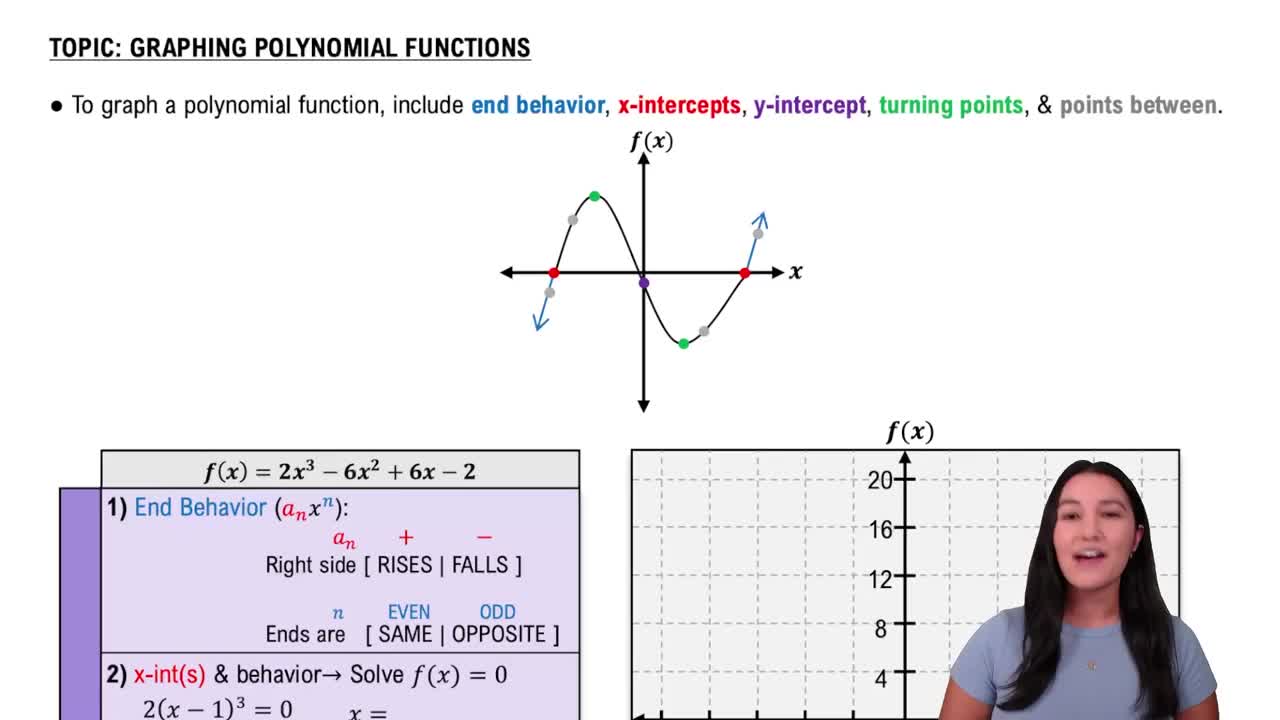
Graphing Polynomial Functions

Graphing Transformations

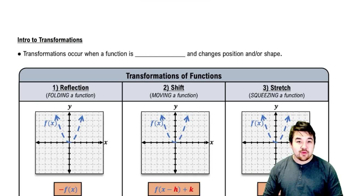
Graphing transformations involve shifting, reflecting, and stretching or compressing the parent function y = x^2. The term (x - 2) shifts the graph 2 units to the right, and the +1 shifts it 1 unit up. The negative sign reflects the graph over the x-axis, and the factor 3 stretches it vertically. Understanding these transformations helps in accurately sketching the graph.
Recommended video:
5:25
Intro to Transformations