Ch. 1 - Equations and Inequalities
Lial - College Algebra 13th Edition
Lial13th EditionCollege AlgebraISBN: 9780136881063Not the one you use?Change textbook
Chapter 2, Problem 24

Solve each equation. 3/(x2+x-2) - 1/(x2-1) = 7/(2x2+6x+4)

Verified step by step guidance
1
First, identify and factor all the quadratic expressions in the denominators to simplify the equation. For the denominators, factor as follows: \(x^{2} + x - 2\), \(x^{2} - 1\), and \(2x^{2} + 6x + 4\).
Rewrite each denominator in its factored form: \(x^{2} + x - 2 = (x + 2)(x - 1)\), \(x^{2} - 1 = (x - 1)(x + 1)\), and \(2x^{2} + 6x + 4 = 2(x + 1)(x + 2)\).
Determine the least common denominator (LCD) by taking the product of the distinct factors with the highest powers: \(2(x - 1)(x + 1)(x + 2)\).
Multiply both sides of the equation by the LCD to eliminate the denominators, resulting in an equation without fractions.
Simplify the resulting equation by distributing and combining like terms, then solve the resulting polynomial equation for \(x\). Remember to check for any excluded values that make the original denominators zero.

Verified video answer for a similar problem:

This video solution was recommended by our tutors as helpful for the problem above.
Video duration:
6m
Was this helpful?

Key Concepts

Here are the essential concepts you must grasp in order to answer the question correctly.

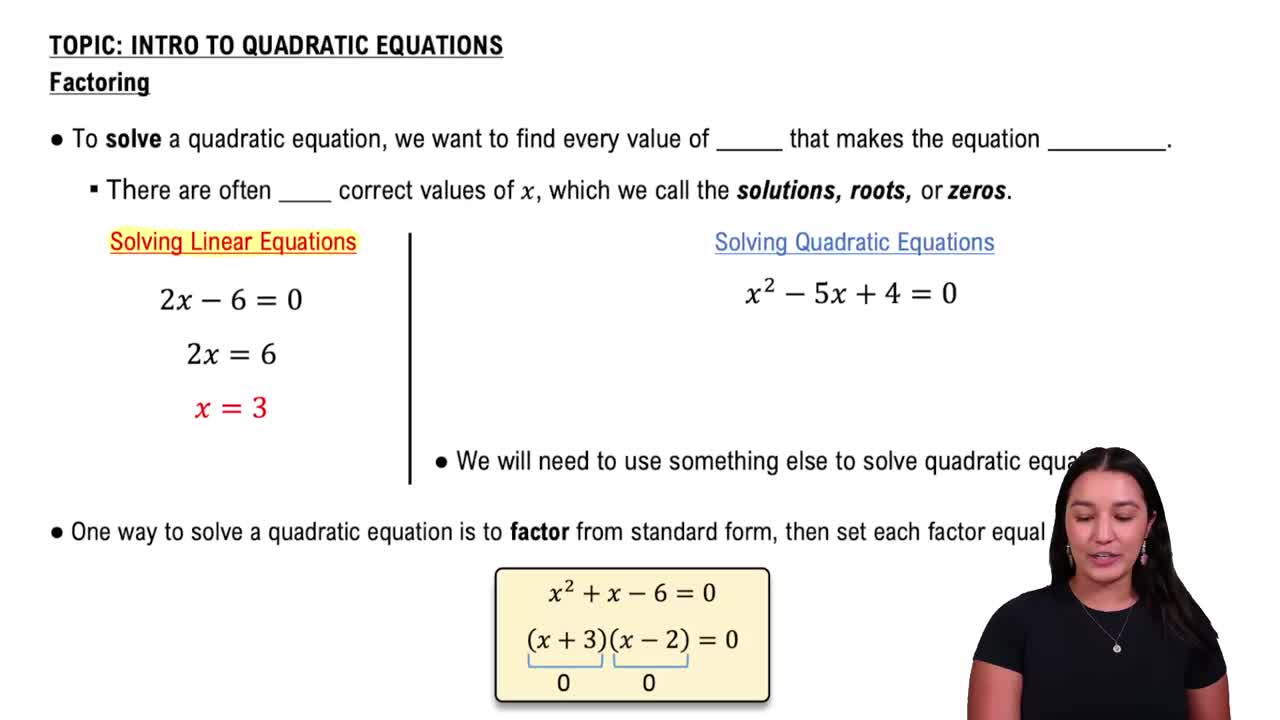
Factoring Quadratic Expressions

Factoring quadratic expressions involves rewriting a quadratic polynomial as a product of two binomials. This is essential for simplifying rational expressions and finding common denominators. For example, x² + x - 2 factors to (x + 2)(x - 1), which helps in identifying restrictions and simplifying the equation.
Recommended video:
06:08
Solving Quadratic Equations by Factoring

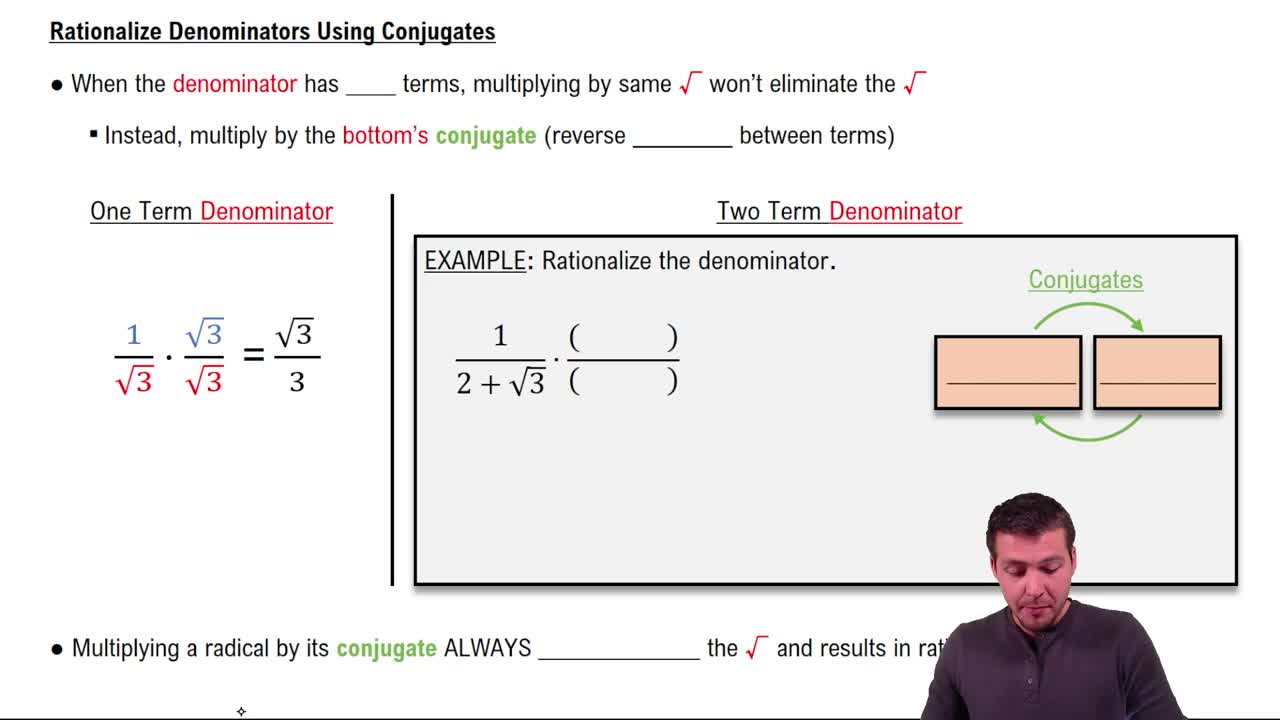
Finding the Least Common Denominator (LCD)

The least common denominator is the smallest expression that all denominators in a rational equation can divide into evenly. Finding the LCD allows you to combine or compare fractions by eliminating denominators, making it easier to solve the equation. It involves factoring each denominator and taking the highest powers of each factor.
Recommended video:
Guided course
03:42
Rationalizing Denominators Using Conjugates

Solving Rational Equations

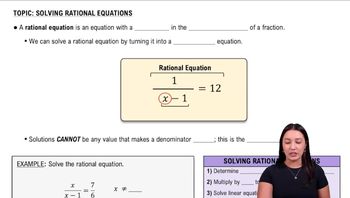
Solving rational equations requires eliminating denominators by multiplying both sides by the LCD, then solving the resulting polynomial equation. It's important to check for extraneous solutions that make any denominator zero, as these are not valid. This process transforms a complex fraction equation into a simpler polynomial form.
Recommended video:
05:56
Introduction to Rational Equations