Identify the binomial coefficient notation given: \(\binom{6}{6}\), which represents the number of ways to choose 6 items from a set of 6 items.
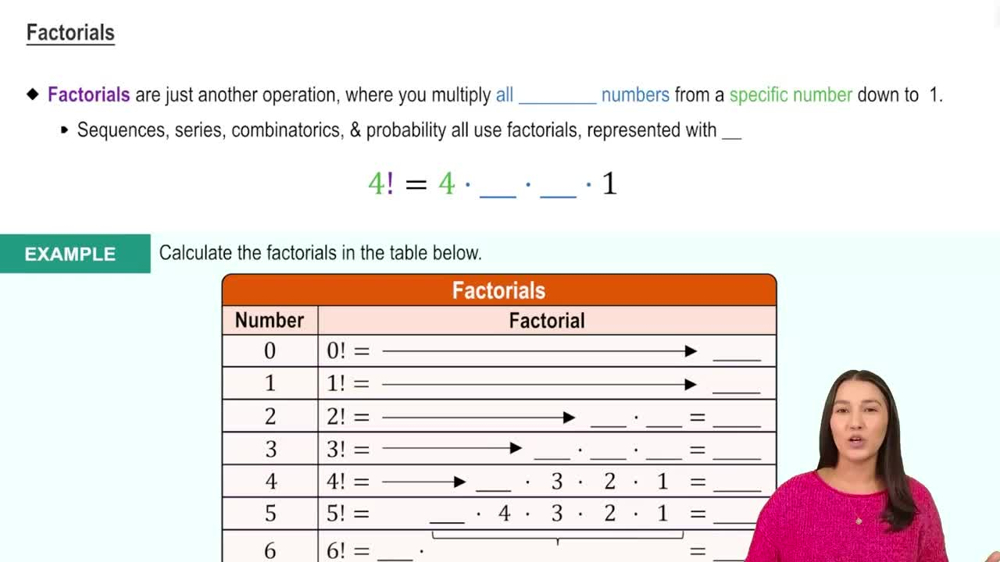
Recall the formula for a binomial coefficient: \(\binom{n}{r} = \frac{n!}{r!(n-r)!}\), where \(n!\) denotes the factorial of \(n\).
Substitute the values \(n = 6\) and \(r = 6\) into the formula: \(\binom{6}{6} = \frac{6!}{6!(6-6)!}\).
Simplify the expression inside the factorial in the denominator: \$6 - 6 = 0$, so the expression becomes \(\frac{6!}{6! \times 0!}\).
Recall that \$0!\( is defined as 1, so the expression simplifies to \(\frac{6!}{6! \times 1}\), which can be further simplified by canceling \)6!$ in numerator and denominator.
Verified video answer for a similar problem:
This video solution was recommended by our tutors as helpful for the problem above
Video duration:
1m
Play a video:
0 Comments
Key Concepts
Here are the essential concepts you must grasp in order to answer the question correctly.
Binomial Coefficient Definition
A binomial coefficient, denoted as C(n, k) or (n choose k), represents the number of ways to choose k elements from a set of n elements without regard to order. It is calculated using the formula C(n, k) = n! / (k! (n-k)!), where '!' denotes factorial.
The factorial of a non-negative integer n, written as n!, is the product of all positive integers less than or equal to n. For example, 6! = 6 × 5 × 4 × 3 × 2 × 1 = 720. Factorials are essential in computing binomial coefficients.
One key property is that C(n, n) = 1 for any non-negative integer n, since there is exactly one way to choose all elements from a set. This property simplifies evaluation without full factorial calculation.

 1:56 minutes
 Verified step by step guidance
 03:41
03:41