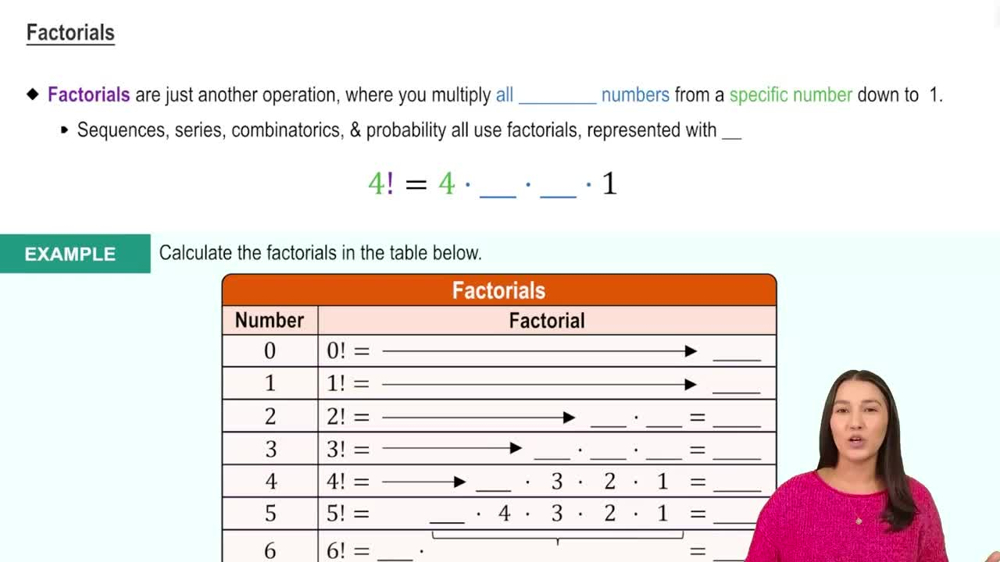
Identify the binomial coefficient notation \( \binom{8}{3} \), which represents the number of ways to choose 3 elements from a set of 8 elements.
Recall the formula for the binomial coefficient: \[ \binom{n}{r} = \frac{n!}{r!(n-r)!} \], where \( n! \) denotes the factorial of \( n \).
Substitute \( n = 8 \) and \( r = 3 \) into the formula: \[ \binom{8}{3} = \frac{8!}{3!(8-3)!} = \frac{8!}{3!5!} \].
Express the factorials to simplify the expression: \[ 8! = 8 \times 7 \times 6 \times 5! \], so \[ \binom{8}{3} = \frac{8 \times 7 \times 6 \times 5!}{3! \times 5!} \].
Cancel the common \( 5! \) terms in numerator and denominator, then simplify the remaining expression \( \frac{8 \times 7 \times 6}{3!} \) to find the value.
Verified video answer for a similar problem:
This video solution was recommended by our tutors as helpful for the problem above
Video duration:
2m
Play a video:
0 Comments
Key Concepts
Here are the essential concepts you must grasp in order to answer the question correctly.
Binomial Coefficient
The binomial coefficient, denoted as (n choose k), represents the number of ways to choose k elements from a set of n elements without regard to order. It is calculated using the formula n! / (k! (n-k)!), where ! denotes factorial.
The factorial of a non-negative integer n, written as n!, is the product of all positive integers less than or equal to n. Factorials are essential in computing binomial coefficients and permutations, e.g., 5! = 5 × 4 × 3 × 2 × 1 = 120.
Binomial coefficients count combinations, which are selections where order does not matter. Understanding this helps in problems involving probability, counting, and algebraic expansions like the binomial theorem.

 2:46 minutes
 Verified step by step guidance
 03:41
03:41