Evaluate the discriminant for each equation. Then use it to determine the number of distinct solutions, and tell whether they are rational, irrational, or nonreal complex numbers. (Do not solve the equation.) 4x2 = -6x + 3
Ch. 1 - Equations and Inequalities

Chapter 2, Problem 88
Solve each inequality. Give the solution set using interval notation.
Verified step by step guidance1
Recognize that the compound inequality \(-8 > 3x - 5 > -12\) can be split into two separate inequalities: \(-8 > 3x - 5\) and \$3x - 5 > -12$.
Solve the first inequality \(-8 > 3x - 5\) by isolating \(x\): add 5 to both sides to get \(-8 + 5 > 3x\), which simplifies to \(-3 > 3x\).
Divide both sides of \(-3 > 3x\) by 3 (remember to keep the inequality direction since 3 is positive), resulting in \(-1 > x\) or equivalently \(x < -1\).
Solve the second inequality \$3x - 5 > -12\( by adding 5 to both sides: \)3x > -12 + 5\(, which simplifies to \)3x > -7$.
Divide both sides of \$3x > -7$ by 3, yielding \(x > -\frac{7}{3}\). Combine this with the first inequality to find the solution set \(-\frac{7}{3} < x < -1\), and express it in interval notation.

Verified video answer for a similar problem:
This video solution was recommended by our tutors as helpful for the problem above.
Video duration:
1mWas this helpful?
Key Concepts
Here are the essential concepts you must grasp in order to answer the question correctly.
Compound Inequalities
A compound inequality involves two inequalities joined together, often with 'and' or 'or'. In this problem, the inequality -8 > 3x - 5 > -12 means 3x - 5 is simultaneously less than -8 and greater than -12. Solving requires treating it as two separate inequalities and finding the intersection of their solution sets.
Recommended video:
Linear Inequalities
Solving Linear Inequalities
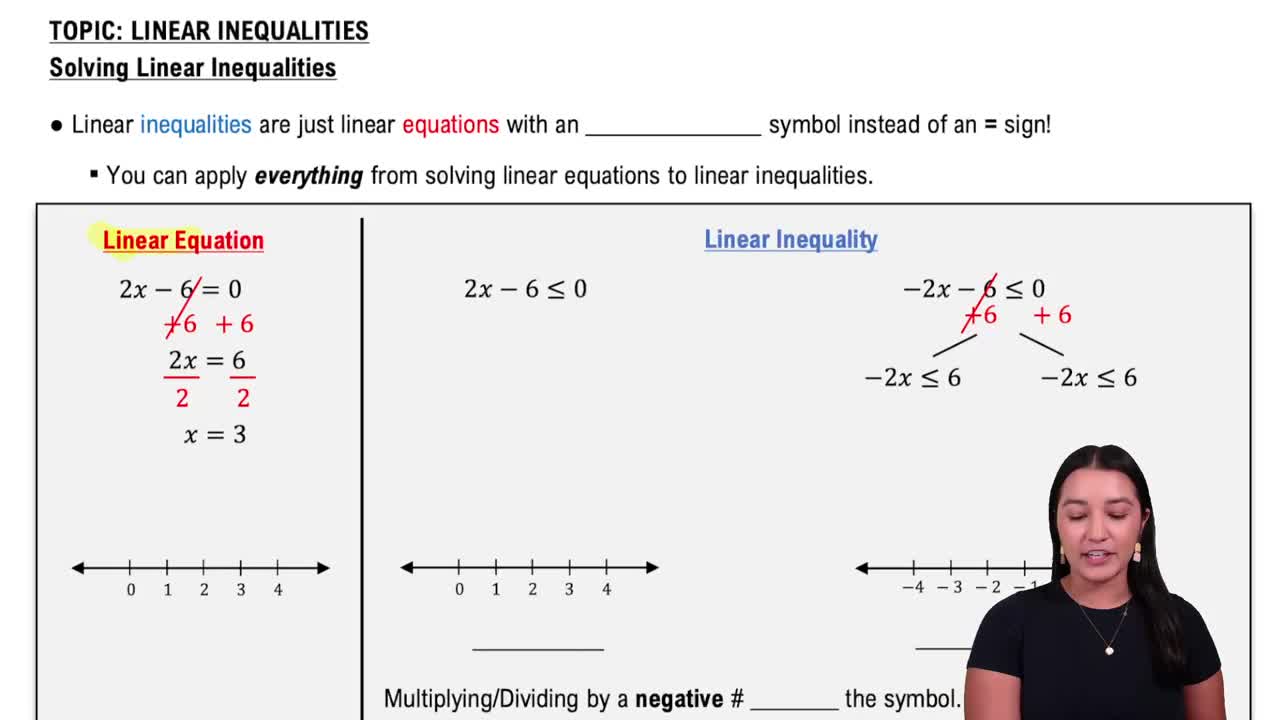
Solving linear inequalities involves isolating the variable by performing inverse operations, similar to solving equations, but reversing the inequality sign when multiplying or dividing by a negative number. This process helps find the range of values that satisfy the inequality.
Recommended video:
Linear Inequalities
Interval Notation
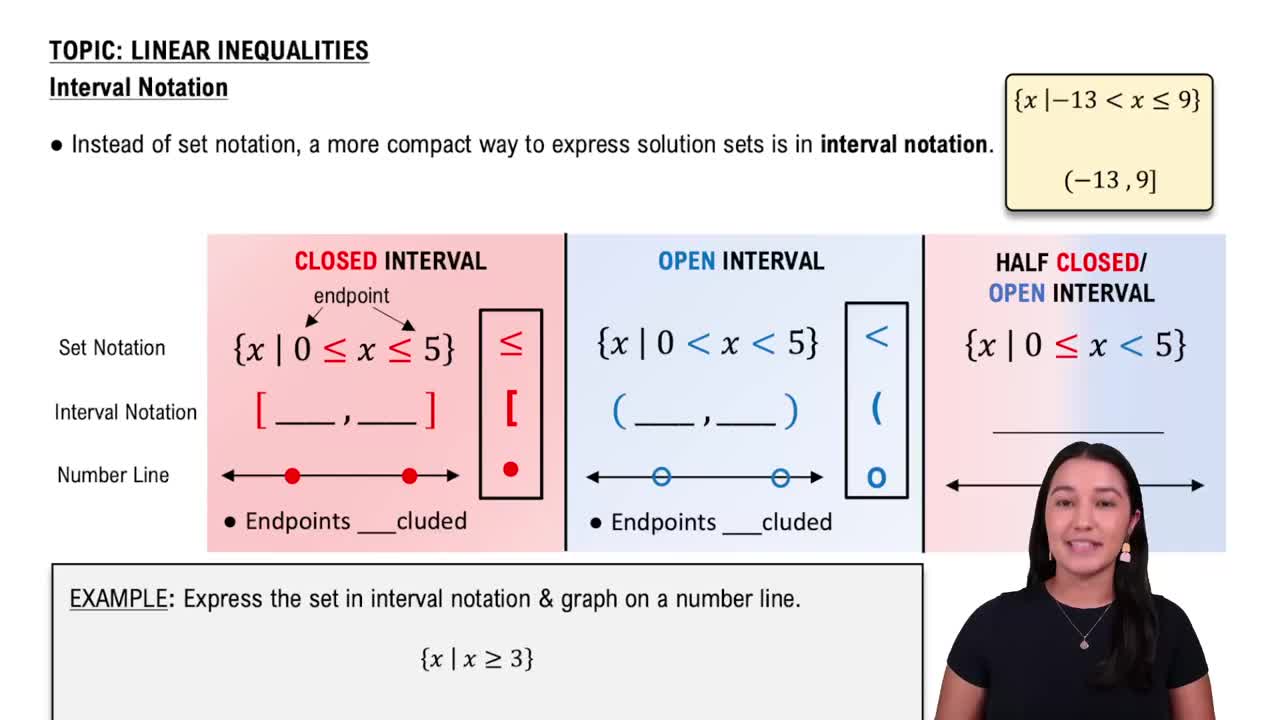
Interval notation is a concise way to represent solution sets of inequalities using parentheses and brackets. Parentheses indicate values not included (open interval), while brackets indicate values included (closed interval). It clearly shows the range of values that satisfy the inequality.
Recommended video:
Interval Notation
Related Practice
Textbook Question
1380
views
Textbook Question
Use the method described in Exercises 83–86, if applicable, and properties of absolute value to solve each equation or inequality. (Hint: Exercises 99 and 100 can be solved by inspection.) | 3x2 - 14x | = 5
640
views
Textbook Question
Solve each equation. 2x4-7x2+5=0
561
views
Textbook Question
Evaluate the discriminant for each equation. Then use it to determine the number of distinct solutions, and tell whether they are rational, irrational, or nonreal complex numbers. (Do not solve the equation.) See Example 9.
1101
views
Textbook Question
Simplify each power of i. i25
973
views
Textbook Question
Solve each inequality. Give the solution set using interval notation. 5 ≤ 2x -3 ≤ 7
1370
views
