
Textbook Question
Use the method described in Exercises 83–86, if applicable, and properties of absolute value to solve each equation or inequality. (Hint: Exercises 99 and 100 can be solved by inspection.) | 3x2 - 14x | = 5
640
views

 Verified step by step guidance
 04:10
04:10 04:10
04:10 5:17
5:17Use the method described in Exercises 83–86, if applicable, and properties of absolute value to solve each equation or inequality. (Hint: Exercises 99 and 100 can be solved by inspection.) | 3x2 - 14x | = 5
Use the method described in Exercises 83–86, if applicable, and properties of absolute value to solve each equation or inequality. (Hint: Exercises 99 and 100 can be solved by inspection.) | x2 + 5x + 5 | = 1
Evaluate the discriminant for each equation. Then use it to determine the number of distinct solutions, and tell whether they are rational, irrational, or nonreal complex numbers. (Do not solve the equation.) See Example 9.
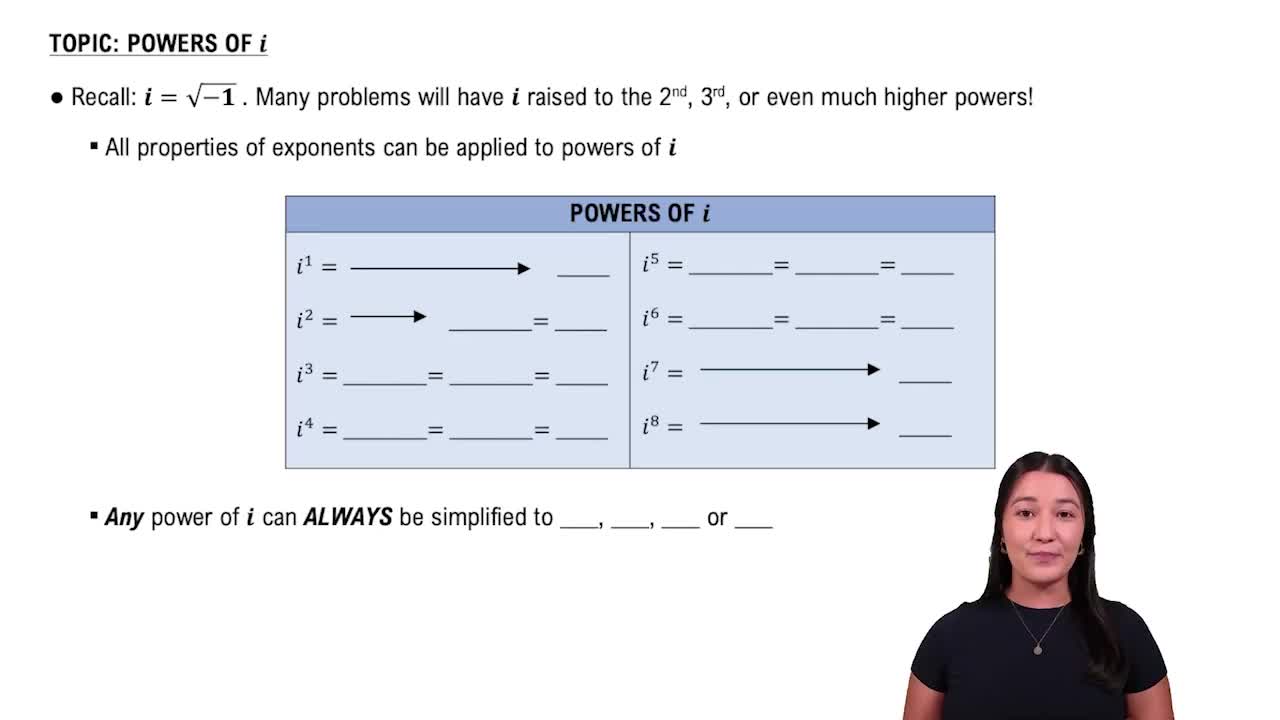
Simplify each power of i. i25
Evaluate the discriminant for each equation. Then use it to determine the number of distinct solutions, and tell whether they are rational, irrational, or nonreal complex numbers. (Do not solve the equation.) See Example 9.
Determine whether each equation has a graph that is symmetric with respect to the x-axis, the y-axis, the origin, or none of these.