Ch. R - Review of Basic Concepts
Lial - College Algebra 13th Edition
Lial13th EditionCollege AlgebraISBN: 9780136881063Not the one you use?Change textbook
Chapter 1, Problem 63

Factor each polynomial. See Examples 5 and 6. 25s4-9t2

Verified step by step guidance
1
Recognize that the polynomial \$25s^4 - 9t^2\( is a difference of squares because it can be written as \)(5s^2)^2 - (3t)^2$.
Recall the difference of squares formula: \(a^2 - b^2 = (a - b)(a + b)\), where \(a = 5s^2\) and \(b = 3t\) in this case.
Apply the difference of squares formula to factor the polynomial as \((5s^2 - 3t)(5s^2 + 3t)\).
Check each factor to see if it can be factored further. Notice that \$5s^2 - 3t\( and \)5s^2 + 3t$ are not difference or sum of squares and cannot be factored further over the real numbers.
Write the final factored form as \((5s^2 - 3t)(5s^2 + 3t)\).

Verified video answer for a similar problem:

This video solution was recommended by our tutors as helpful for the problem above.
Video duration:
3m
Was this helpful?

Key Concepts

Here are the essential concepts you must grasp in order to answer the question correctly.

Difference of Squares

The difference of squares is a factoring technique used when an expression is in the form a² - b². It factors into (a - b)(a + b). Recognizing this pattern helps simplify polynomials like 25s⁴ - 9t² by identifying perfect squares.
Recommended video:
06:24
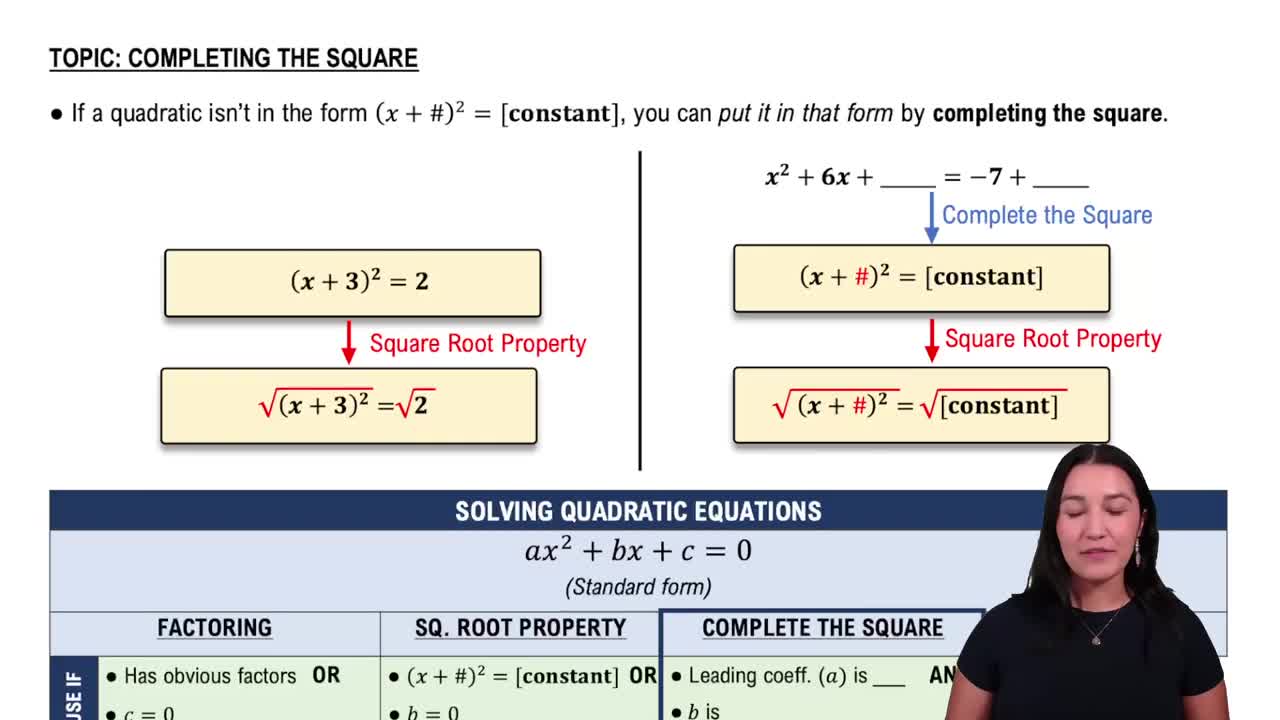
Solving Quadratic Equations by Completing the Square

Factoring Higher Powers

When variables are raised to powers greater than 2, such as s⁴, it can be helpful to rewrite them as powers squared (e.g., s⁴ = (s²)²). This allows the use of difference of squares or other factoring methods on more complex terms.
Recommended video:
05:10
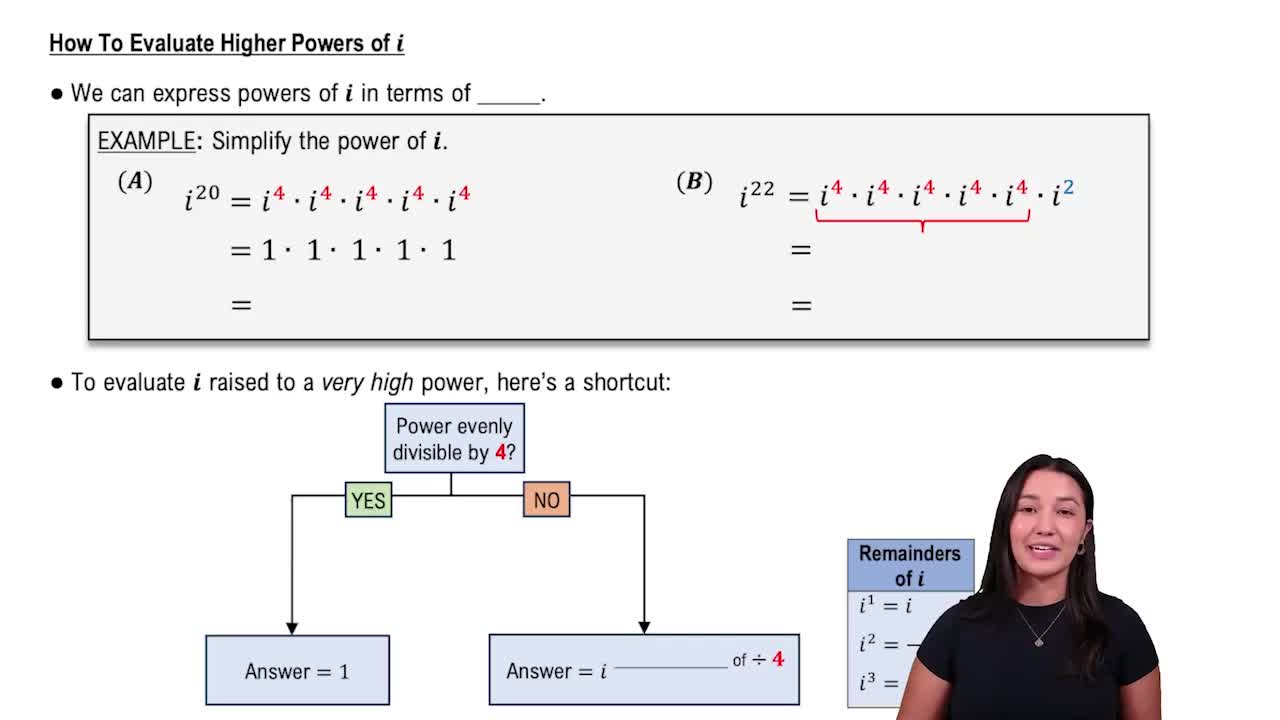
Higher Powers of i

Prime Factorization of Coefficients

Breaking down numerical coefficients into their prime factors helps identify perfect squares and simplifies the factoring process. For example, 25 is 5² and 9 is 3², which aids in recognizing the difference of squares structure.
Recommended video:
Guided course
07:30
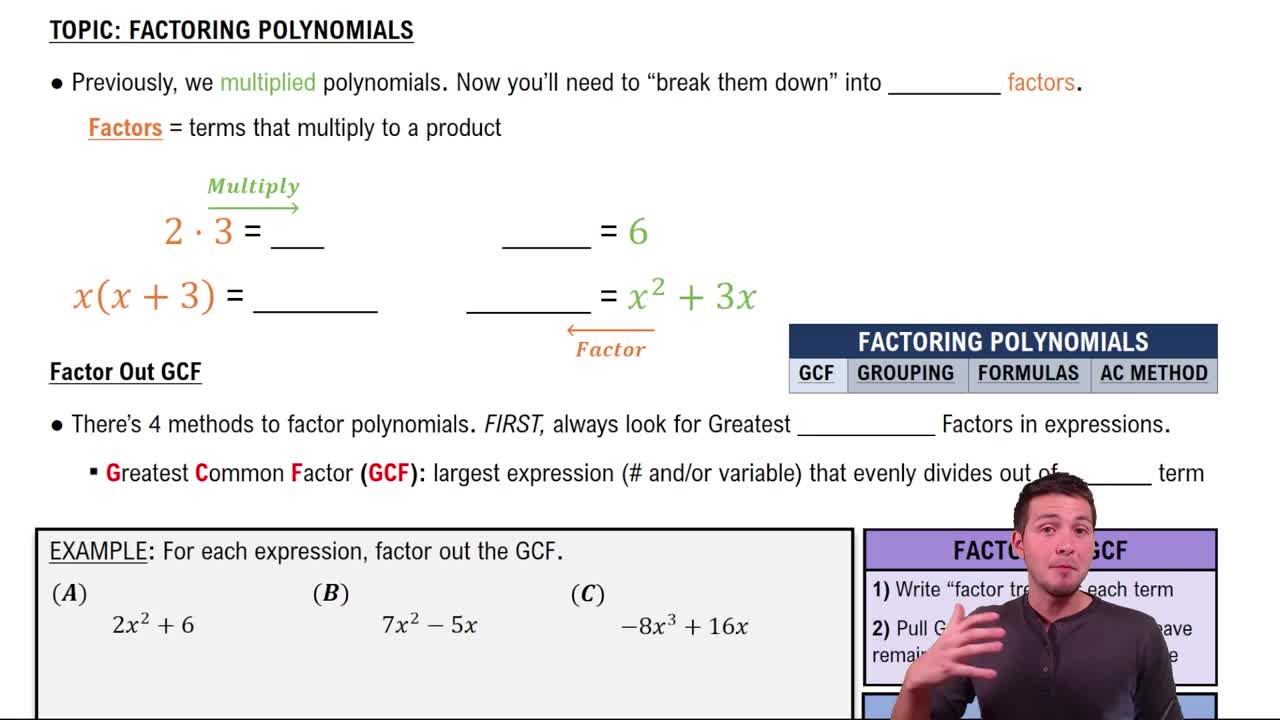
Introduction to Factoring Polynomials