Determine whether each statement is true or false. -13 ≤ -2
Verified step by step guidance
1
Identify the inequality given: \(-13 \leq -2\).
Recall that the symbol \(\leq\) means "less than or equal to." So the statement says "-13 is less than or equal to -2."
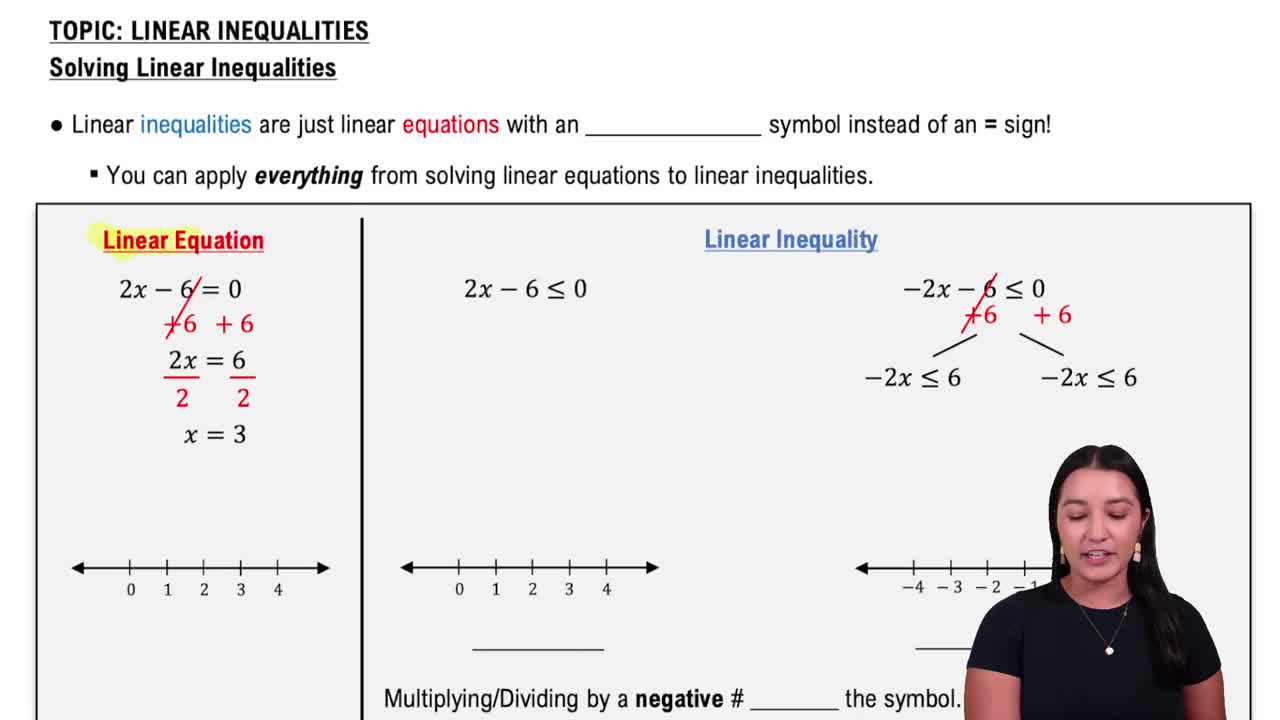
Compare the two numbers on the number line: -13 is to the left of -2, which means -13 is indeed less than -2.
Since -13 is less than -2, the inequality \(-13 \leq -2\) is true.
Therefore, the statement is true because the inequality holds as written.
Verified video answer for a similar problem:
This video solution was recommended by our tutors as helpful for the problem above
Video duration:
1m
Play a video:
0 Comments
Key Concepts
Here are the essential concepts you must grasp in order to answer the question correctly.
Inequality Symbols and Their Meaning
Inequality symbols like ≤ (less than or equal to) compare two values to show their relative size. The symbol ≤ means the value on the left is either less than or exactly equal to the value on the right.
Integers are ordered on a number line from left (smaller) to right (larger). Understanding that -13 is to the left of -2 helps determine that -13 is less than -2, which is essential for evaluating inequalities.
Evaluating True or False Statements in Inequalities
To determine if an inequality is true or false, substitute the values and check if the relationship holds. For example, check if -13 ≤ -2 by comparing their positions on the number line or their numeric values.

 1:50 minutes
 Verified step by step guidance
 06:07
06:07