Simplify each exponential expression in Exercises 23–64.
Verified step by step guidance
1
Identify the expression to simplify: \((-3x^2 y^5)^2\). This means the entire quantity inside the parentheses is raised to the power of 2.
Apply the power of a product rule, which states that \((abc)^n = a^n b^n c^n\). So, rewrite the expression as \((-3)^2 (x^2)^2 (y^5)^2\).
Simplify each part separately: \((-3)^2\) means multiply -3 by itself, \((x^2)^2\) means raise \(x^2\) to the power 2, and \((y^5)^2\) means raise \(y^5\) to the power 2.
Use the power of a power rule for the variables: \((x^2)^2 = x^{2 \times 2} = x^4\) and \((y^5)^2 = y^{5 \times 2} = y^{10}\).
Combine all simplified parts to write the final expression as \((-3)^2 x^4 y^{10}\).
Verified video answer for a similar problem:
This video solution was recommended by our tutors as helpful for the problem above
Video duration:
1m
Play a video:
0 Comments
Key Concepts
Here are the essential concepts you must grasp in order to answer the question correctly.
Exponentiation of a Product
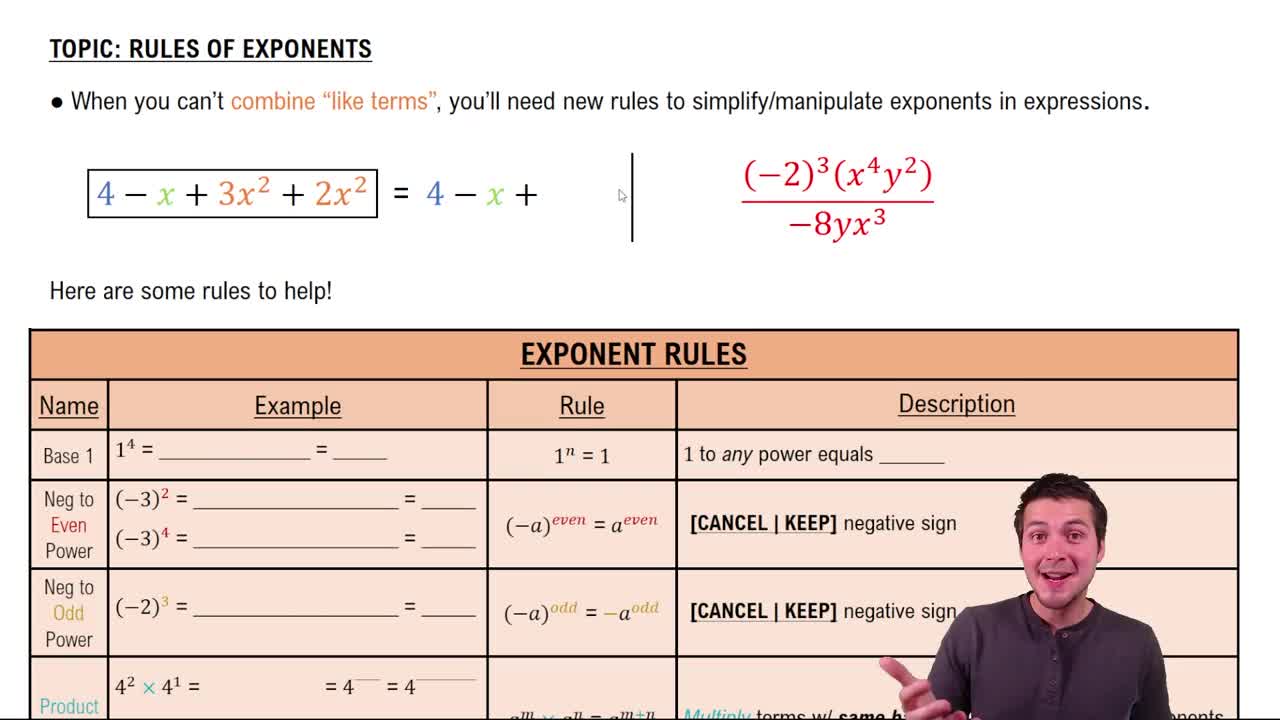
When raising a product to a power, each factor inside the parentheses is raised to that power separately. For example, (ab)^n = a^n * b^n. This rule helps simplify expressions like (−3x^2 y^5)^2 by applying the exponent to −3, x^2, and y^5 individually.
The power of a power rule states that (a^m)^n = a^(m*n). This means when an exponent is raised to another exponent, you multiply the exponents. In the expression (x^2)^2, you multiply 2 by 2 to get x^4.
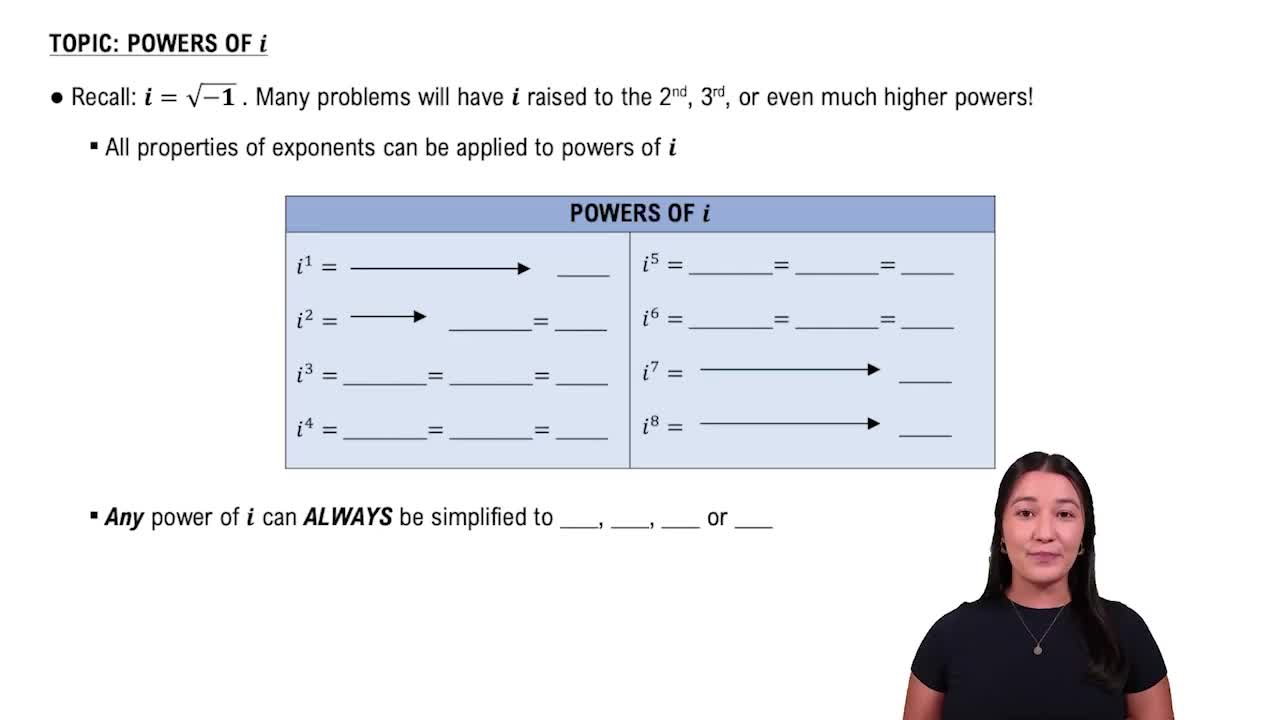
When a negative number is raised to an even power, the result is positive because multiplying an even number of negative factors yields a positive product. For example, (−3)^2 = 9. This is important for correctly simplifying expressions like (−3x^2 y^5)^2.

 1:42 minutes
 Verified step by step guidance
 6:13
6:13