Use the various properties of exponential and logarithmic functions to evaluate the expressions in parts (a)–(c). Given ƒ(x) = log2 x, find ƒ(22 log_2 2)
Ch. 4 - Inverse, Exponential, and Logarithmic Functions

Chapter 5, Problem 98a
Use the various properties of exponential and logarithmic functions to evaluate the expressions in parts (a)–(c). Given ƒ(x) = log2 x, find ƒ(27)
Verified step by step guidance1
Identify the function given: \( f(x) = \log_2 x \), which means the logarithm base 2 of \( x \).
Substitute the input \( 2^7 \) into the function: \( f(2^7) = \log_2 (2^7) \).
Recall the logarithmic property that \( \log_b (b^k) = k \), where \( b \) is the base of the logarithm and \( k \) is the exponent.
Apply this property to simplify \( \log_2 (2^7) \) to just the exponent \( 7 \).
Conclude that \( f(2^7) = 7 \) based on the simplification.

Verified video answer for a similar problem:
This video solution was recommended by our tutors as helpful for the problem above.
Video duration:
1mWas this helpful?
Key Concepts
Here are the essential concepts you must grasp in order to answer the question correctly.
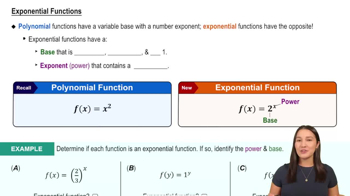
Exponential Functions
Exponential functions have the form f(x) = a^x, where the variable is in the exponent. Understanding how to manipulate and evaluate expressions like 2^7 is essential, as these functions grow rapidly and are the inverse of logarithmic functions.
Recommended video:
Exponential Functions
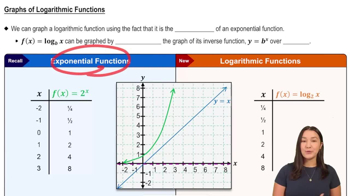
Logarithmic Functions
A logarithmic function, such as f(x) = log_2 x, is the inverse of an exponential function. It answers the question: 'To what power must the base 2 be raised to get x?' Recognizing this inverse relationship helps simplify expressions like f(2^7).
Recommended video:
Graphs of Logarithmic Functions
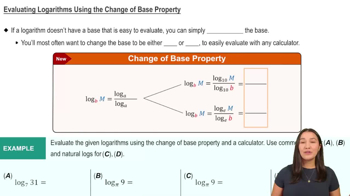
Properties of Logarithms and Exponents
Key properties include log_b(b^x) = x and b^{log_b x} = x. These allow simplification of expressions involving logs and exponents by 'canceling' the operations when the base matches, which is crucial for evaluating f(2^7) when f(x) = log_2 x.
Recommended video:
Change of Base Property
Related Practice
Textbook Question
693
views
Textbook Question
Given that log10 2 ≈ 0.3010 and log10 3 ≈ 0.4771, find each logarithm without using a calculator. log10 √30
989
views
Textbook Question
Solve each equation for the indicated variable. Use logarithms with the appropriate bases. A = P (1 + r/n)tn, for t
1009
views
Textbook Question
Use the various properties of exponential and logarithmic functions to evaluate the expressions in parts (a)–(c). Given ƒ(x) = log2 x, find ƒ(2log_2 2)
730
views
Textbook Question
Use the various properties of exponential and logarithmic functions to evaluate the expressions in parts (a)–(c). Given ƒ(x) = 3x, find ƒ(log3 (2 ln 3))
811
views
Textbook Question
Given that log10 2 ≈ 0.3010 and log10 3 ≈ 0.4771, find each logarithm without using a calculator. log10 9/4
881
views