Find b such that (4x - b)/(x - 5) = 3 has a solution set given by {Ø}.
Verified step by step guidance
1
Step 1: Understand the problem. The equation (4x - b)/(x - 5) = 3 is given, and we are tasked with finding the value of b such that the solution set is empty (denoted by {Ø}). This means there should be no value of x that satisfies the equation.
Step 2: Recall that a rational equation has no solution if it leads to a contradiction. Start by solving the equation algebraically. Multiply both sides of the equation by (x - 5), ensuring to note that x ≠ 5 (since division by zero is undefined). This gives 4x - b = 3(x - 5).
Step 3: Expand and simplify the equation. Distribute the 3 on the right-hand side: 4x - b = 3x - 15. Combine like terms to isolate x: 4x - 3x = b - 15, which simplifies to x = b - 15.
Step 4: Analyze the condition for the solution set to be empty. For the equation to have no solution, the value of x derived from the equation must contradict the domain restriction x ≠ 5. This means the solution x = b - 15 must equal 5, leading to a contradiction.
Step 5: Solve for b to ensure x = b - 15 equals 5. Set b - 15 = 5 and solve for b. This will give the value of b that makes the solution set empty.
Verified video answer for a similar problem:
This video solution was recommended by our tutors as helpful for the problem above
Video duration:
3m
Play a video:
0 Comments
Key Concepts
Here are the essential concepts you must grasp in order to answer the question correctly.
Rational Expressions
A rational expression is a fraction where both the numerator and the denominator are polynomials. Understanding how to manipulate and simplify these expressions is crucial for solving equations involving them. In this case, the expression (4x - b)/(x - 5) must be analyzed to determine conditions under which it can equal 3.
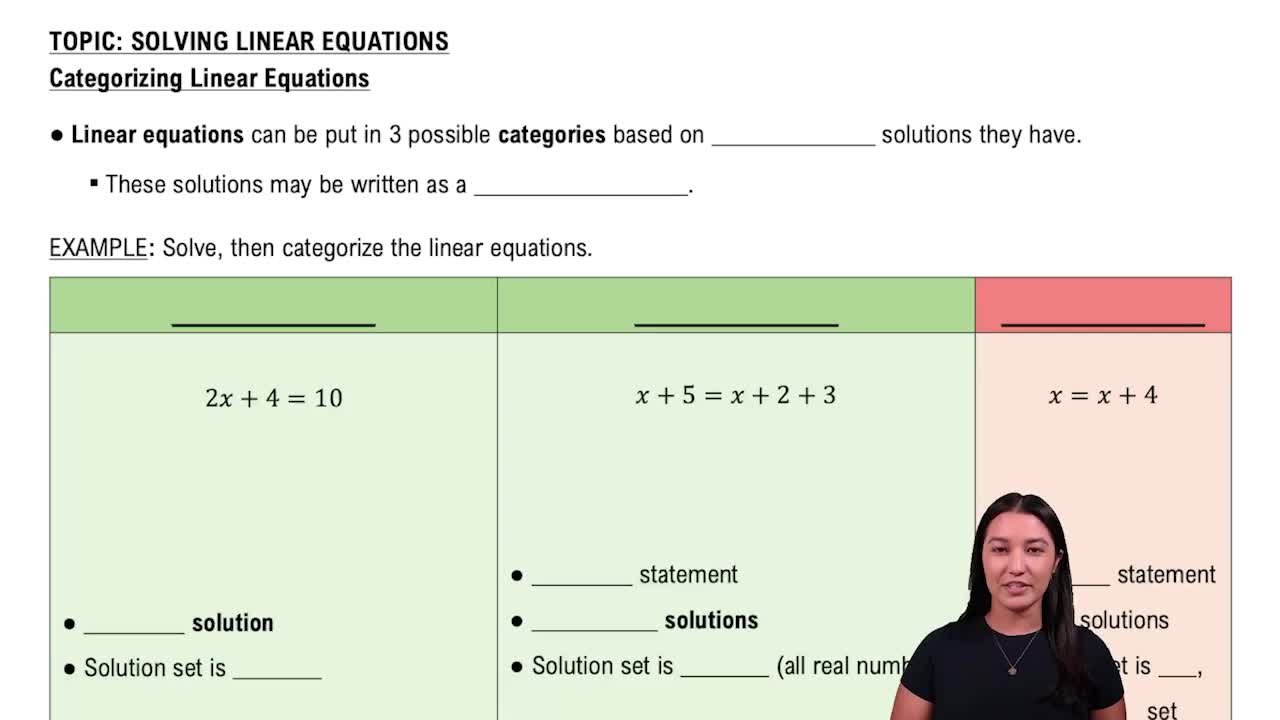
The solution set of an equation is the set of all values that satisfy the equation. In this context, the notation {Ø} indicates that there are no solutions. This implies that the equation must be set up in such a way that it leads to a contradiction, which is essential for determining the value of b.
When a rational expression is set equal to a constant, such as 3 in this case, it can lead to specific conditions for the variable. To find b such that the solution set is empty, we need to ensure that the expression cannot equal 3 for any value of x, which typically involves analyzing the behavior of the expression as x approaches certain values.