Ch. 1 - Equations and Inequalities
Blitzer - College Algebra 8th Edition
Blitzer8th EditionCollege AlgebraISBN: 9780136970514Not the one you use?Change textbook
Chapter 2, Problem 54

Solve each formula for the specified variable. Do you recognize the formula? If so, what does it describe? 1/R = 1/R1 + 1/R2 for R1

Verified step by step guidance
1
Start with the given formula: 1R = 1R1 + 1R2. The goal is to solve for R1.
Subtract 1R2 from both sides of the equation to isolate the term involving R1: 1R - 1R2 = 1R1.
Simplify the left-hand side by finding a common denominator if necessary. This will combine the fractions into a single term: expressiondenominator = 1R1.
Take the reciprocal of both sides to solve for R1. This step involves flipping the numerator and denominator on both sides of the equation.
Simplify the resulting expression to express R1 explicitly in terms of R and R2.

Verified video answer for a similar problem:

This video solution was recommended by our tutors as helpful for the problem above.
Video duration:
3m
Was this helpful?

Key Concepts

Here are the essential concepts you must grasp in order to answer the question correctly.

Algebraic Manipulation

Algebraic manipulation involves rearranging equations to isolate a specific variable. This process includes operations such as adding, subtracting, multiplying, or dividing both sides of the equation by the same value. In this case, solving for R1 requires moving terms around to express R1 in terms of R and R2.
Recommended video:
Guided course
05:09
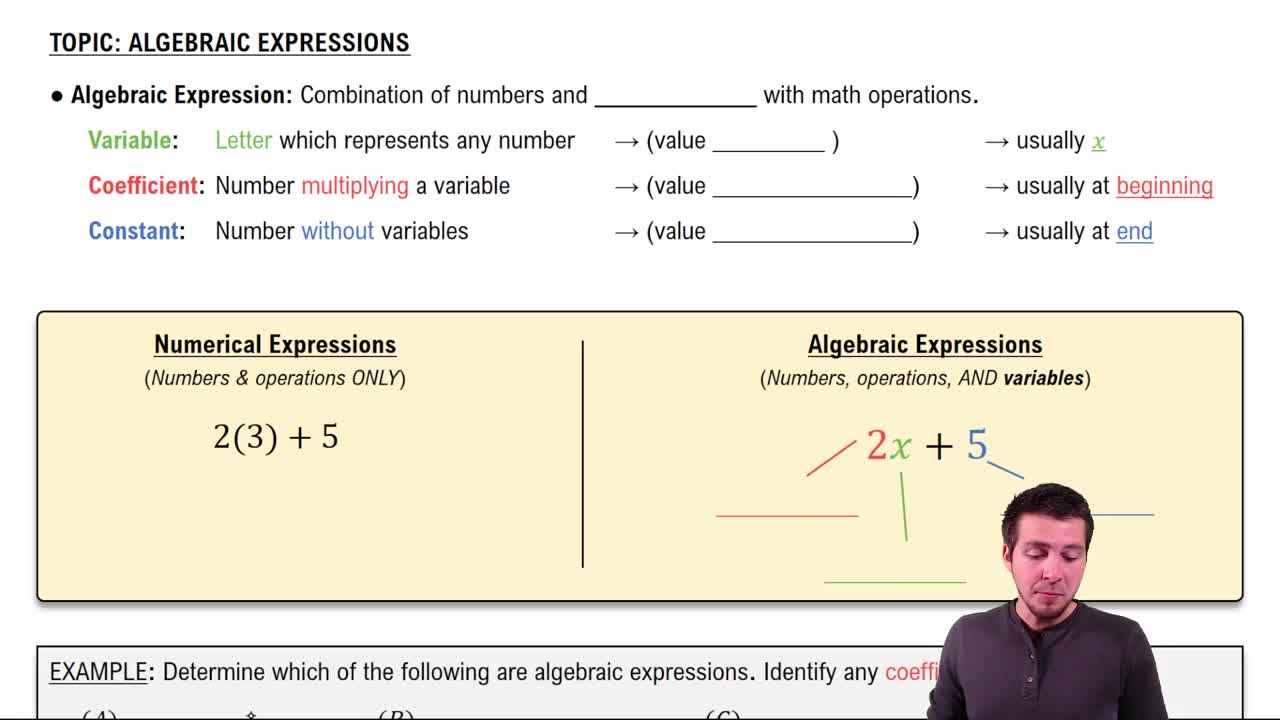
Introduction to Algebraic Expressions

Reciprocal Relationships

The formula 1/R = 1/R1 + 1/R2 describes the relationship between resistances in a parallel circuit, where the total resistance (R) is the reciprocal of the sum of the reciprocals of individual resistances (R1 and R2). Understanding reciprocals is crucial, as it helps in visualizing how combining resistances affects the overall circuit behavior.
Recommended video:
Guided course
07:52
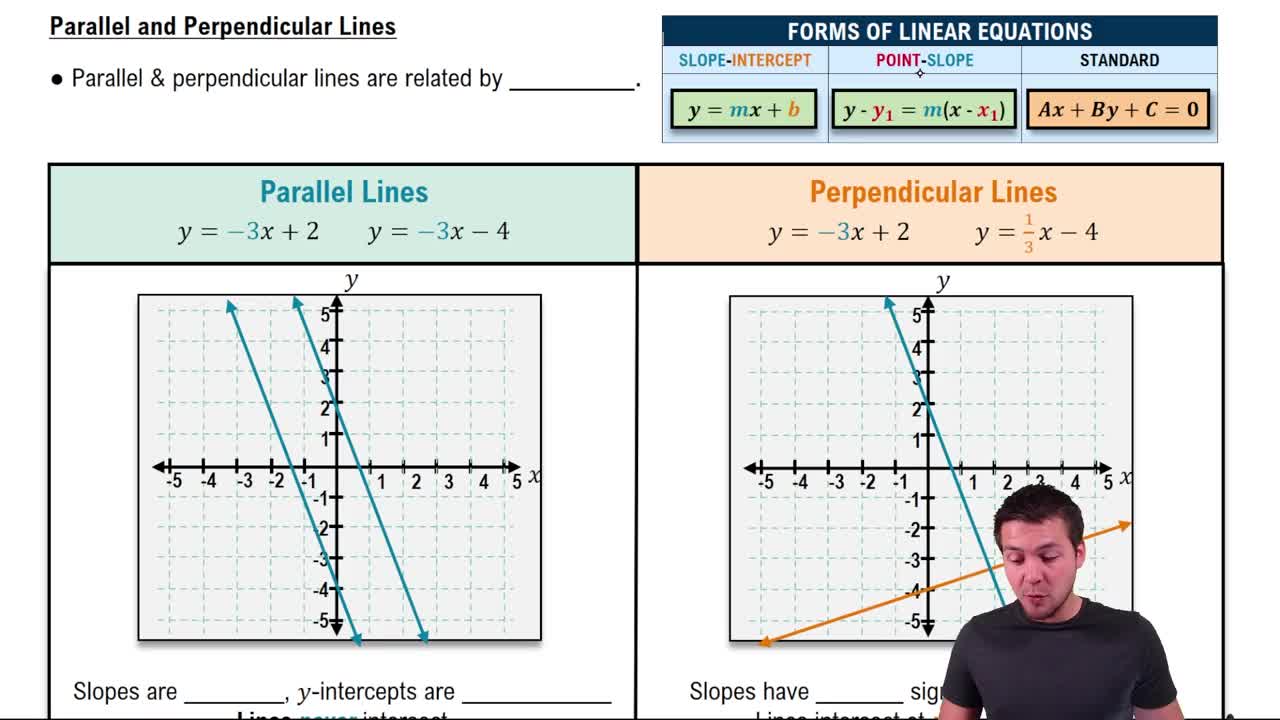
Parallel & Perpendicular Lines

Circuit Theory

Circuit theory is the study of how electrical components interact within a circuit. The formula provided is a fundamental concept in electrical engineering, specifically for parallel circuits, where the total resistance is less than the smallest individual resistance. Recognizing this formula helps in understanding how electrical systems function and how to calculate total resistance effectively.