Ch. 2 - Graphs and Functions
Lial - College Algebra 13th Edition
Lial13th EditionCollege AlgebraISBN: 9780136881063Not the one you use?Change textbook
Chapter 3, Problem 23

Graph each piecewise-defined function.
f(x)={4xif x<21+2xif x2f(x) =\(\begin{cases}\)4 - x & \(\text{if }\) x < 2 \\1 + 2x & \(\text{if }\) x \(\geq\) 2\(\end{cases}\)

Verified step by step guidance
1
Identify the two pieces of the piecewise function: \(f(x) = x + 5\) for \(x \leq 3\) and \(f(x) = 14 - 3x\) for \(x > 3\).
Graph the first piece \(f(x) = x + 5\) for all \(x\) values less than or equal to 3. This is a line with slope 1 and y-intercept 5. Plot points such as \((0, 5)\) and \((3, 8)\) and draw the line up to \(x = 3\).
At \(x = 3\), mark the point on the first piece as a closed dot since the inequality includes \(x = 3\). The point is \((3, 8)\) because \$3 + 5 = 8$.
Graph the second piece \(f(x) = 14 - 3x\) for \(x > 3\). This is a line with slope \(-3\) and y-intercept 14. Plot points such as \((4, 2)\) and \((5, -1)\) and draw the line starting just to the right of \(x = 3\).
At \(x = 3\), mark the point on the second piece as an open dot since the inequality is strict (\(x > 3\)). Calculate \(f(3)\) for the second piece to find the open dot location: \$14 - 3(3) = 5$.

Verified video answer for a similar problem:

This video solution was recommended by our tutors as helpful for the problem above.
Video duration:
5m
Was this helpful?

Key Concepts

Here are the essential concepts you must grasp in order to answer the question correctly.

Piecewise-Defined Functions

A piecewise-defined function is a function composed of different expressions depending on the input value's domain. Each piece applies to a specific interval, and the function's overall behavior is determined by these separate rules.
Recommended video:
3:51
Domain Restrictions of Composed Functions

Graphing Piecewise Functions

To graph a piecewise function, plot each piece on its respective domain interval. Pay attention to endpoints, using open or closed circles to indicate whether points are included or excluded, ensuring continuity or jumps are accurately represented.
Recommended video:
5:26
Graphs of Logarithmic Functions

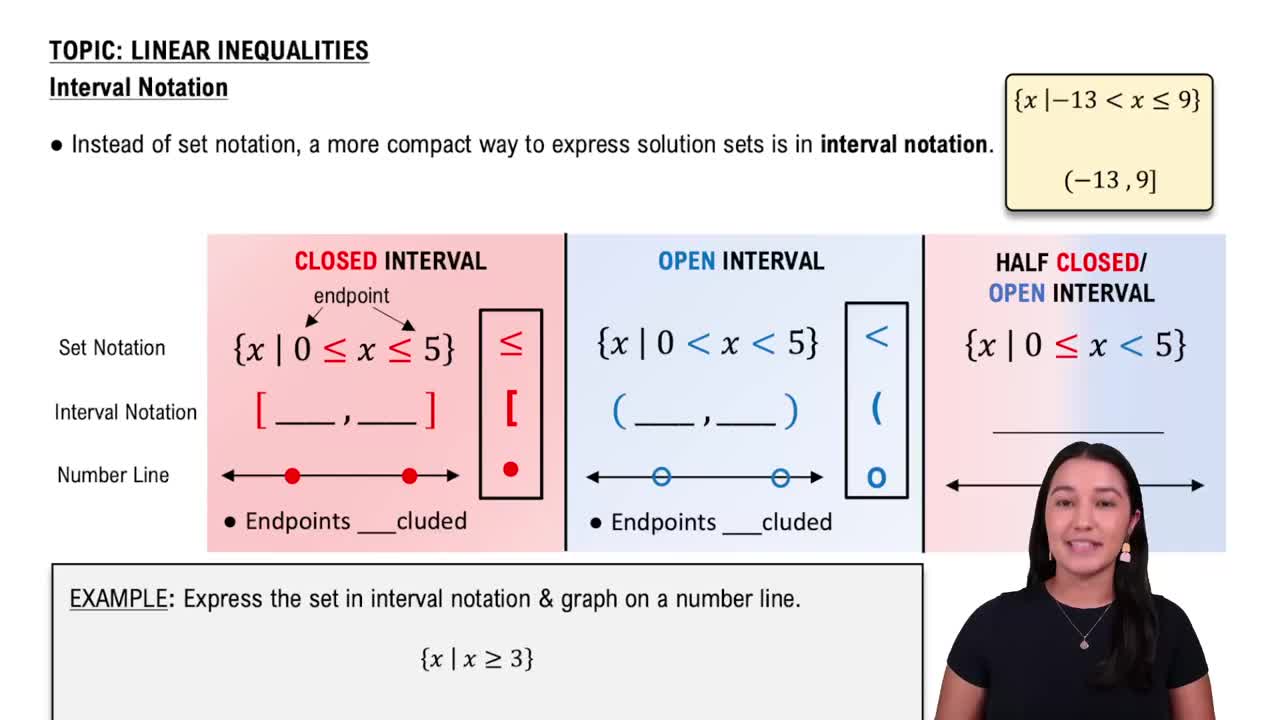
Domain and Interval Notation

Understanding domain restrictions is crucial for piecewise functions. Each piece is valid only over a specified interval, often expressed using inequalities. Correctly interpreting these intervals ensures the function is graphed and analyzed properly.
Recommended video:
05:18
Interval Notation